


Apollo is the sales tool I hear about most when I ask outbound teams what they’re using.
And I understand why.
You can start for free. Paid plans begin at $49 per user. You get access to 240M+ contacts across 30M+ companies, along with sequencing and a dialer in the same product.
For a team getting outbound off the ground, Apollo makes a lot of sense.
The problems usually show up as your team grows.
Credits expire instead of rolling over, costs increase with every seat, and data coverage can become less consistent outside the US.
These limitations matter more once outbound becomes a meaningful part of your pipeline. That’s when an Apollo alternative becomes worth considering.
So I tested 12 Apollo.io alternatives across the things I’d care about when building an outbound motion: data coverage, verification, actual cost as the team scales, and whether the platform helps you do anything with the contacts once you find them.
For every tool, I’ll break down where it beats Apollo, where it doesn’t, what you’ll actually pay, and the type of team I think it makes sense for.
Let’s get started!
Apollo.io Alternatives and Competitors – TOC
TL;DR: Best Apollo.io Alternatives and Competitors at a Glance
- Saleshandy is the strongest Apollo.io alternative for prospecting and outbound, with an 852M+ real-time verified database and multichannel outreach (email, dialer, LinkedIn, and WhatsApp) without per-seat pricing.
- Cognism is an alternative to Apollo for GDPR-compliant B2B data, because it verifies mobile numbers by actually calling them and screens against 15 national do-not-call registries where Apollo screens seven.
- ZoomInfo is the tool similar to Apollo.io for enterprise sales intelligence, because it holds roughly 122.8M companies and is the only vendor here that publishes a dated monthly record of what changed in its database.
All 12 Apollo.io Alternatives Compared
| Tool | Best Apollo.io Alternative For | Data Coverage | Built-in Outreach Capabilities | Integrations | Pricing |
|---|---|---|---|---|---|
| Saleshandy ⭐⭐⭐⭐⭐ | Prospecting and outbound in one platform | 852M+ contacts across 42M+ companies | ✅ (multichannel outreach) | Salesforce, HubSpot, Pipedrive, MCP + CLI | $34/mo |
| Cognism ⭐⭐⭐⭐ | GDPR-compliant B2B data and verified mobiles | 90% of Director+ contacts in Europe and US | ❌ | Salesforce, HubSpot, Bullhorn, Outreach, Salesloft | Custom pricing |
| ZoomInfo ⭐⭐⭐⭐ | Enterprise sales intelligence | 122.8M companies, 158.5M locations | ✅ | Salesforce, Snowflake, Salesloft | Custom pricing |
| Clay ⭐⭐⭐⭐ | Data enrichment and contact enrichment | No owned database, 150+ providers | ✅ | Snowflake, BigQuery, Smartlead | $167/mo |
| 6sense ⭐⭐⭐ | Lead scoring, account scoring and buyer intent | 750M+ profiles, 111M+ verified emails | ❌ | Salesforce, HubSpot, Outreach, Salesloft, Bombora | Custom pricing |
| UpLead ⭐⭐⭐⭐ | Verified B2B contact data | 208.5M contacts, 20.9M companies | ❌ | Salesforce, HubSpot, Pipedrive, 1,500+ via Zapier | $74/mo |
| Lusha ⭐⭐⭐⭐ | A Chrome extension for LinkedIn prospecting | 290M+ contacts, 26M+ companies | ✅ | Salesforce, HubSpot, Pipedrive, Clay, Zapier | $49.90/mo |
| Hunter.io ⭐⭐⭐⭐ | Finding and verifying email addresses | 150M email addresses, no company count | ✅ | HubSpot, Salesforce, Sheets, Zapier, API on all plans | $34/mo |
| LinkedIn Sales Navigator ⭐⭐⭐ | LinkedIn prospecting and warm introductions | 1B+ profiles, no emails or phone numbers | ⚠️ (50 LinkedIn InMails/mo) | Salesforce, HubSpot, Dynamics (full sync on top tier only) | $1,079.88/yr |
| RocketReach ⭐⭐⭐ | Finding personal emails for recruiting | 700M profiles, 60M companies | ✅ | Salesforce, HubSpot, Outreach, Bullhorn, API on all paid plans | $399/yr |
| Lead411 ⭐⭐⭐ | A free and cheaper Apollo.io alternative | Not published | ❌ | 25+ CRMs. API on upper tiers only | $490/yr |
| Seamless.AI ⭐⭐⭐ | Building B2B lead lists at volume | 2.2B+ contacts, 121M+ companies | ✅ | Salesforce, HubSpot, n8n. Free API on every plan | Custom pricing |
In-depth Review of 12 Best Alternatives to Apollo.io (Competitors Compared)
Here are the 12 alternatives to Apollo.io that made the cut.

1. Saleshandy
Saleshandy is the strongest Apollo alternative for prospecting and outbound.
It offers a bigger database, 852M+ B2B and B2C contacts across 42M+ companies, roughly 3.5x what Apollo publishes, with global coverage across the USA, Europe, Asia, and Africa.
Every contact is verified in real time when you reveal it, not on a refresh cycle that last ran weeks ago.
And it has built-in multichannel outreach without the per-seat pricing.
The AI search is where I started. Instead of stacking filters, I described what I wanted in plain language and let it build the list:
“Heads of Sales at B2B SaaS companies in the UK that raised a Series A in the last six months and use HubSpot. It came back with a working list in seconds, which matters for any rep who does not want to learn a filter panel before they can prospect.”
Then I went the other way and used the filters properly.
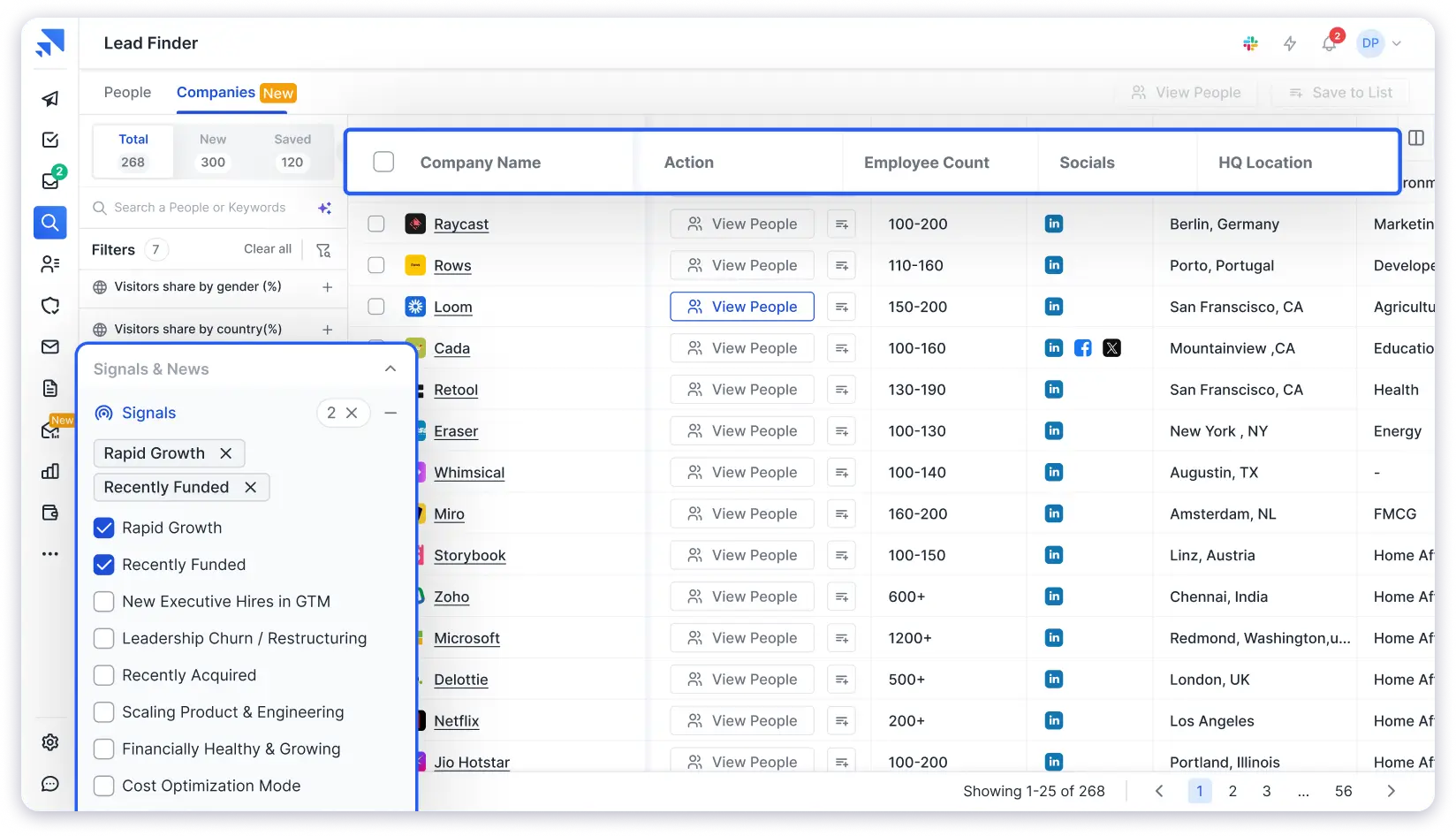
The Company tab is genuinely deep and it is where I spent most of my time, because it carries technographics, lookalike companies, ownership type, funding, revenue, employee count broken out by department and seniority, hiring signals, news triggers, and a website visitors filter that screens companies by last month’s traffic volume and visitor share by country.
That last filter surprised me.
I built a segment of companies whose traffic was growing and where more than 40% of visitors came from the US, which is a buying-behaviour signal rather than a firmographic one, and nothing else I tested lets you apply that inside the prospecting step.
The fact that it offers real-time verification and guarantees a 98% accuracy rate.
When you unlock a contact, Saleshandy runs a waterfall across multiple providers and verifies the address at that moment instead of serving you something checked a month ago.
If it does not come back verified, the credit is never spent. One credit gives you a work email, seven gives you email plus phone, and personal emails are available separately when the work address turns out to be a dead end.
The outreach runs in the same platform.
I pushed prospects into a sequence without leaving the tab, and the AI Sequence Copilot drafted the first version so I only had to rewrite the parts that sounded like a robot.
Behaviour-based conditions then handled the follow-ups, sending people who opened down a different path from people who ignored it.
What I Liked
- High-quality, verified data: Real-time verification with automatic credit refunds for invalid contacts, plus waterfall enrichment from multiple providers
- Powerful prospecting: 75+ filters, AI lead search, and separate People & Company views for better targeting
- Supports CSV enrichment: Easily upload and enrich bulk lead lists without relying only on in-app search
- Built for outbound: Built-in CRM, one-click export to sequences, and AI Sequence Copilot for personalization
- Stronger email execution: Behavior-based follow-ups, unlimited sending accounts, built-in warm-up, and sender rotation
- Deliverability support: Inbox Radar for placement testing across Gmail, Outlook, and Yahoo
- Flexible pricing model: 50% unused credits roll over monthly
- Agency-friendly: Unlimited clients with no per-client fees and white-label support
- Secure and compliant: SOC 2 and GDPR compliant
Limitations I Faced
- No free forever plan
Saleshandy vs Apollo.io: Who Is Better?
| Capabilities | Saleshandy | Apollo.io |
|---|---|---|
| Database Size | 852M+ contacts, 42M+ companies | 240M+ contacts, 30M+ companies |
| Verification | Real-time | Quaterly |
| Credit Rollover | ✅50% of unused credits carry to next month | ❌ No credit rollover |
| Team Seats | Ulimited | Charges per seat |
| Ideal Plan for Agencies | Scale at $149/mo, unlimited clients, whitelabel on Enterprise | No agency tier, every client seat billed separately |
| Invalid Data Refund | Credit only spent on a verified result | ❌ No refund policy published |
| Outreach | ✅Email, dialer, LinkedIn, WhatsApp | ✅ Email + US dialer, LinkedIn as manual tasks |
See the full Saleshandy vs Apollo comparison →
Saleshandy Pricing
- Starter: $34/mo
- Pro: $76/mo
- Scale: $149/mo
- Enterprise: Custom pricing
2. Cognism
Cognism is an excellent Apollo.io alternative for GDPR-compliant B2B data and phone-verified mobile numbers, particularly if your outbound runs on the phone and your market is Europe.
It covers 90% of Director-level and above contacts across Europe and the US, with phone-verified mobiles, B2B emails and direct dials spanning Europe, North America and Asia-Pacific.
The verified mobile filter is the reason to use it, so that is where I began.
I built a list of Heads of Sales at UK and DACH companies over 200 employees, then narrowed it to contacts carrying a Diamond Data mobile.

Those numbers have been physically called by a researcher who confirmed the right person picked up, and Cognism publishes a study of 1,000 dials showing that happened 45% of the time on verified numbers against 18% on standard ones.
It is vendor-commissioned, so treat it as a claim rather than independent research, but it is still more evidence than Apollo offers, which is none at all.
Where it stopped short was the moment I actually had my list.
There is no sequencer, no dialer and no warm-up anywhere in the product, so the contacts had to go out to a separate tool before anyone could be contacted.
Cognism is a data layer that assumes you already own Outreach, Salesloft or something like them, and while researching Cognism alternatives I kept hitting that same wall: the European data is genuinely excellent, and the second subscription is unavoidable.
What I Liked
- Diamond Data phone-verified mobiles with 87% connect rate claim
- Strongest European contact coverage on the market
- GDPR and CCPA compliant with DNC list screening across 15 countries
- Bombora-powered intent data to time outreach
- Diamonds-on-Demand for manual verification of priority contacts
- Chrome extension for LinkedIn prospecting
- No credit limits — unlimited views and exports on contract plans
- CRM integration with Salesforce and HubSpot
Limitations I Faced
- No built-in outreach or email sequencing — you need a separate sending tool
- North American SMB data is weaker than Apollo or ZoomInfo
- Asia-Pacific contact coverage has noticeable gaps
- No free plan and no public pricing — you must book a demo
Cognism vs Apollo.io: Who Is Better?
| Capabilities | Cognism | Apollo.io |
|---|---|---|
| Database Size | Not published. 90% coverage of Director+ in Europe and US | 240M+ contacts, 30M+ companies |
| Verification | Five-step process including human-called mobiles, plus 48-hour on-demand verification | No published method or accuracy rate |
| Credit Rollover | Revealed contacts stay usable for the contract term at no further cost | Expire every billing cycle, no rollover |
| Team Seats | Five seats included per package, effectively a five-seat floor | Charges per seat |
| Ideal Plan for Agencies | No agency tier. The five-seat minimum makes small client rosters costly | No agency tier, every client seat billed separately |
| Invalid Data Refund | Not published | No refund policy published, DNC-flagged numbers still charged |
| Outreach | None. Data only | Email, US dialer, LinkedIn as manual tasks |
See how Cognism compares to Saleshandy →
Cognism Pricing
Cognism doesn’t publish pricing. Everything is custom-quoted based on team size, features, and contract length.
3. ZoomInfo
ZoomInfo is a solid Apollo.io competitor for enterprise sales intelligence and account-level firmographics, and it is the closest thing on this list to a like-for-like Apollo replacement at the enterprise end.
It publishes roughly 122.8M companies across 158.5M business locations, which is about four times Apollo’s company count.
The distinction that matters is what you get for that: where Apollo gives you contacts, ZoomInfo gives you the shape of the organisation those contacts sit inside, and that only pays off if your motion is account-based rather than list-based.
I used it for territory work rather than day-to-day prospecting, because that is where it pulls ahead.
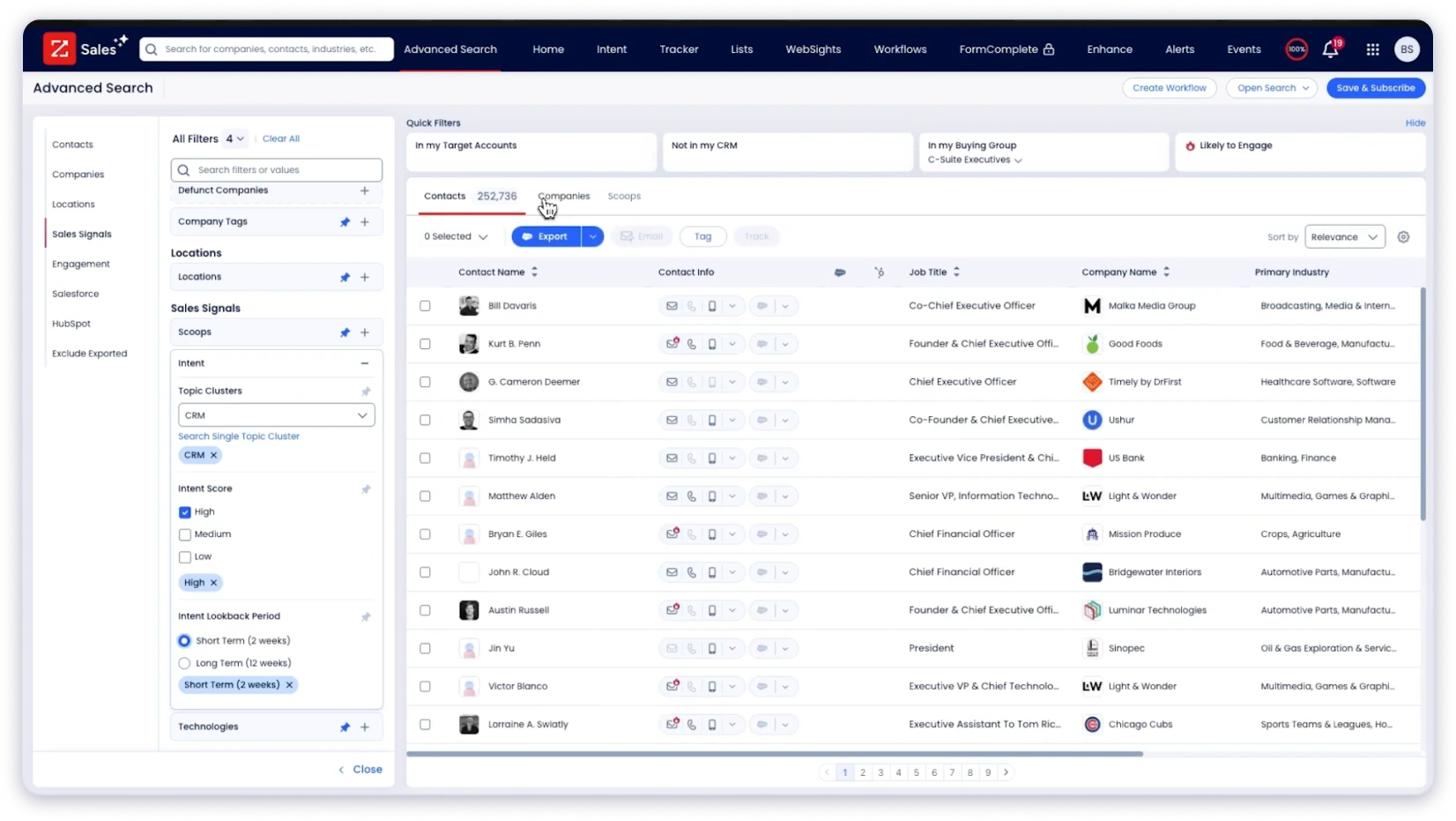
Building a target account list gave me department-level headcounts, parent-child company hierarchies, technographic detail showing exactly what software each company runs, and buyer intent drawn from both first-party signals and Bombora.
I mapped a segment by revenue band, employee count by department and technology installed, then pulled the org chart for every account that qualified, which is work Apollo simply cannot do at the same depth.
Two things pulled me back, though.
The dialer only places calls from US numbers, so a European team cannot use local presence at all, and nothing on the site tells you what any of this costs.
If you want the wider category view, our roundup of B2B data providers covers where ZoomInfo sits against the rest.
What I Liked
- Deepest US firmographic and technographic data available
- Intent data from first-party and Bombora sources
- Org charts and department-level insights
- Website visitor identification
- Real-time alerts on target account activity
- 185 integrations across 23 categories, including Snowflake and 22 dialer platforms
- Data Passport Controls, allowing up to 20 region-specific data access rules
Limitations I Faced
- No published pricing at any tier, so every route runs through a demo
- Credit-based system with expiring credits and costly overages
- International data is weaker than US coverage
- Annual contracts with auto-renewal and rigid cancellation terms
- Built-in outreach tools are basic compared to dedicated platforms
ZoomInfo vs Apollo.io: Who Is Better?
| Capabilities | ZoomInfo | Apollo.io |
|---|---|---|
| Database Size | ~122.8M companies, 158.5M locations. No single contact total published | 240M+ contacts, 30M+ companies |
| Verification | Published monthly data-cube accounting, with per-project precision figures | No published method or accuracy rate |
| Credit Rollover | Not published either way | Expire every billing cycle, no rollover |
| Team Seats | Per licence plus credits, with no published price | $49–$119 per seat, 3-seat minimum on Organization |
| Ideal Plan for Agencies | No agency tier. Built for enterprise RevOps, not client rosters | No agency tier, every client seat billed separately |
| Invalid Data Refund | Not published | No refund policy published, DNC-flagged numbers still charged |
| Outreach | Email cadences and a US-only dialer | Email, US dialer, LinkedIn as manual tasks |
See how ZoomInfo compares to Saleshandy →
ZoomInfo Pricing
ZoomInfo gives custom pricing plans.
4. Clay
Clay is a great alternative to Apollo.io for data enrichment and contact enrichment, though it works in a fundamentally different way from everything else on this list.
It does not own a database at all. Instead, it runs a single record through 150+ named data providers in sequence until one of them returns a match, which means the failure of any single vendor stops being your failure too.
Apollo queries its own database and stops when it finds nothing, whereas Clay simply keeps going, and that is why fill rates on hard segments look so different between the two.
Waterfall enrichment is the whole product, so that is where I started.
I uploaded a list where Apollo had returned nothing for roughly a third of the rows, then built a waterfall across Prospeo, Dropcontact, Datagma, Hunter and People Data Labs.
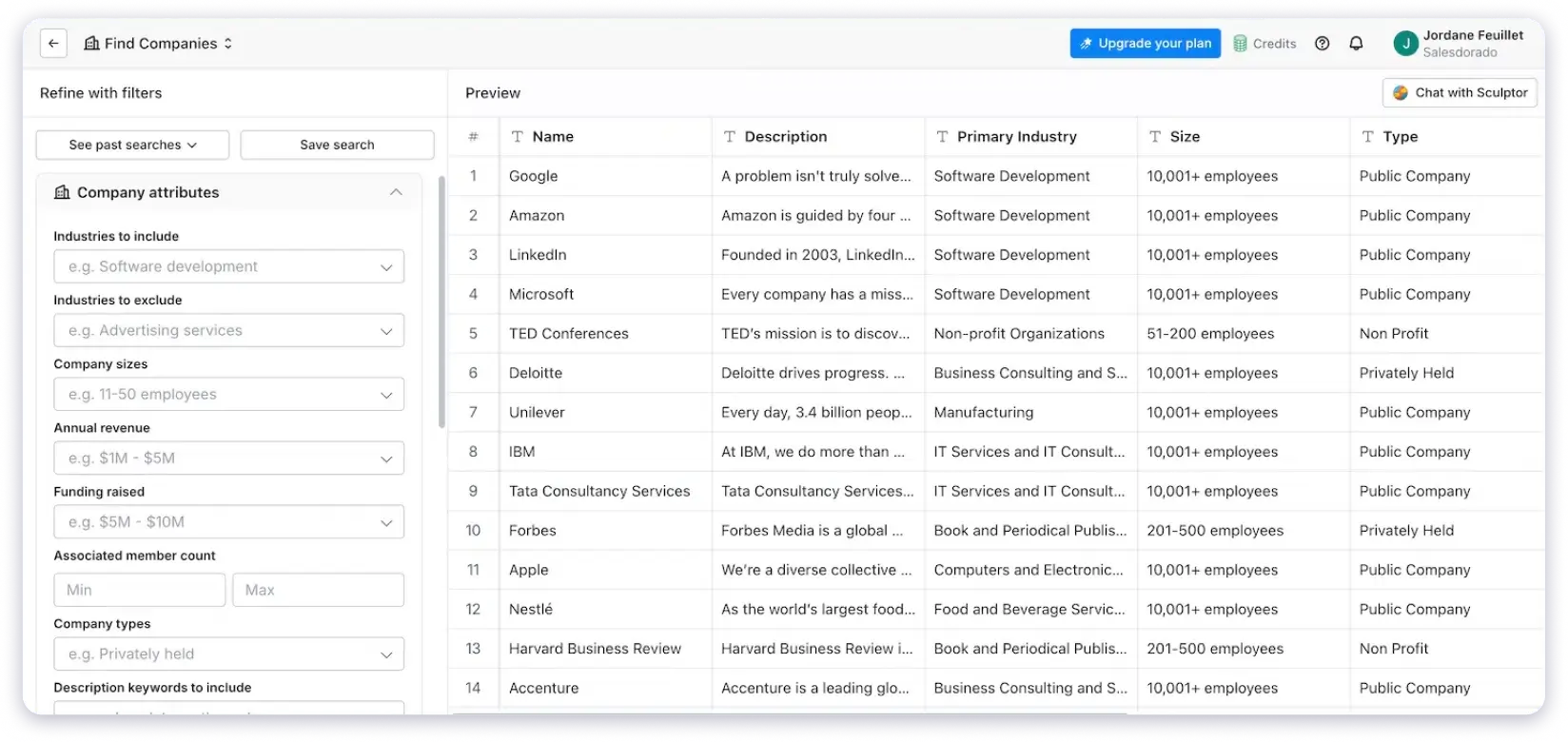
Records that came back empty from the first provider automatically passed to the second, then the third, and most of the gap filled by the end of the run.
Clay claims this roughly triples coverage, and on a list that had already failed elsewhere, the improvement was hard to argue with..
Two things are worth knowing before you commit.
You are not charged when an enrichment returns nothing, which is fairer than Apollo’s model, but your bill tracks enrichment volume rather than headcount, so a busy month genuinely costs more than a quiet one.
And if you specifically want Apollo’s data inside Clay, you will need to keep your Apollo subscription, because Clay cannot resell it.
What I Liked
- Waterfall enrichment across 150+ named providers, with the full list published openly
- Claygent researches custom data points that no database sells as a field
- No charge when an enrichment returns nothing
- Data Credits roll over between billing cycles
- Unlimited seats on every plan, including the free tier
- Bring your own API keys and skip data credits entirely
- Native email sequencer with warm-up, available even on the free plan
- 158 integrations including Snowflake, BigQuery, Smartlead and Outreach
Limitations I Faced
- No database of its own, so there is no coverage figure to evaluate before you buy
- Search caps at 500 results per cell, and bulk enrichment sits on Enterprise only
- Cost tracks usage rather than team size, which makes budgeting genuinely harder
- CRM sync, warehouse connections and API access all start at Growth or above
- Apollo and ZoomInfo data require you to keep paying for those subscriptions
- Steep learning curve that really needs someone whose job is building the workflows
Clay vs Apollo.io: Who Is Better?
| Capabilities | Clay | Apollo.io |
|---|---|---|
| Database Size | No owned database. Coverage depends on which of 150+ providers you stack | 240M+ contacts, 30M+ companies |
| Verification | A marketplace category you assemble yourself, not a built-in guarantee | No published method or accuracy rate |
| Credit Rollover | Data Credits roll over. Actions reset monthly | Expire every billing cycle, no rollover |
| Team Seats | Unlimited seats on every plan, including Free | $49–$119 per seat, 3-seat minimum on Organization |
| Ideal Plan for Agencies | Growth at $446/mo, strong for one operator running many client workspaces | No agency tier, every client seat billed separately |
| Invalid Data Refund | No charge when an enrichment returns nothing | No refund policy published, DNC-flagged numbers still charged |
| Outreach | Native email sequencer with warm-up. Email only | Email, US dialer, LinkedIn as manual tasks |
Clay Pricing
- Free: $0, unlimited seats
- Launch: $167/mo
- Growth: $446/mo
- Enterprise: Custom pricing
5. 6sense
6sense is a strong Apollo.io alternative for lead scoring, account scoring and buyer intent, though it is worth being clear up front that it is a different category of purchase rather than a like-for-like swap.
It holds 750M+ buyer profiles, 111M+ verified business emails and 75M+ companies across 200+ countries, but the reason to look at it is not the database.
It is the layer sitting above the database that tells you which of your target accounts are actually in market this quarter.
Predictive scoring is the whole pitch, so I tested it against accounts I already knew.
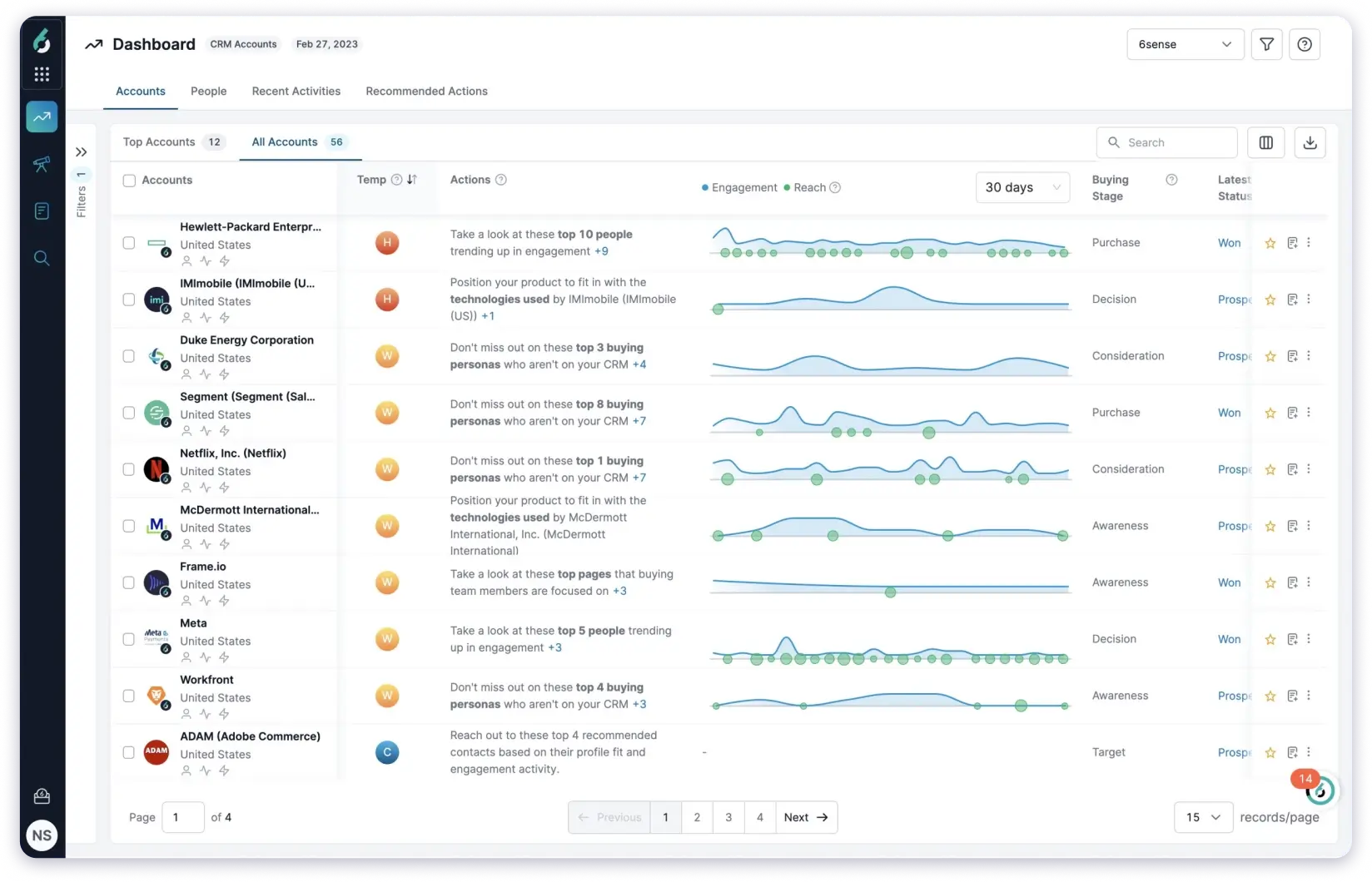
6sense builds a model on your own historical win patterns rather than applying a generic score, then compares current account activity against it to produce a buying stage and a revenue potential figure per account.
What I could not do in Apollo is see keyword-level intent, because Apollo meters intent by topic count instead: one topic on Free, six on Basic and Professional, twelve on Organization.
6sense runs its own publisher-crawl keyword intent and layers G2, TrustRadius, Bombora, PeerSpot and Gartner on top of it, so you are not picking twelve topics from a list.
Where the fit genuinely breaks down is contact data. On the Sales Intelligence plus Predictive AI package, 6sense states plainly that data credits are not included, which means a contract can be signed with no usable contact access at all.
If you are leaving Apollo because the emails bounce or the credits ran out, this will not solve your problem. There is also no sequencer and no dialer, only AI email agents, so everything you learn still has to be executed somewhere else.
What I Liked
- Predictive buying-stage models trained on your own closed-won data
- Keyword-level intent rather than a capped list of topics
- Account-level website de-anonymisation with a publicly documented matching method
- Credits pooled across the organisation and allocated by an admin rather than stranded per seat
- Re-enriching a record costs nothing for 12 months
- ISO 42001 for AI management, which Apollo does not hold
- Explicit CCPA and GDPR claims, plus UK-US and Swiss-US Data Privacy Framework participation
- MCP server exposing intent and scoring data to AI agents
Limitations I Faced
- Contact data can be excluded from the contract entirely, so this is not a database replacement
- No published pricing, no free plan and no trial, since every route starts with a demo
- No sequencer and no dialer, so execution happens in a separate paid product
- Inaccurate contact data is the most-cited complaint in user reviews
- Roughly a two-month implementation and a twelve-month ROI horizon
- The legacy Orchestrations product is being sunset during 2026
6sense vs Apollo.io: Who Is Better?
| Capabilities | 6sense | Apollo.io |
|---|---|---|
| Database Size | 750M+ buyer profiles, 111M+ verified emails, 75M+ companies | 240M+ contacts, 30M+ companies |
| Verification | No published accuracy rate. 70,000 job changes processed daily | No published method or accuracy rate |
| Credit Rollover | Credits pooled at org level, but do not carry between timeframes | Expire every billing cycle, no rollover |
| Team Seats | Per licence with an org-level credit pool, no published price | Charges per seat |
| Ideal Plan for Agencies | No agency tier. Built for enterprise ABM programmes | No agency tier, every client seat billed separately |
| Invalid Data Refund | Not published. Re-enrichment is free for 12 months | No refund policy published, DNC-flagged numbers still charged |
| Outreach | AI email agents only. No sequencer, no dialer | Email, US dialer, LinkedIn as manual tasks |
6sense Pricing
Custom Pricing
6. UpLead
UpLead is a solid Apollo.io competitor for verified B2B contact data, and it is the tool to look at if your complaint about Apollo is bounce rate rather than list size.
It publishes 208.5M contacts across 20.9M companies with coverage in 200+ countries, which is smaller than Apollo on both counts.
What it does instead of competing on volume is put a number on quality and then stand behind it with a mechanism, which Apollo does not attempt anywhere on its site.
Verification happens at the moment you reveal a contact, not when the record was ingested.
I unlocked a batch and watched each address get checked in real time, returned as Valid, Invalid or Accept-all before it reached my list.
What matters more than the labels is what happens next: if verification fails, the email is not shown and no credit is spent.

Apollo publishes no accuracy percentage and no refund policy at all, and charges a credit for a phone number even when it comes back flagged on a do-not-call list.
The constraint that caught me out is seats.
Essentials and Plus are both single user, so the flat pricing advantage only holds while one person builds the lists and shares them.
A team where four reps each want their own login has to negotiate a Professional quote, and that price is not published. There is also no inbuilt outreach capabilities whatsoever, so a sending tool is mandatory.
While putting together our UpLead alternatives roundup, the single-seat limit came up more often than any data complaint.
What I Liked
- A published 95% accuracy guarantee, where Apollo publishes no figure at all
- Verification runs at the moment of reveal rather than on an ingestion cycle
- No credit spent when an email fails verification
- Four selectable quality thresholds, so you choose between precision and volume
- Technographic targeting for ICPs defined by the software a company runs
- 50+ search filters covering firmographic, technographic and demographic data
- Published per-credit top-up rates, so overage cost is knowable in advance
- Dated public release notes with actual database totals in them
Limitations I Faced
- Essentials and Plus are single user, so teams must negotiate an unpublished quote
- No outreach layer at all, meaning a sending tool is mandatory
- No SOC 2 or ISO 27001 certification published, which stops enterprise procurement
- Cancellation requires 60 days notice, and all fees are non-refundable
- Smaller database than Apollo on both contacts and companies
- A 7-day trial with 5 credits, which is barely enough to evaluate properly
UpLead vs Apollo.io: Who Is Better?
| Capabilities | UpLead | Apollo.io |
|---|---|---|
| Database Size | 208.5M contacts, 20.9M companies, 200+ countries | 240M+ contacts, 30M+ companies |
| Verification | Real time at the point of reveal, with a published 95% accuracy guarantee | No published method or accuracy rate |
| Credit Rollover | Not published | Expire every billing cycle, no rollover |
| Team Seats | 1 user on Essentials and Plus. Custom on Professional | Charges per seat |
| Ideal Plan for Agencies | No agency tier, and the single-seat limit works against client work | No agency tier, every client seat billed separately |
| Invalid Data Refund | No credit spent when verification fails | No refund policy published, DNC-flagged numbers still charged |
| Outreach | None. Data only | Email, US dialer, LinkedIn as manual tasks |
See how UpLead compares to Saleshandy →
UpLead Pricing
- Free trial: 7 days, 5 credits
- Essentials: $74/mo
- Plus: $149/mo
- Professional: Custom pricing
7. Lusha
Lusha is a great alternative to Apollo.io for a Chrome extension that handles fast LinkedIn lookups, and it is the lightest tool on this list by some distance.
It publishes 290M+ contacts across 26M+ companies, but the reason people pick it has less to do with the database than with how quickly you can get a contact out of it.
If you prospect directly on LinkedIn and just want the email and mobile without opening another tab, Lusha does that faster than Apollo’s interface does.
Setup took minutes rather than an onboarding session.
I installed the extension, opened Sales Navigator, and started revealing contact details on profiles as I browsed, saving them to a list and pushing them into a CRM without ever loading the web app.
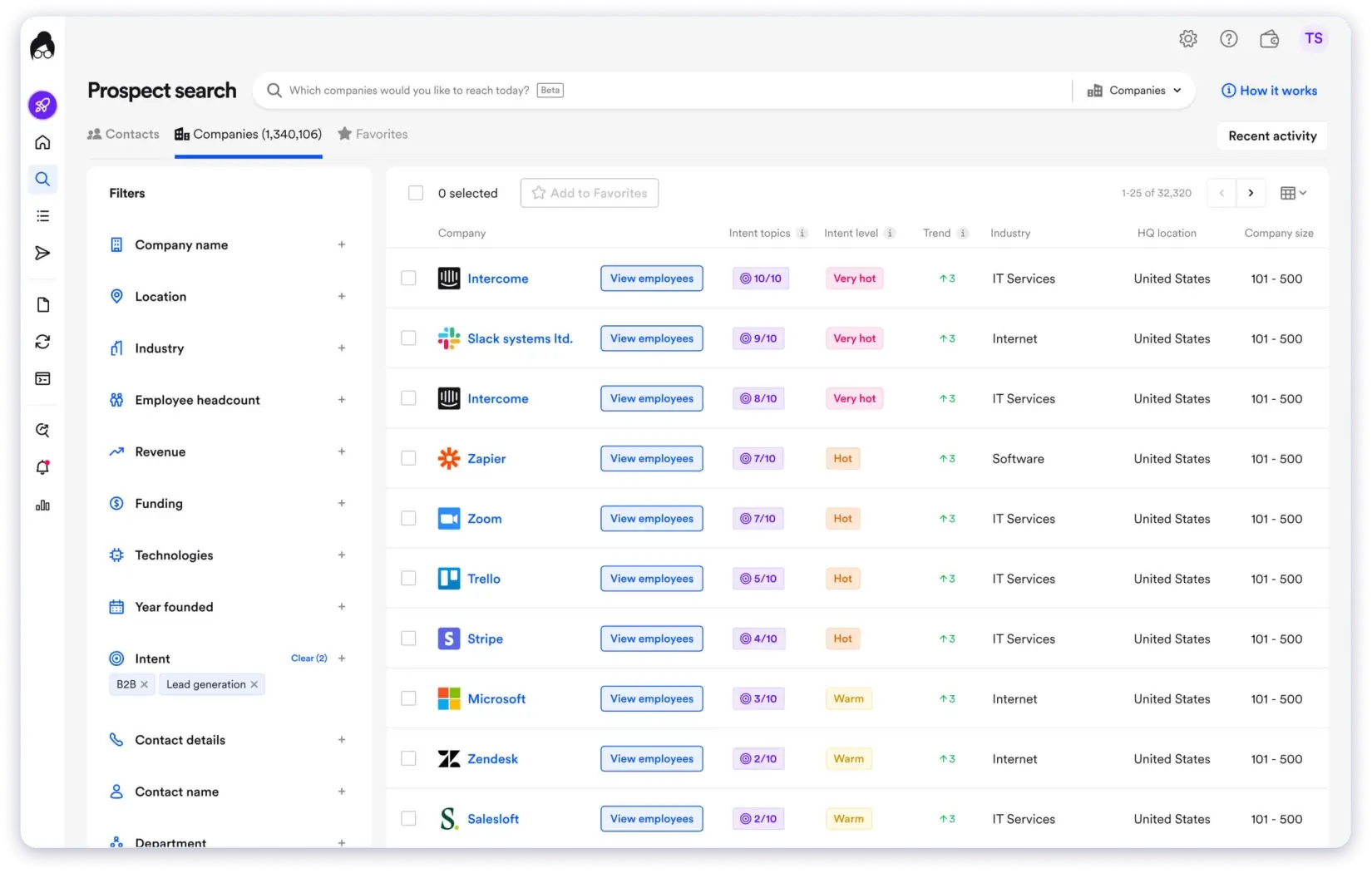
For a rep whose entire prospecting motion happens inside LinkedIn, that removes a step from every single lookup, and there is no learning curve attached to it.
However, the tradeoff is the pricing. The credit model is asymmetric, because an email costs one credit and a phone number costs ten, so a phone-heavy month burns an allowance roughly ten times faster than an email-heavy one.
What I Liked
- Chrome extension that works on LinkedIn and Sales Navigator with no setup
- Five ISO certifications including 27701 and 31700, more than any other tool here
- SOC 2 Type II, ePrivacyseal GDPR certificate and TrustArc CCPA validation
- A free plan with credits that renew monthly, not a time-limited trial
- Native email sequences included, even on the free tier
- Job change alerts and 18 buying signals across five categories
- Credits roll over up to 2x on monthly-billed Pro and Premium plans
- DNC-flagged numbers are hidden across the product rather than sold to you
Limitations I Faced
- Phone numbers cost ten credits against one for an email, so allowances vanish fast
- Published pricing stops at five seats, and anything larger needs a sales call
- Sending runs only through your own Gmail or Outlook, with no warm-up or rotation
- Replies land in your personal inbox, since there is no shared team inbox
- No dialer at all, so a calling motion needs a separate tool
- Coverage thins outside the US and Europe, with reviewers flagging gaps in emerging markets
Lusha vs Apollo.io: Who Is Better?
| Capabilities | Lusha | Apollo.io |
|---|---|---|
| Database Size | 290M+ contacts, 26M+ companies | 240M+ contacts, 30M+ companies |
| Verification | Claims 98% email and 86% phone accuracy, with no published method | No published method or accuracy rate |
| Credit Rollover | Up to 2x the monthly allowance on monthly-billed Pro and Premium | Expire every billing cycle, no rollover |
| Team Seats | Bundled per plan: 1, 2 or 5. Above 5 requires a sales call | $49–$119 per seat, 3-seat minimum on Organization |
| Ideal Plan for Agencies | No agency tier, and the five-seat ceiling limits client work | No agency tier, every client seat billed separately |
| Invalid Data Refund | Not published | No refund policy published, DNC-flagged numbers still charged |
| Outreach | Email sequences through your own Gmail or Outlook mailbox | Email, US dialer, LinkedIn as manual tasks |
See how Lusha compares to Saleshandy →
Lusha Pricing
- Free: $0
- Starter: $49.90/mo
- Pro: $69.90/mo
- Premium: $399.90/mo
- Scale: Custom pricing for teams above 5 seats
8. Hunter.io
Hunter.io is a strong Apollo.io alternative for finding and verifying email addresses, and it is the most transparent tool on this list about where its data actually comes from.
It indexes 150M professional email addresses, which is smaller than Apollo, but every address it returns arrives with the public source it was found on and the date it was found.
Nobody else here does that, and it matters if you ever have to justify a cold outreach list to a legal team.
Domain search is the workflow it is built around. I typed in a company website and Hunter pulled every discoverable address connected to that domain, each carrying a confidence score and the source page behind it.
Verified addresses show a green marker while everything else returns a score instead, so you know which is which before you spend a credit.

The verification is the strongest part. Hunter publishes its full nine-step method covering format, gibberish detection, disposable domains, MX records, SMTP connection, mailbox testing and accept-all handling, then returns one of five defined statuses.
It also tells you the threshold worth trusting, which is a confidence score of 90 to 95 or higher. Apollo publishes none of this.
What surprised me is how much of a sending stack Hunter has quietly built. Sequences now include mailbox rotation, SMTP and IMAP support, A/B testing, and Inbox Protection for warm-up, which shipped in April 2026.
Every plan carries unlimited team members sharing one credit pool, so a five-person team pays $104 a month rather than five times anything.
The hard limit is phone data, because Hunter does not sell any. If your motion involves dialing, this cannot be your data source.
What I Liked
- Every address returns with its public source and the date it was found
- A fully published nine-step verification method with five defined statuses
- Unlimited team members on every plan, including the free tier
- No credit charged when a search finds nothing or verification returns Unknown
- Inbox Protection warm-up and mailbox rotation on all paid plans
- SMTP and IMAP support, so you are not locked to Gmail and Outlook
- API access included on every plan, even Free
- Records without a remaining public source are removed after six months
- Data Platform credits can be bought outright with no subscription
Limitations I Faced
- No phone data of any kind, so calling teams need a second vendor
- No company count published, so the Discover database cannot be sized
- Coverage thins for small companies and niche startups
- No SOC 2 or ISO certification published, which blocks enterprise procurement
- Intent signals cover funding and hiring events, not topic-level buying intent
- Credits deplete quickly at volume and get expensive on larger campaigns
Hunter.io vs Apollo.io: Who Is Better?
| Capabilities | Hunter.io | Apollo.io |
|---|---|---|
| Database Size | 150M email addresses. No company count published | 240M+ contacts, 30M+ companies |
| Verification | Published nine-step method with five defined statuses and a stated confidence threshold | No published method or accuracy rate |
| Credit Rollover | Plan credits are annual. Data Platform credits last 12 months from purchase | Expire every billing cycle, no rollover |
| Team Seats | Unlimited team members on every plan, including Free, sharing one credit pool | Charges per seat |
| Ideal Plan for Agencies | Growth at $104/mo with unlimited users, though no client separation | No agency tier, every client seat billed separately |
| Invalid Data Refund | No credit charged when nothing is found or verification returns Unknown | No refund policy published, DNC-flagged numbers still charged |
| Outreach | Email sequences with rotation, warm-up, A/B testing and a reply inbox | Email, US dialer, LinkedIn as manual tasks |
See how Hunter compares to Saleshandy →
Hunter.io Pricing
- Free: $0
- Starter: $34/mo
- Growth: $104/mo
- Scale: $209/mo
- Enterprise: Custom pricing
LinkedIn Sales Navigator is a solid Apollo.io competitor for LinkedIn prospecting and warm introductions, but it solves a genuinely different problem from every other tool here.
It sits on 1B+ member profiles that the members themselves maintain, which means job changes and promotions surface as alerts rather than as bounced emails discovered three weeks later.
What it does not give you is a single email address or phone number.
I used it for account mapping rather than list building.
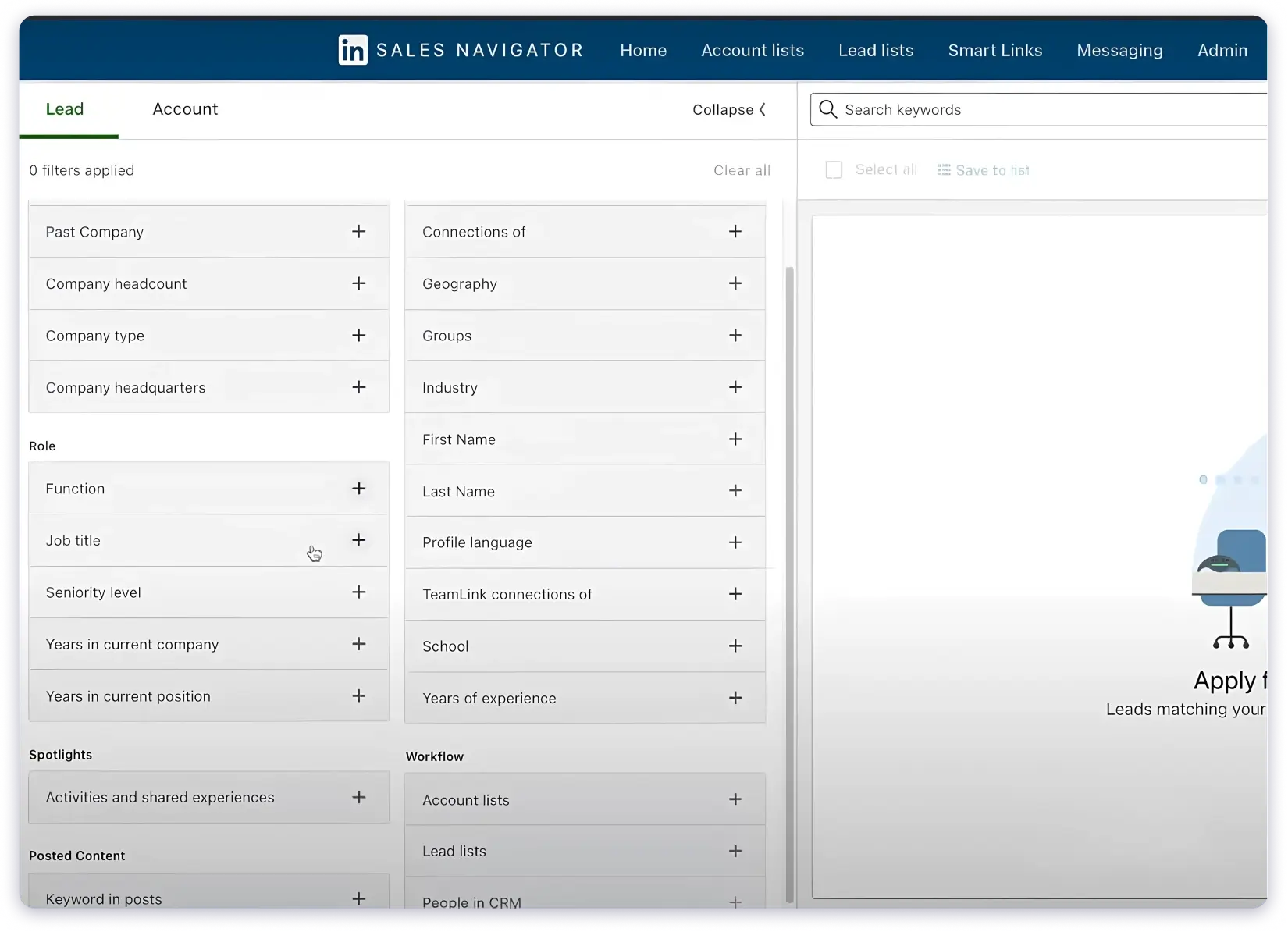
Relationship Explorer and Relationship Map lay out who sits inside a buying committee and how they connect, and TeamLink shows which colleague across your company already has a first-degree connection into a target account.
That is the capability Apollo has no answer to at any tier, and for a rep working thirty named accounts rather than three thousand contacts, it changes the opening move from a cold email to a warm introduction.
Then the wall arrives. LinkedIn states plainly that there is no option to export account or lead information to CSV or XLS, and the entire outreach budget is 50 InMails a month, capped at 150 banked, which cannot be topped up with money at any price.
Third-party scrapers exist, but LinkedIn’s user agreement prohibits them and the risk lands on your rep’s account rather than the vendor’s.
What I Liked
- Access to LinkedIn’s full 1B+ professional network, updated by members themselves
- 50+ advanced search filters including LinkedIn-specific attributes
- Lead and account alerts for job changes, promotions, and company news
- InMail access for direct messaging outside your network
- Lead recommendations powered by LinkedIn’s algorithm
- CRM sync with Salesforce and HubSpot (Advanced and Advanced Plus)
- TeamLink shows which colleague already has a first-degree connection into an account
Limitations I Faced
- No email addresses or phone numbers — you need a separate data tool
- No outreach automation — research only, no execution
- Per-seat pricing from $1,079.88 a year adds up fast for teams
- InMail response rates have declined with increased platform volume
- Third-party automation tools risk LinkedIn account bans
- No intent data beyond LinkedIn engagement signals
Sales Navigator Pricing
- Core: $1,079.88/seat/year
- Advanced: $1,799.88/seat/year
- Advanced Plus: Custom pricing
10. RocketReach
RocketReach is an excellent Apollo.io alternative for finding personal emails, particularly if your work involves reaching people outside their current employer.
It aggregates 700M profiles across 60M companies from licensed datasets, public records, human verification, and its own sources, which produces a wider net than a pure B2B sales database casts.
Recruiters use it for personal email access, and it is available on the entry plan.
I set the lookup preference to personal-only and worked through a list of candidates who would never answer a work address, which is not something Apollo is built for.
Essentials includes unlimited verified personal and professional emails on annual billing, so you are not paying a premium tier to unlock the thing that makes the tool useful.

The refund model is better than Apollo’s too. A lookup that fails to return a verified email or phone is refunded rather than charged, where Apollo charges a credit for every phone number request including numbers that come back flagged on a do-not-call list.
Two constraints shape how far this scales.
Exports are hard-capped per year even though lookups are marketed as unlimited, at 1,200 on Essentials and 3,600 on Pro, so the export ceiling arrives long before the lookup ceiling does
And the sequencer that shipped in 2026 connects one Gmail or Outlook mailbox per seat with a 500-send daily limit, no warm-up and no rotation, which caps outbound well below what a real programme needs.
What I Liked
- 700M profiles, roughly 2.9x Apollo’s contact count
- Verified personal emails included on the entry paid plan
- A personal-only lookup mode for reaching people outside their work inbox
- Failed lookups are refunded rather than charged
- Bullhorn integration, which no other tool on this list offers
- API access on every paid tier, including the entry plan
- Contact profiles carry social links alongside emails and phone numbers
- Published monthly data additions showing exactly what was added and removed
Limitations I Faced
- Exports are capped annually at 1,200 or 3,600 even though lookups are unlimited
- One mailbox per seat with 500 sends a day, no warm-up and no rotation
- Phone lookups require Pro or above, so the entry plan is email only
- No DNC screening despite selling phone numbers
- SSO and suppression lists sit on Ultimate at $1,699 per seat per year
- Cancellation only takes effect at the end of the prepaid term
RocketReach vs Apollo.io: Who Is Better?
| Capabilities | RocketReach | Apollo.io |
|---|---|---|
| Database Size | 700M profiles, 60M companies | 240M+ contacts, 30M+ companies |
| Verification | Prediction and verification run at lookup time. 90 to 98% deliverability claimed | No published method or accuracy rate |
| Credit Rollover | Annual plans carry unlimited lookups, but exports are capped per year | Expire every billing cycle, no rollover |
| Team Seats | Per seat, with a 5% discount on team plans | Charges per seat |
| Ideal Plan for Agencies | Custom team plans from $6,000 a year with pooled credits | No agency tier, every client seat billed separately |
| Invalid Data Refund | A lookup that returns nothing verified is refunded | No refund policy published, DNC-flagged numbers still charged |
| Outreach | Email sequences from one mailbox per seat, 500 sends a day | Email, US dialer, LinkedIn as manual tasks |
See how RocketReach compares to Saleshandy →
RocketReach Pricing
- Free: 3 lookups
- Essentials: $399/seat/year
- Pro: $899/seat/year
- Ultimate: $1,699/seat/year
- Custom team plans: From $6,000 annually with pooled credits
11. Lead411
Lead411 is a solid Apollo.io competitor for teams looking for a cheaper alternative with growth signals built in, and it carries the lowest published annual entry price on this list at $490 a year.
What makes it interesting is not the database, which Lead411 never actually sizes anywhere on its own site, but the way it handles two things Apollo gets wrong: credits that expire and signals that sit behind a paywall.
Unused exports roll over into the next billing cycle.
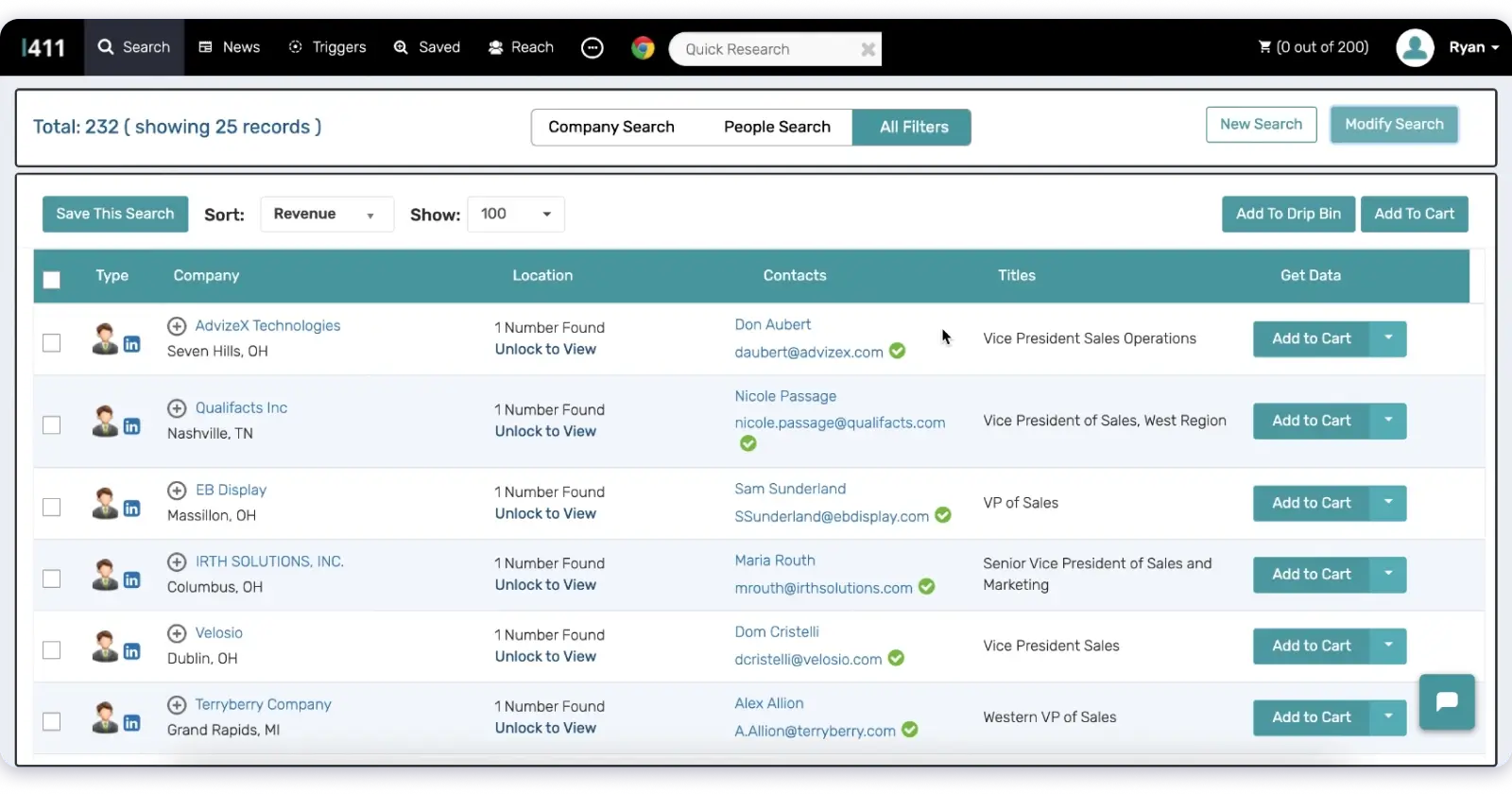
That is the single most direct answer to the Apollo complaint I hear most often, where teams spend the last week of every month burning credits on lists they do not need because the alternative is losing them entirely.
Lead411 simply carries them forward, and on a plan that costs $490 a year, that changes the maths on how carefully you have to ration prospecting.
The thing to know before you buy is that “unlimited exports” is only true on Blaze, the top tier, which carries no published price at all. Spark prints a 12,000-export annual cap on the plan card, so the headline claim and the price list do not quite agree with each other.
What I Liked
- Unused exports roll over rather than expiring at the end of the cycle
- The lowest published annual entry price on this list at $490 a year
- Growth signals covering hiring, funding, executive hires and new locations, on every plan
- Lead scoring included in every subscription rather than gated to a higher tier
- A documented triple-verified process with a published 90-day re-verification cycle
- BounceBan named openly as the catch-all verification partner
- An AI search assistant that builds lists from a plain-language description
- Direct dial phone numbers included on every tier, including the free trial
Limitations I Faced
- No database size published anywhere, so you cannot size it against Apollo
- Unlimited exports only exist on Blaze, which carries no published price
- No outreach layer on any current plan, so a sending tool is mandatory
- No SOC 2 or ISO 27001 certification published
- Accuracy is stated as 95%, 96% and 97% across different pages of the same site
- Coverage is US-first, with reviewers flagging gaps outside North America
- Annual plans carry a one-year minimum and cancellation is by email rather than in-app
Lead411 vs Apollo.io: Who Is Better?
| Capabilities | Lead411 | Apollo.io |
|---|---|---|
| Database Size | Not published anywhere on the site | 240M+ contacts, 30M+ companies |
| Verification | Triple-verified using SMTP, human checks and open validation, re-verified every 90 days | No published method or accuracy rate |
| Credit Rollover | All unused exports roll over to the next billing cycle | Expire every billing cycle, no rollover |
| Team Seats | Effectively per seat, but only Spark carries a published price | $49–$119 per seat, 3-seat minimum on Organization |
| Ideal Plan for Agencies | No agency tier, and pricing above Spark is negotiated | No agency tier, every client seat billed separately |
| Invalid Data Refund | Not published | No refund policy published, DNC-flagged numbers still charged |
| Outreach | None on any published plan | Email, US dialer, LinkedIn as manual tasks |
Lead411 Pricing
- Pilot Light: Free 7-day trial, 50 exports, no card required
- Spark: $490 per year, with a 12,000 annual export cap
- Ignite: From $1,500 per year, adds API access and flexible exports
- Blaze: Custom pricing, the only tier with genuinely unlimited exports
12. Seamless.AI
Seamless.AI is a strong Apollo.io alternative for building B2B lead lists at volume, and it publishes the largest numbers on this entire list at 2.2B+ contacts across 121M+ companies.
Those figures are self-reported with no methodology attached, so treat them as a claim rather than a measurement, but the practical effect is real: on long-tail and fragmented markets where Apollo returns thin results, Seamless usually returns something.
The credit model is where it genuinely beats Apollo.
One credit returns the phone number and the email together, where Apollo charges separately for each.

On a list where you need both, that halves the credit cost per usable contact, and for a team working through thousands of records a month the difference compounds quickly.
It also runs a live mailbox check at the moment you spend a credit, querying the recipient’s mail server to confirm the mailbox exists. If the address comes back invalid, the credit is returned automatically.
Seamless markets itself as a real-time search engine rather than a database, which is looser than what actually happens, since it clearly holds an indexed corpus you can filter. What is verifiably real-time is the verification step, and that is the part worth caring about.
What I Liked
- The largest published record counts of any tool on this list
- One credit returns the phone number and email together
- Credits are returned automatically when an email fails verification
- A live mailbox check runs at the moment you spend the credit
- Connect brings emailing, calling and tasks to every plan, including Free
- API access free on every plan since May 2026
- Strong coverage in long-tail and fragmented markets where other databases return nothing
- Powers HubSpot’s Breeze Prospecting Agent, plus a native n8n integration
Limitations I Faced
- Every subscription is a 12-month contract with a 60-day cancellation window
- No published pricing at any paid tier, so every route runs through a sales call
- No warm-up, no sender rotation and no deliverability tooling at all
- Sending requires your own Gmail and calling requires your own Twilio account
- No DNC screening despite selling 448M phone numbers
- Bulk research is unreliable, with reviewers reporting dropped records on large runs
- Coverage names only the US, Canada and Mexico, with no European claim
Seamless.AI vs Apollo.io: Who Is Better?
| Capabilities | Seamless.AI | Apollo.io |
|---|---|---|
| Database Size | 2.2B+ contacts, 121M+ companies, self-reported | 240M+ contacts, 30M+ companies |
| Verification | Live mailbox reachability check at the moment you spend a credit | No published method or accuracy rate |
| Credit Rollover | Not published | Expire every billing cycle, no rollover |
| Team Seats | Per user on Pro. Unlimited users on Enterprise | $49–$119 per seat, 3-seat minimum on Organization |
| Ideal Plan for Agencies | Enterprise offers unlimited users, but carries no published price | No agency tier, every client seat billed separately |
| Invalid Data Refund | Credits returned automatically on emails the verifier marks invalid | No refund policy published, DNC-flagged numbers still charged |
| Outreach | Email and calling through your own Gmail and Twilio | Email, US dialer, LinkedIn as manual tasks |
See how Seamless.AI compares to Saleshandy →
Seamless.AI Pricing
- Free: 50 credits, 1 user, includes Connect and API access
- Pro: Custom pricing, per user
- Enterprise: Custom pricing, unlimited users
Final Verdict: Which Apollo Alternative Should You Pick?
I’ve listed 12 of the best Apollo alternatives, each one built to solve a specific gap that Apollo leaves open, whether that’s data accuracy, deliverability, regional coverage, pricing flexibility, or outreach depth.
But if you’re looking for one tool that covers everything, finding accurate contacts, running cold email sequences, managing deliverability, and tracking prospects in a CRM, Saleshandy is the most complete Apollo alternative on this list.
Everything you need for outbound lives in one platform.
- 852M+ real-time verified contacts across 42M+ companies
- Automatic credit refunds for unverified data
- Unlimited email accounts with built-in warm-up on every plan
- Sender rotation, Inbox Radar, and A-Z testing for deliverability
- Behavior-based follow-up sequences that adjust automatically
- Built-in outbound CRM to track every prospect interaction
- No per-user pricing, the whole team shares one subscription
- 7-day free trial with 50 free leads (no credit card required)
Still comparing options? Check out our guides on
Frequently Asked Questions About Apollo.io Alternatives
1. Is Apollo.io free? What’s the catch?
Yes, Apollo has a free forever plan. It caps you at two sequences and one intent topic, and non-paying accounts can only connect Gmail mailboxes.
2. What is Apollo.io’s pricing in 2026?
Basic is $49, Professional $79 and Organization $119 per seat per month on annual billing, with a three-seat minimum on Organization. Our full Apollo.io pricing breakdown covers the credit system and add-on costs.
3. How accurate is Apollo.io’s data?
Apollo publishes no accuracy rate anywhere on its own site. Any figure you find elsewhere comes from a third party.
4. Do Apollo.io credits expire?
Yes. Credits expire at the end of each billing cycle and do not roll over. Saleshandy carries half your unused credits into the next month.
5. Is Apollo.io GDPR compliant?
Apollo claims GDPR compliance as both processor and controller, and holds ISO 27001 and SOC 2. Its do-not-call screening is opt-in and covers seven countries, against Cognism’s fifteen.
6. What do G2 reviews say about Apollo.io competitors?
Among Apollo.io competitors on G2, UpLead scores highest at 4.7, followed by Clay and Saleshandy at 4.6, then Cognism, ZoomInfo, Hunter.io and Seamless.AI between 4.4 and 4.5. Apollo itself sits at 4.7. G2 measures the product in use rather than what happens at renewal, so check contract terms separately.
7. What is the best free Apollo.io alternative?
Hunter.io and Clay. Hunter gives you unlimited team members and API access free, while Clay includes waterfall enrichment and its sequencer on the free plan.
8. Which Apollo.io alternatives include email sending?
Seven of the twelve. Cognism, UpLead, Lead411 and LinkedIn Sales Navigator are data-only, so budget for a separate sending tool.
9. What’s the best Apollo.io alternative for mobile numbers?
Cognism, if you sell into Europe. Its mobiles are verified by a researcher actually calling the number. Saleshandy is better if you also want a dialer to call them from.
10. Is Apollo.io safe to use?
Apollo holds ISO 27001 and SOC 2. It did have a 2018 breach exposing around 126 million email addresses, with no subsequent incident recorded.



 Anil Salvi