

When comparing Instantly vs Apollo for outbound sales, I look at four things first: prospecting capabilities, email outreach features, pricing, and how well each platform scales as your team grows.
Finding the right prospects and reaching them through cold email are two different challenges. Apollo helps teams discover contacts and run multichannel outreach, while Instantly focuses on scaling email campaigns and improving deliverability.
The challenge is choosing a platform that matches your workflow without paying for features you do not need or adding unnecessary complexity as your outbound efforts grow.
After spending time analyzing both platforms, I’ve found clear differences in how they approach prospecting, outreach, and scalability.
In this Instantly vs Apollo comparison, I’ll break down where each tool stands out, where they fall short, and which one may be a better fit for your sales process.
I’ll also share an alternative that combines prospecting, outreach, and deliverability features to help teams build a more complete outbound workflow.
Instantly vs Apollo – TOC
TL;DR: Instantly vs Apollo at a Glance (2026)
If you run a sales team and rely on cold email, choose a platform that helps you scale without high per-user costs.
- Choose Instantly if: You send cold emails at scale, manage multiple inboxes, focus on deliverability, and want simple pricing without per-user fees.
- Choose Apollo if: You need prospect data, multichannel outreach, and sales tools like email, calls, LinkedIn, and CRM in one place.
- Both falling short? Saleshandy brings prospecting, cold email, and outreach automation together in one platform. Get verified contacts, unlimited email accounts, unified inbox, and multichannel sequences without per-seat pricing.
Keep reading: if you want to see how Saleshandy compares directly, read our Instantly alternative and Apollo alternative breakdowns.
Instantly vs Apollo: Feature-by-Feature Comparison
I tested both tools across nine feature areas: database accuracy, sequences, warm-up, personalization, AI automation, multichannel outreach, reply management, CRM integrations, and agency features.
Here’s exactly where each tool wins, where it falls short, and what that means for your outbound setup.
1. Data Quality & Lead Accuracy
First, I decided to see which tool was best for finding leads.
Both platforms sell you data, but they’re solving different halves of the problem.
So how reliable is Apollo’s data compared to Instantly’s for B2B sales? Apollo gives you a broad dataset of 240M+ contacts and 30M+ companies, with 65+ filters and built-in verification.
Instantly gives you a larger list on paper, then wraps it in deliverability tooling to get it delivered.
The Apollo.io vs Instantly data enrichment reliability question really comes down to two things: how the data is sourced, and what happens when you try to use it.
Apollo Data Quality
Apollo has the more mature database, with richer filters and better company data for US-based prospecting.

I counted 65+ filters in the People panel, and Research with AI builds the filter stack from a plain-language prompt, which cut real time off list-building.
I ran a search for CEOs and CFOs at software companies in the United Kingdom, United States and France. Apollo returned 61,232 people, with name, job title, company and contact actions per row.
Here’s what worked:
- Deep, richer B2B database with the widest 65+ filter set of the three, at 240M+ contacts and 30M+ companies, included in your seat price.
- Built for SDR-style targeting with buying intent and Lookalikes wired in.
- Structured, intent-enriched data, so you’re not just finding contacts, you’re finding the ones showing interest.
That said, the complaint that keeps surfacing: verified emails still bounce more often than the label suggests. Run your own ICP on Apollo’s free plan before you trust the label. Also, credits are annual, shared across your team, and don’t roll over.
Instantly Data Quality
Instantly is built around deliverability first, and that shows in how its database works. It combines a large lead pool with email verification and search filters to help you find and check prospects before sending.

I ran a search on SuperSearch for CEOs and CFOs at software companies in the United Kingdom, United States, and France. AI search let me describe the prospect in plain English instead of stacking filters.
The search returned 728,580 people, with names, titles, companies, locations, and LinkedIn URLs.
Here are some features worth mentioning:
- Skip owned leads so reruns don’t waste credits on leads you’ve already pulled.
- Contains vs Exact titles gives you control over broad or precise job-title searches.
- 450M+ contacts across the database for a wide range of leads.
- Deliverability tooling wrapped around the data. Bulk verification and placement testing sit in the same platform as the list.
- Credits roll over, with monthly credits lasting two months and annual credits lasting a year, giving you more flexibility with uneven usage.
Keep in Mind
Instantly’s database is a separate subscription from its outreach plans, and you need credits to reveal email and enrichment data. Sending and data together start at $94/month on Instantly’s own Starter bundle, not the $47 most comparisons quote.
Keep reading: if you’re weighing Apollo against the wider field, see our Apollo alternatives breakdown.
Apollo.io vs Instantly.ai for B2B Sales: Which Platform Is Better for Built-In Contact Data?
Apollo wins. Better filters, verification wired into enrichment, structured intent signals, and the database is in your seat price rather than sold twice.
Instantly has more records. Apollo has more usable ones, and you can search them properly.
That’s the answer to apollo vs instantly for b2b contact data: whichever team needs the deeper prospecting engine.
Both have limitations. Here’s what users say:
Apollo User Review
“A big portion of the ‘verified’ emails still bounce or are invalid.”
Test your own ICP on Apollo’s free plan first. “Verified” is an aggregate, and you only find out on send.
Instantly User Review
“The lead finder B2B database is more geared for the US market.”
With only 13 filters, you cast wider than you want and waste credits on the extra rows.
How Does Saleshandy Give You More Accurate Data Without Paying Twice?
Saleshandy helps you overcome both problems Apollo and Instantly leave open.
First, Saleshandy’s B2B Lead Finder gives you a large database with 852M+ contacts and 42M+ companies. But the real difference is its focus on email accuracy. You only get A-grade verified email addresses with 98% deliverability. You can also use AI lead search with ChatGPT-style prompts to find relevant prospects quickly.
If you want a tool that gives you both quantity and quality at an affordable price, Saleshandy is worth a look.
2. Cold Email Campaigns & Sequence Builder
Next, I compared how each tool handles cold email campaigns and sequences.
Both offer sequences, follow-ups, and A/B testing. The difference is what you get at each price point and how much control you have over sending.
Apollo
Apollo’s sequence builder was better than I expected. When I opened a sequence, I got a clean multi-step editor where I could mix automatic and assisted emails.
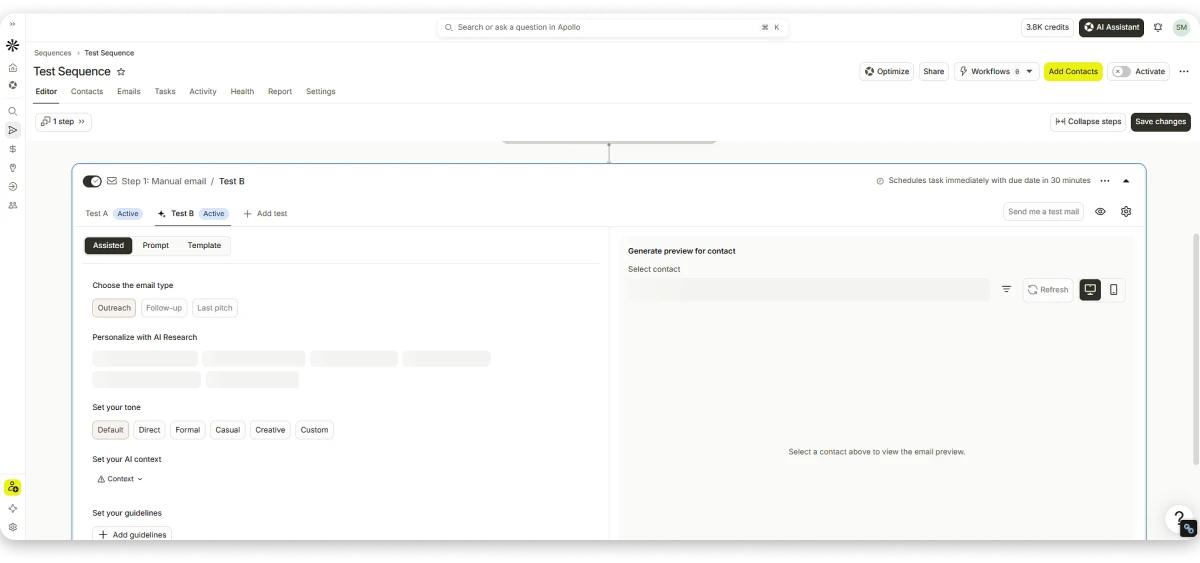
A/B testing is well done. I could add B, C, and more variants and track Delivered, Bounce, Spam Blocked, Open, Click, Reply, Interested, and Opt Out for each one.
I also liked Bounce Guard. It can automatically pause a sequence when the bounce rate gets too high, which is useful for protecting sender reputation.
What worked well for me:
- Email, LinkedIn, and call steps in one sequence
- Multiple sending accounts on Professional and above
- Built-in task management
One thing to know: unlimited sequences start at Basic ($49/seat), but A/Z testing (multivariate) requires Professional at $79/seat.
Instantly
Instantly’s builder was faster to learn, and the sending controls go deeper.
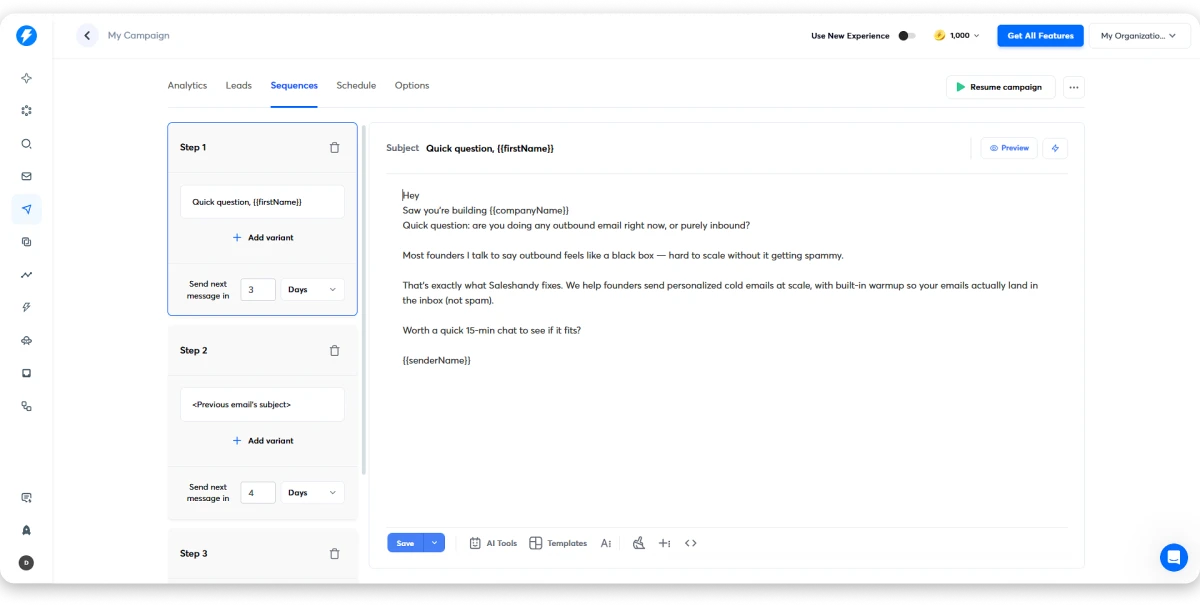
The Schedule and Advanced Options sections are where it stood out. I could set sending hours, time zones, daily lead limits, delays, random wait times, and whether new leads should take priority over follow-ups.
I especially liked the ability to control the minimum gap between emails and automatically optimize A/Z tests once enough data comes in.
Other features I found useful:
- Unlimited email accounts
- Unibox for managing replies
- CC and BCC
- Auto-stop on reply
- AI Reply Agent
That said, AI Sequence Generation is only available on Hypergrowth at $97. Growth at $47 gives you ready-made templates instead.
Personalization is a whole conversation on its own, covered in the next section.
Keep reading: for the wider field, see our best cold email software breakdown.
Apollo.io vs Instantly for Cold Email Sequences: Which Is Better for Cold Email Outreach?
So which one actually wins?
Instantly, but only for pure cold email outreach at scale and deliverability. Unlimited sending accounts, automatic inbox rotation, one Unibox for all replies, and an AI Reply Agent that books meetings via Calendly.
Apollo wins if you want an all-in-one for lead data, CRM, and multichannel outreach. Its sequences hold LinkedIn tasks and calls alongside email in one queue, which is what SDR teams actually want.
Before going with apollo. Here’s what users say:
Apollo User Review
“Apollo is stronger for prospecting than for high-volume email.”
Built for structured SDR motions, not pure sending volume.
Instantly User Review
“Instantly’s AI generator is not available on the Growth plan.”
Growth at $47 is an entry-level plan if AI sequence generation matters to you.
Why Users Choose Saleshandy for Better Sequence Automation
Saleshandy stands out here because you don’t have to move to expensive plans to access important sequence features.
With the Starter plan at $34/mo, you get AI Sequence Copilot, conditional sequences, A/Z testing, and a built-in spam checker. You also get Spintax, Bounce Guard, auto-save, and unlimited email accounts.
Compared to this, Instantly locks AI Sequence Generation and A/Z testing behind Hypergrowth at $97, while Apollo requires the Professional plan at $79/seat for A/Z testing.
3. Email Warm-Up & Deliverability
This is the section most comparisons get wrong, and I want to be specific about it.
Almost every Instantly vs Apollo article online says Apollo discontinued email warm-up in 2024. Our own earlier version of this page said it too.
It’s not true. Apollo has warm-up. But the how matters as much as the fact.
Apollo
Apollo’s pricing page, checked 31 August 2026, lists Deliverability Suite & Email Warmup on Basic, Professional and Organization.
Inside the product, the Mailboxes section under Email Setup & Health shows a “Mailboxes warmed up” counter with a completion percentage.
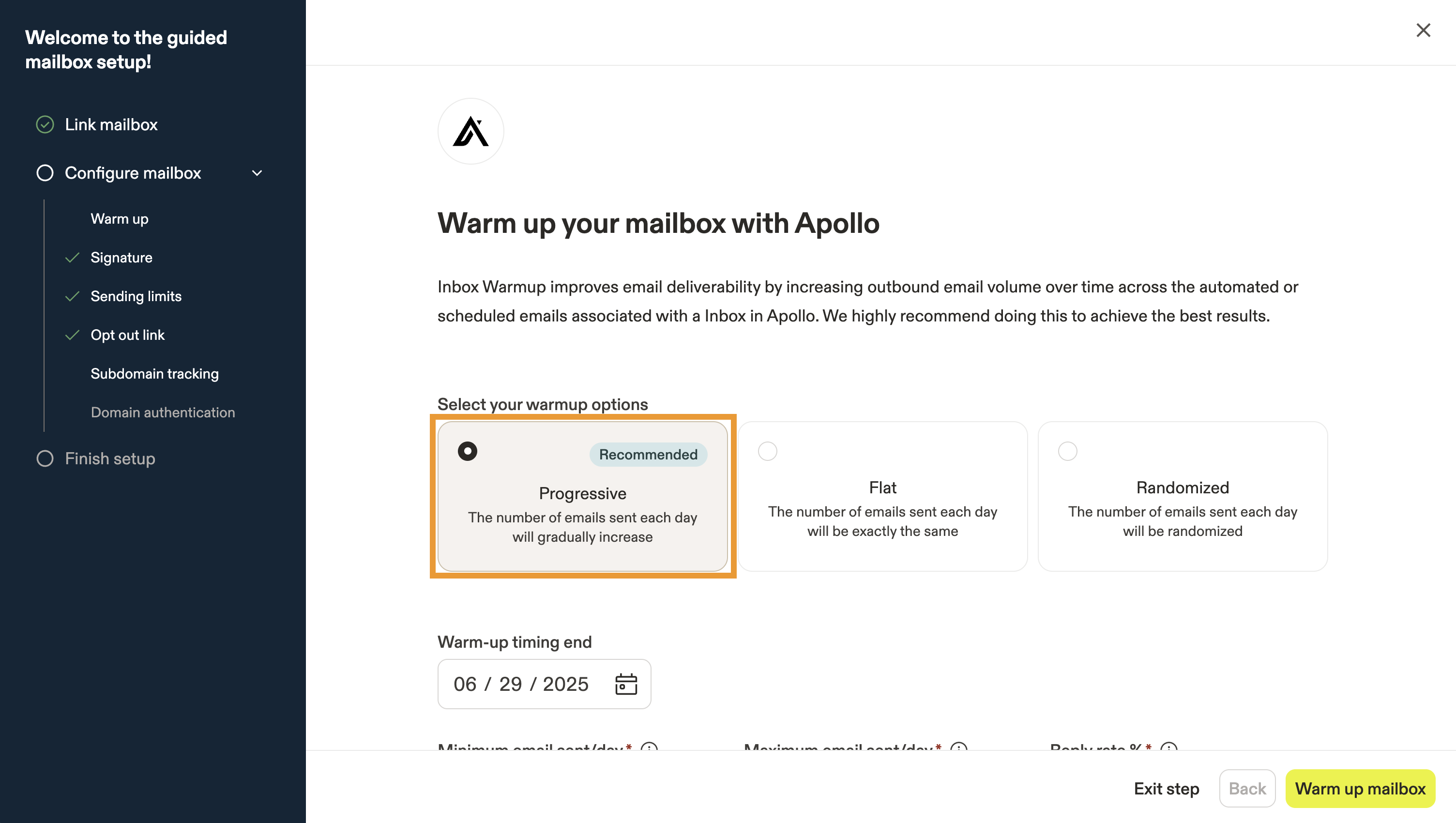
The Email Setup & Health hub is organised into five sub-pages: Overview, Domains for SPF/DKIM/DMARC, Mailboxes for per-mailbox warm-up status, Bounce logs with reason codes, and Sending Policies. The Sending Policies interface is draggable, so rules stack in priority order.
Here’s what stood out:
- Warm-up runs through Warmbox.ai, a third-party. Apollo’s own words: “Email warmup is conducted through Warmbox.ai, a third-party provider. Apollo doesn’t control, manage, or take responsibility for any third-party warmup services or their practices.”
- It costs credits. 1 mailbox per seat is included on paid plans. Each additional mailbox costs 200 credits per 30 days. Free-plan users pay 200 credits per mailbox from day one. Run out of credits and Apollo auto-pauses warm-up until you top up.
- You can’t send while warming up, instead add: Apollo’s own guidance: “Allow warmup to finish before sending automated or manual emails in Apollo.”
Three modes: Progressive (recommended), Flat, and Randomized. Recommended is 10–40 emails per day at 30% reply rate. Ceilings sit at 50 emails and 45%.
What Apollo does instead of scale is restrict. Free and Basic allow one mailbox per user. Professional opens unlimited Google and Microsoft mailboxes plus five SMTP.
Organization adds fifteen. Combined with conservative sending defaults, domains last longer, but you can’t ramp aggressively.
Instantly
Instantly built the opposite kind of system, and this is where it genuinely shines.
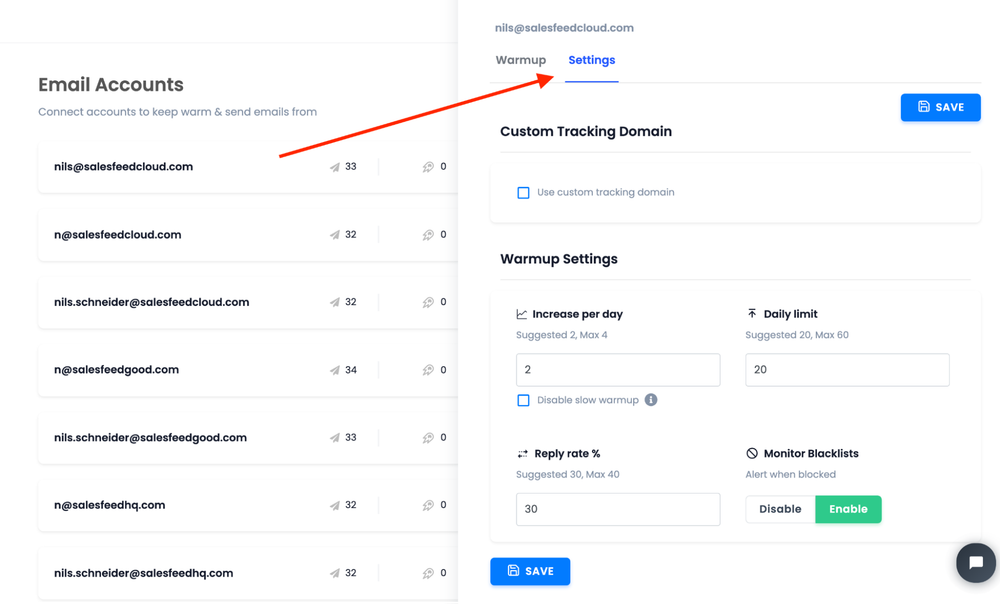
I enabled one-click email warm-up across a large network of real inboxes. Send volume ramped gradually, and behavior simulation mimicked real engagement. No setup gymnastics. It just worked.
What stood out:
- 1,000,000+ real email accounts in the pool. Owned, not rented.
- 1-click activation on any account. Warm-up runs in parallel with sending.
- Slow ramp. Day 1: 2 emails, Day 2: 4, Day 3: 6.
- Read emulation so bots scroll through emails instead of just opening and archiving.
- Per-account control over open rate, response rate and spam protection.
- Deliverability dashboard with inbox vs spam breakdown per account.
Inside a campaign, Provider Matching routes Outlook-to-Outlook and Gmail-to-Gmail. ESP Routing lets you write custom routing rules. BounceProtect auto-blocks risky addresses.
Instantly’s Inbox Placement tool tests where emails land and monitors 400+ blacklists. Worth knowing: some of the advanced deliverability features sit behind higher tiers, so the basic plan mostly gets you warm-up and sending. Everything else costs extra.
Instantly.ai vs Apollo.io: Which Has Better Cold Email Deliverability?
Instantly wins, and it’s not close.
Instantly is the clear winner on email execution and deliverability. Apollo has warm-up, but it’s rented, costs credits per extra mailbox, and pauses your sending while it runs. Fine for a small team. It falls apart when you scale.
Instantly wins on three things Apollo doesn’t offer:
- Owned infrastructure. A million real accounts, all Instantly’s.
- Unlimited warm-up on every paid plan. No per-mailbox credit meter.
- Sending and warm-up run in parallel.
Setting up high-volume campaigns is genuinely simple, and the warm-up does what it promises. One r/agency user tracked their reply rate climbing from 0.8% to 5.1% after switching to Instantly.
That said, deliverability is also the most common complaint. Even with warm-up, some campaigns land in spam. A G2 reviewer called it “trial and error loops.” And paying separately for lead generation and outreach hits smaller teams harder.
How Does Saleshandy Keep Emails Out of Spam Without a Per-Mailbox Fee?
If you want strong deliverability features without moving to expensive plans, Saleshandy is a better value.
The Starter plan at $34/mo includes features you usually have to pay more for:
- Unlimited email warm-up. Every connected account, no cap, no per-mailbox charge.
- Inbox Radar. Tracks your sender score so you spot drops early.
- Sender rotation. Spreads sends across mailboxes to protect each domain.
- ESP matching. Routes Gmail-to-Gmail and Outlook-to-Outlook for better inbox placement.
- Sequence score. Grades your copy for spam risk before you send.
Meanwhile, Instantly locks these behind Hypergrowth at $97/mo (or higher), and the lead database is a separate subscription on top.
So if deliverability is a priority, Saleshandy gives you the essential tools in one plan without extra credit costs.
4. Personalization
Next up, I compared how each tool handles personalization inside a live campaign.
Both offer variable tags and AI writing. The main difference is how much control you get and how much setup is required.
Apollo
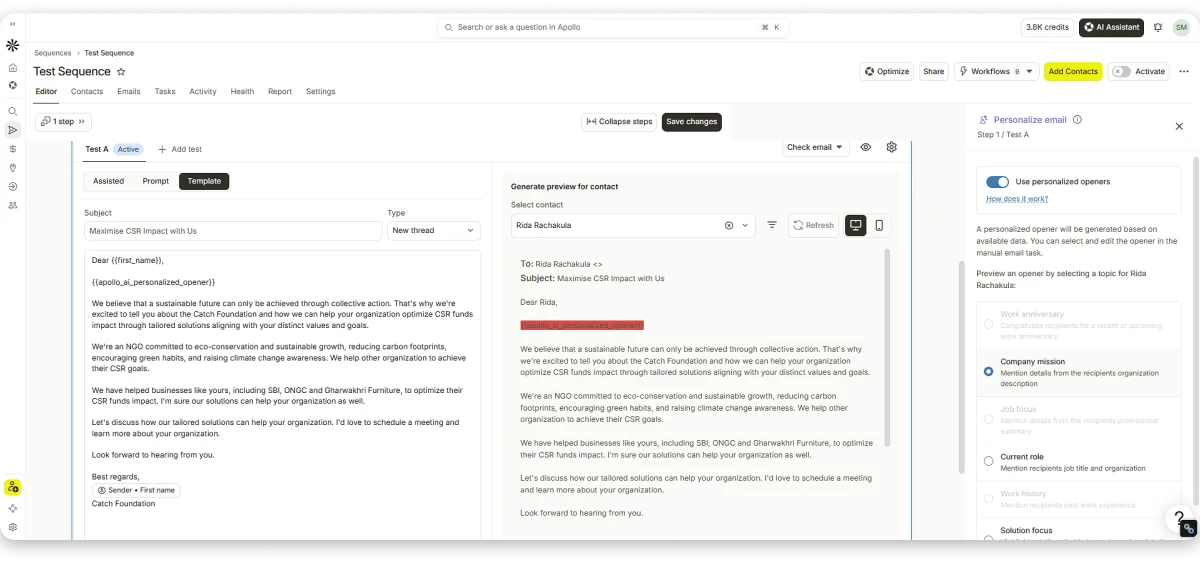
Apollo puts AI in four places inside the sequence editor:
- Write with AI creates a complete email using your prompt and contact data.
- Personalize with AI adds contact-specific lines.
- Opener creates a personalized first sentence.
- P.S. Line generates a personalized postscript.
You also get dynamic tags, custom variables, and conditional logic. I especially liked Generate preview for contact, which lets you see how an email will look for a specific lead before sending.
One gap: Apollo doesn’t offer spintax. AI-generated variations use AI credits.
Instantly
Instantly keeps personalization simpler. You get standard variables, a Personalization field for AI-generated icebreakers, and an AI Spintax Writer for creating email variations.
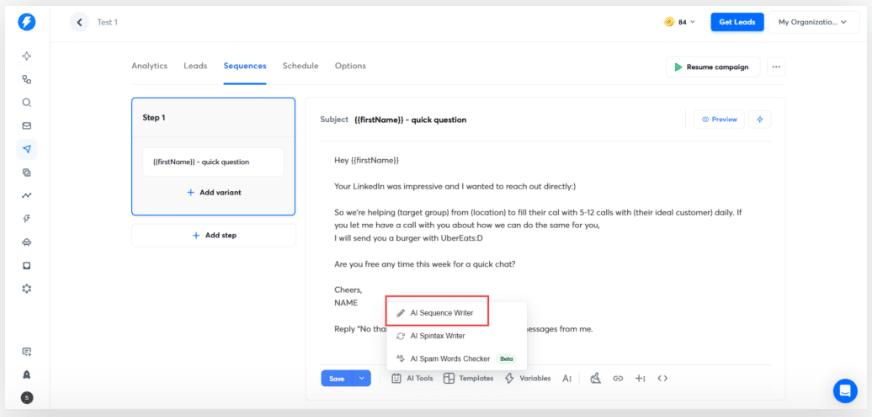
The catch? Variables must exist in your lead list before import. Miss one and you can’t add it later from the sequence editor.
How Do Apollo and Instantly Compare on Sequence Building and Personalization at Scale?
Apollo wins on depth with more AI tools, conditional variables, and contact previews. Instantly is simpler and uses spintax for cost-efficient variation.
My pick: Apollo for high-value, highly personalized campaigns; Instantly for larger campaigns where speed and scale matter.
Where Saleshandy Fits on AI Prospect Enrichment
Saleshandy combines both approaches without adding extra complexity.
Merge tags, spintax, and variables like {{SenderFirstName}}, {{CurrentDate + N}}, and {{DaysLeftInMonth}} are available directly in the email editor. No extra setup or adding fields to your lead list first.
The bigger difference is AI Prospect Enrichment. You can choose from GPT, Claude, Gemini, Perplexity, and Grok, then update or overwrite enriched fields anytime.
Instantly offers basic enrichment on higher plans, while Apollo requires the Organization plan for a BYO LLM.
Saleshandy starts AI enrichment on the Starter plan at $34/mo, using credits and letting you choose the AI model.
If you want more control over personalization and AI enrichment, Saleshandy is worth considering.
5. AI Features & Automation
Next, I compared Apollo and Instantly’s AI features to see which one actually reduces manual sales work.
Both are investing heavily in AI, but they take different paths. Apollo focuses on automating sales workflows, while Instantly focuses on AI agents that handle outreach.
Apollo
Apollo’s AI is built into the platform. The AI Assistant is available across the app, and you can ask questions about your data without leaving your workflow.
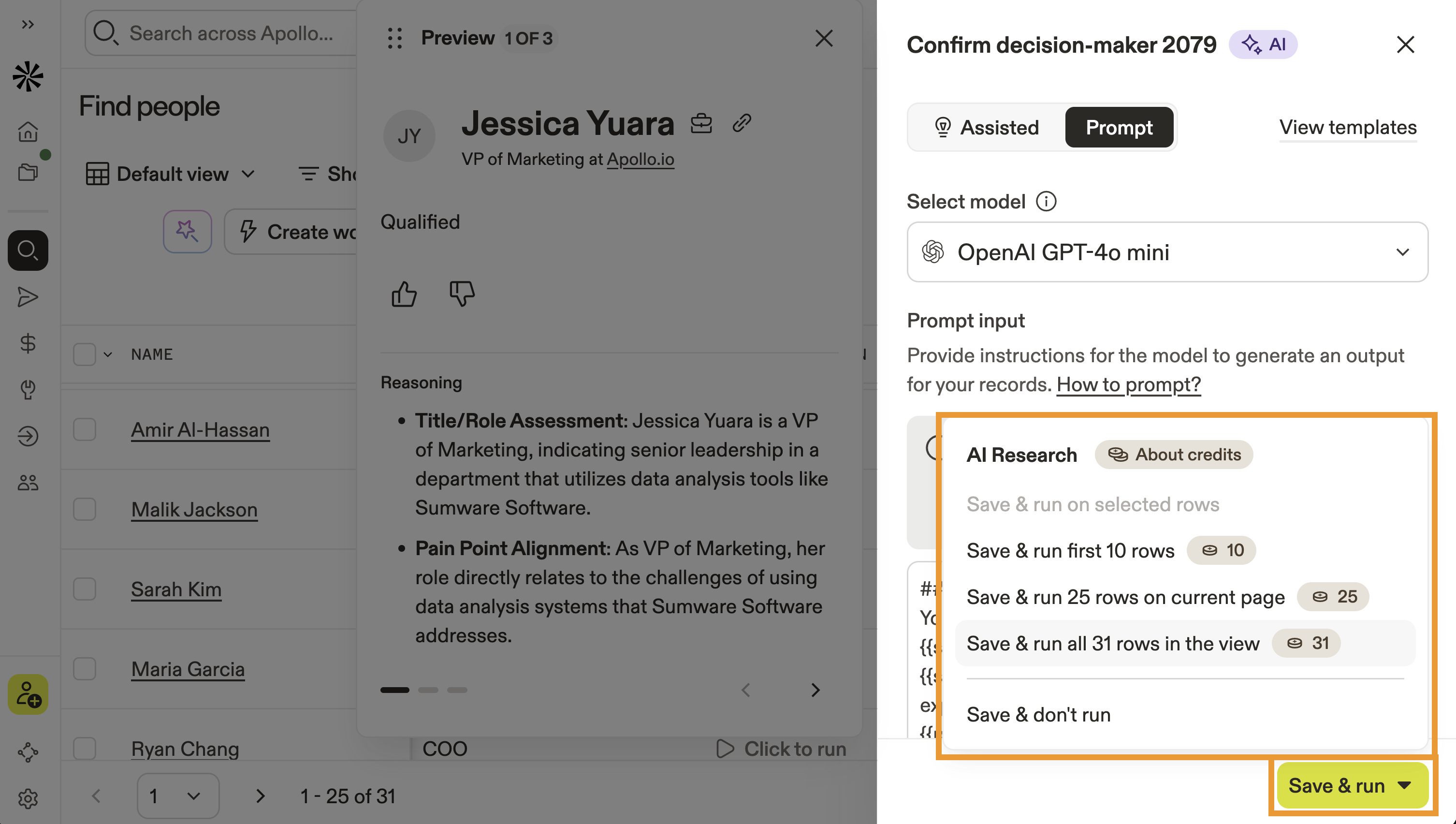
The biggest standout is Workflows. Apollo includes 32 automation templates for tasks like lead routing, data enrichment, follow-ups, and pipeline actions.
You can build branching workflows with triggers and conditions, making Apollo more than just an email tool.
Advanced AI features like Agentic Loops require Professional, while bringing your own LLM key is available on Organization.
Instantly
Instantly focuses its AI around campaign execution.
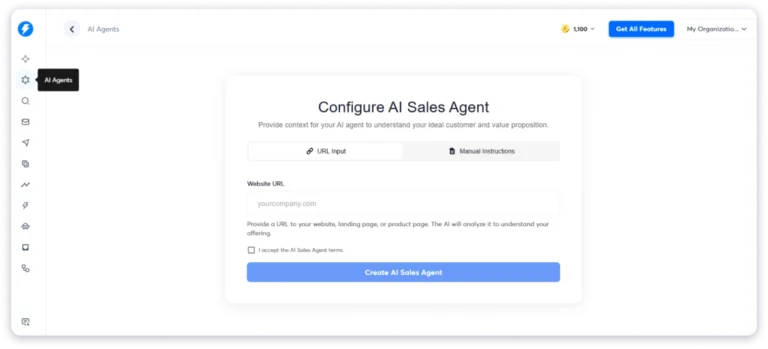
The AI Sequence Writer creates complete sequences from a few inputs like your offer, audience, and case studies. The output is usable, but the messaging still needs editing to avoid generic AI copy.
Instantly also offers AI Sales Agents and Instantly Copilot. These agents can help with lead finding, campaign setup, and replies, with human approval options built in.
The downside: AI agents require the separate Instantly Credits subscription, and pricing for agent usage is not clearly shown upfront.
Instantly.ai vs Apollo: Which Runs More Outreach on Autopilot?
Instantly is closer to true AI-driven outreach automation. Its AI agents can handle more of the campaign execution.
Apollo is better at automating the sales process around outreach. Its workflows handle lead routing, enrichment, follow-ups, and other sales tasks.
The difference is simple:
- Instantly automates outreach.
- Apollo automates sales workflows.
For most teams, Apollo is easier to plan around because its automation costs and limits are clearer.
How Does Saleshandy Give Developers More Flexibility with AI?
Saleshandy sits between Apollo and Instantly, combining AI sequence creation with stronger developer flexibility.
You get:
- AI Sequence Copilot: Creates sequences from a simple prompt.
- AI Prospect Enrichment: Lets you choose models like GPT, Claude, Gemini, Perplexity, and Grok.
- MCP support: Connects with tools like Claude, ChatGPT, Cursor, and n8n.
- CLI access: Lets teams manage prospects, sequences, analytics, enrichment, and other workflows programmatically.
If your team runs outbound through AI tools or custom workflows instead of only using a dashboard, Saleshandy gives you more flexibility.
6. Multichannel Outreach
Email alone is not enough for most outbound teams anymore. The question is how well each platform combines email with other channels.
Apollo and Instantly take different approaches. Apollo is built for SDR-style multichannel outreach, while Instantly stays focused on email volume.
Apollo
Apollo is the stronger option if you want email, LinkedIn, and calling in one workflow.
You can combine email steps, LinkedIn tasks, and calls inside the same sequence.

In my test, Apollo’s LinkedIn steps turned out to be tasks, not automation. I opened one and got a message box, a link to the prospect’s profile, and a Copy text button. I wrote the message inside Apollo, copied it, then sent it on LinkedIn myself.
Then I came back and marked the task complete. Nothing got sent by Apollo. It’s a reminder with a text field attached.
That’s still useful. LinkedIn tasks sat in the same queue as my emails and calls, so a rep works one prioritized list instead of jumping between tools. Just know you’re doing the clicking.

Apollo also has native calling. The US Dialer costs 2 credits per minute, while advanced features like parallel dialing, international calling, and local presence require the Advanced Dialer add-on.
Instantly
Instantly takes a different route. It is still an email-first platform, but it has added tools around the inbox.
You get a unified inbox for emails, calls, and SMS, along with Website Visitors that helps identify companies checking your site.
The biggest limitation is LinkedIn. Instantly does not support LinkedIn steps inside sequences, so teams relying on LinkedIn outreach will need another tool.
How Does Instantly Compare With Apollo for Cold Email Outreach?
For cold email, the difference is smaller than it looks.
Both platforms handle sequences, follow-ups, and campaign testing. The real difference is the extra channels they bring into the workflow.
Apollo wins for sales teams. It combines email, LinkedIn tasks, and calling in one place.
Instantly works better for email-heavy teams. It gives you the tools to manage high-volume email campaigns but does not offer the same multichannel sales workflow.
The simple answer:
- Want SDR-style outreach across multiple channels? Apollo.
- Want to scale cold email campaigns? Instantly.
Why Do Teams Choose Saleshandy for Email, LinkedIn, Calls, and WhatsApp in One Sequence?
Saleshandy takes the Apollo approach but adds more channels into the same workflow.
You can build sequences across email, LinkedIn, calls, WhatsApp, and custom tasks without moving prospects between tools.
That makes it a stronger fit for teams that don’t want email to be the only touchpoint.
What stands out:
- Multichannel sequences: Add email, LinkedIn tasks, calls, WhatsApp, and custom actions in the same sequence.
- Built-in calling: Run call steps with Saleshandy’s Dialer alongside email outreach instead of managing a separate tool.
- WhatsApp outreach: Add personalized WhatsApp steps with merge tags and attachments.
- Unified workflow: Keep every prospect touchpoint in one place instead of splitting activity across multiple platforms.
Apollo is still the better choice if LinkedIn and SDR-style workflows are your priority. Instantly remains the better fit for teams focused mainly on high-volume email.
But if you want email + LinkedIn + calls + WhatsApp in one sequence, Saleshandy gives you the most complete multichannel setup.
7. Inbox Management & Reply Handling
This is Apollo’s clearest weakness, and it’s structural rather than fixable with a setting.
Speaking of Apollo.io, its Inbound Optimization and Deal Management features make it a fully-fledged sales automation suite.
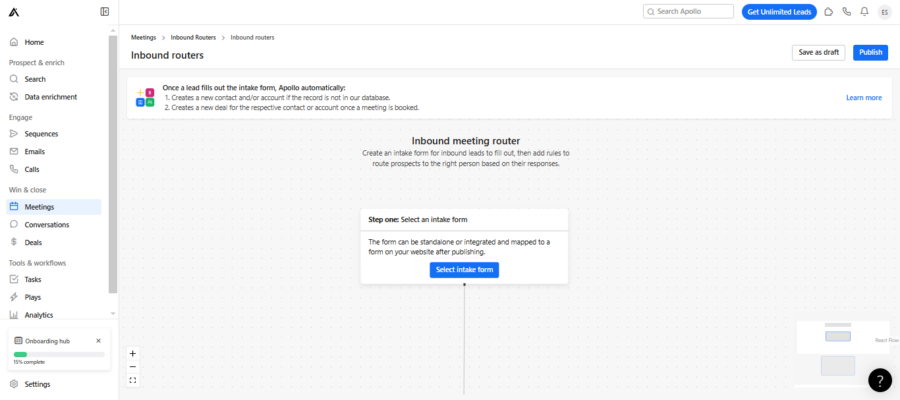
The platform allows users to create customizable forms and, based on the prospect and/or company data submitted, uses AI to generate personalized messages for every relevant inbound lead.
Apollo does give you Bounce logs under Email Setup & Health, so you can see which emails failed to deliver.
This is where Instantly takes a different approach with Unibox. It brings replies from your connected inboxes into one place.

You can filter replies by lead status, campaign, or inbox. You can also create custom labels and manage conversations from the same screen. Instantly even has a mobile app.
There is one important catch: Unibox is available on Hypergrowth at $97/month. The Growth plan at $47 doesn’t include full Unibox access.
So while Unibox is one of Instantly’s biggest advantages, you need the higher plan to actually use it.
Instantly versus Apollo.io: Which Manages Replies Better Across Multiple Accounts?
Instantly, and this is the least close section in the comparison.
Managing replies across ten mailboxes in Apollo means moving between sequences. There’s no central view. Instantly gives you one inbox, status labels, custom tags, campaign filtering and a mobile app.
The thing to budget for: Unibox needs Hypergrowth at $97 monthly, $77.60 annual. Growth at $47 is view-only. If you’re running multi-mailbox cold email, $47 is not your real entry price.
How Does Saleshandy Give You a Full Unified Inbox From the Entry Plan?
This is the clearest gap in the entire comparison, so I’ll be direct about it.
Apollo has no unified inbox at any price. Instantly has an excellent one, but you need Hypergrowth at $ 97/month to reply from it. Saleshandy gives you full unified inbox access from Starter at $34/mo, including sentiment detection and reply tagging.
If you’re running cold email across multiple mailboxes, reply management isn’t a nice-to-have. It’s the difference between a working operation and logging into six inboxes every morning.
That’s the one feature I’d tell you to check on a trial before you commit to any of the three.
8. CRM & Integrations
Apollo is the stronger platform here and it isn’t particularly close.
It has a native Deals pipeline, so contact and company records carry CRM-style fields and you can manage opportunities without leaving the tool.
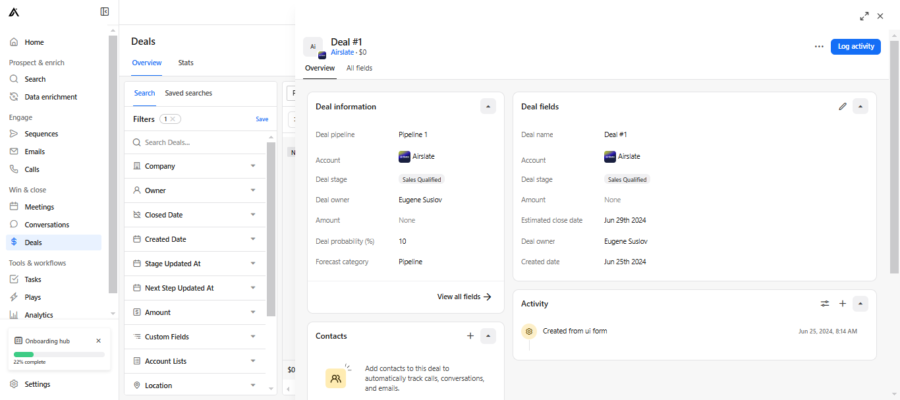
For external CRMs, the integrations page lists Salesforce, HubSpot, Pipedrive, Zoho and Microsoft Dynamics, marked new. Conversation tools include Zoom, Google Meet, Microsoft Teams and Gong.
There are 50+ data and enrichment providers organised under Data Sources & Validation, ATS, Automation, Sales Engagement and Workflow.
On the developer side there are API keys, MCP support and custom API plugins. Apollo’s MCP connector works with Claude, ChatGPT and Perplexity, letting you search prospects, enrich contacts, add them to sequences and update your CRM from an AI conversation.
Instantly’s CRM sidebar is more built out than I expected from a tool marketed as an email platform: Inbox with Done and Upcoming views, Opportunities, All Leads, Lists, Campaigns, AI Sales Agents, Salesflows and Website Visitors. It’s positioned as one subscription with unlimited seats.

Two Honest Limits From My Session
Clicking Opportunities prompted “Connect an Email Account to Get Started”, so the deal pipeline is gated behind a connected inbox I didn’t set up.
Salesflows was empty, and the standalone Automations page stuck on a loading state and never rendered its builder. I can’t tell you how deep that workflow tool goes.
On integrations, Instantly’s pricing page lists one relevant row: “API, webhooks, and integrations.” Salesforce isn’t named anywhere on it. Instantly’s MCP server works with Claude, ChatGPT and n8n.
Both offer live chat and both respond quickly on first contact. Apollo’s documentation is deeper. Instantly’s bot draws the more common complaint.
How Do Apollo and Instantly.ai Compare for CRM Sync and Email Campaigns?
Apollo, decisively.
If your team runs on Salesforce or HubSpot, Apollo has two-way sync and automated CRM enrichment. Instantly doesn’t advertise Salesforce at all, which means Zapier or webhooks and a sync you maintain yourself.
Apollo is built as an intelligence layer other tools plug into. Instantly is built as a sending layer that exports results.
For anyone with an existing CRM, that difference outweighs almost everything else in this comparison.
How Does Saleshandy Stand Out in the Integration Race?
On traditional CRM integrations, Apollo wins and Saleshandy doesn’t beat it. Two-way Salesforce and HubSpot sync plus 50+ enrichment providers is a genuinely deep ecosystem.
Saleshandy CRM covers HubSpot, Salesforce, Pipedrive and Zoho. Handles most B2B stacks, but not the same depth.
Where it pulls ahead is the AI layer: 40+ MCP commands against Apollo’s and Instantly’s smaller sets, plus a CLI Instantly doesn’t have.
If your team lives in Salesforce, Apollo is the better platform. If your team lives in Claude or Cursor, Saleshandy is.
9. Agency & Team Features
This is where both tools have limitations, and the difference matters if you run outbound for clients. For agencies, the question is simple: can you manage multiple clients without your costs getting out of control?
Apollo and Instantly take different paths.
Apollo
Apollo is built for internal sales teams, not agencies.
It has strong team features like user roles, shared sequences, permissions, ownership rules and workspace controls. But it has no way to create separate client accounts, white-label the platform or manage multiple client environments.
If you run outreach for five clients, you need five separate Apollo setups.
The pricing makes it harder to scale. Apollo charges per seat, and the Organization plan starts with a three-seat minimum at $119/seat, creating a $357/month floor before you add clients.
Instantly
Instantly is more agency-friendly because it supports separate workspaces.
You can create different workspaces for different clients and assign campaign ownership to team members.
The downside is cost transparency. Instantly doesn’t publish agency pricing anywhere, and advanced agency features like white-labelling aren’t clearly listed on their compare-features table.
If you’re an agency trying to model your cost before signing up, you can’t do it from the site.
Which Tool Is Better for Agencies: Apollo or Instantly?
Instantly wins over Apollo for agencies.
Apollo has better internal team management, but it was never designed for managing client accounts.
Instantly gives agencies the structure they need: separate workspaces and campaign-level ownership. But you’ll need a sales call to find out what it costs at scale.
Why Do Lead Gen Agencies Choose Saleshandy Over Instantly and Apollo?
Saleshandy is the stronger agency-first outbound platform if you want to scale without paying more for every new client.
You get:
- Unlimited client management
- Agency-level reporting
- White-labeling
- Team collaboration and user roles
- Unlimited email accounts
Unlike Apollo, you don’t need a separate setup for every client. Unlike Instantly, agency pricing is transparent from the start. Agencies like Saleslink and Hotlead run multi-client outbound on Saleshandy exactly this way.
For agencies, the winner is simple: Saleshandy gives you the features you need to scale without increasing your costs with every client.
Instantly vs Apollo Pricing Comparison (2026): Which Gives Better Value?
When you’re in the decision-making process, pricing plays a huge role. These are annual subscriptions with real money attached, so you want to know exactly what you’re paying for.
Here’s the honest Apollo vs Instantly pricing breakdown, checked against both live pricing pages.
Both pricing pages hide something, and they hide different things.
Instantly Pricing
Instantly isn’t one product with one price. You pick a tab: Outreach, Instantly Credits, or VIP. Each is its own subscription. There’s no bundle combining them.
Outreach, monthly and annual:
| Plan | Monthly | Annual | Key limits |
|---|---|---|---|
| Growth | $47 | $37.60 | Unlimited accounts and warm-up, 1,000 contacts, 5,000 emails/mo. No Unibox. |
| Hypergrowth | $97 | $77.60 | 25,000 contacts, 125,000 emails/mo, Unibox, premium live support |
| Light Speed | $358 | $286.30 | 500,000 emails, 100,000 contacts |
| Enterprise | Custom | Custom | Private deliverability network |
Instantly Credits (the database, sold separately):
| Plan | Monthly | Annual | Credits |
|---|---|---|---|
| Growth Credits | $47 | $37.60 | 1,500–2,000/mo |
| Supersonic | $97 | $87.30 | 5,000–7,500/mo |
| Hyper Credits | From $197 | $177.30 | 10K–200K/mo |
Also worth knowing: Instantly doesn’t offer a free plan. You get a 14-day free trial, then a paywall.
The honest entry price is $97, not $47. Without Unibox you’re logging into each mailbox individually to read replies.
Apollo Pricing
Apollo is one plan, priced per seat.
| Plan | Per seat/mo (annual) | Credits per seat/yr | Mailboxes per user |
|---|---|---|---|
| Free | $0 | 1,200 (granted monthly) | 1 |
| Basic | $49 | 30,000 (granted upfront) | 1 |
| Professional | $79 | 48,000 | Unlimited Google/Microsoft + 5 SMTP |
| Organization | $119, min 3 seats | 72,000 | Unlimited + 15 SMTP |
Credit costs: email 1, phone number 8, data enrichment 1–8, AI research 1 per run, US dialer 2 per minute.
Two add-ons not in the seat price:
- Inbound at $119/team/month
- Advanced Dialer, which is where parallel and international calling live
If cold calling is central to your motion and you’re considering Apollo, plan for that extra cost upfront.
Apollo’s floor is genuinely $0, and the free plan is actually usable. But Organization’s three-seat minimum makes the real cost of the top tier $357/month.
Read more: Apollo.io pricing and plan comparison
Team Size Pricing Comparison
| Team size | Instantly | Apollo | Saleshandy |
|---|---|---|---|
| 1 user | $97/mo (Hypergrowth, no database) | $49/mo (Basic, database included) | $34/mo (Starter) |
| 3 users | $97/mo | $147/mo | $76/mo (Pro, up to 10 users) |
| 5 users | $97/mo | $245/mo | $76/mo (Pro) |
| 10 users | $97/mo | $490/mo | $76/mo (Pro) |
Apollo figures: Basic at $49/seat annual. Instantly figures: Outreach Hypergrowth only. Add $37.60–$177.30/mo for Instantly Credits if you need the database.
The breakeven sits at two users. Below that, Apollo is cheaper and gives you a database. Above it, Apollo’s per-seat model compounds while Instantly’s stays flat.
At ten users the gap is roughly $414/month, or about $5,000 a year. But that comparison isn’t quite fair, because Apollo includes prospecting data and Instantly doesn’t. Add Supersonic credits at $87.30 and Instantly’s ten-user cost becomes $184.30 against Apollo’s $490.
Still a large gap. Just a smaller one than the headline suggests.
Instantly vs Apollo Pros & Cons
Apollo and Instantly are both strong tools, but they are built for different jobs.
Apollo instantly stands out for prospecting and multichannel outreach. Its database, filters, and LinkedIn + email workflows make it ideal for SDR teams. The downside: data accuracy can vary, and advanced features cost more.
Instantly Apollo comparison for cold email deliverability tips the other way. Instantly’s warm-up, inbox rotation, and sending controls make scaling high-volume cold email easier. The downside: lead data is a separate cost.
Here’s a quick breakdown:
| Platform | Pros | Cons | ||||||
|---|---|---|---|---|---|---|---|---|
| Apollo | • 240M+ contacts with advanced filters • Email, LinkedIn, and calling in one workflow • Strong sales intelligence and enrichment • Built-in automation and CRM features | • Contact data can still have inaccuracies • Pricing increases quickly as teams grow • No unified inbox for managing replies | ||||||
| Instantly | • Excellent email deliverability features • Unlimited email accounts and warm-up • Simple campaign setup for high-volume outreach • Strong sending controls and inbox management | • Lead database costs extra • Limited sales intelligence compared to Apollo • No LinkedIn outreach | ||||||
Quick Verdict
Apollo is the better all-in-one sales platform. Instantly is the better choice for teams focused mainly on high-volume cold email. I’ve compared both with Saleshandy throughout, so you can pick the platform that actually fits your workflow, no settling for less.
Instantly vs Apollo: And The Winner Is
After testing both platforms across data, sequences, deliverability, and pricing, here’s where we landed.
Instantly comes ahead in warm-up and deliverability. Unlimited accounts, a 1M+ warm-up pool, and flat pricing make it the pick for high-volume, email-first outbound.
Apollo comes ahead in prospecting depth, multichannel outreach, and buyer intent signals. Its 240M+ contact database, 65+ filters, LinkedIn tasks in the same queue as email, and native CRM sync make it the pick for full-cycle sales teams.
However, if you’re looking for the best overall option that combines both without stitching two vendors together, Saleshandy is worth the look:
- 852M+ contacts and 42M+ companies in the lead database
- A-grade verified emails at 98% deliverability, withheld when uncertain
- AI Prospect Enrichment with model choice (GPT, Claude, Gemini, Perplexity, Grok)
- Unlimited email accounts and warm-up on every plan
- Full unified inbox with sentiment detection from $34/mo
- Multichannel sequences across email, LinkedIn, calls, WhatsApp and SMS
- 40+ MCP commands across Claude, ChatGPT, Cursor and n8n, plus a CLI
- Unlimited agency clients with white-labeling on the entry plan
If your goal is to book more meetings in 2026 while spending less time managing your outbound tools, Saleshandy is worth a look.
Try Saleshandy Free for 7 Days →
FAQs for Apollo.io vs Instantly
1. What are the key differences between Apollo and Instantly as outbound email tools?
Apollo is a prospecting database with sending attached. Instantly is a sending engine with a database attached. Apollo includes contact data in one per-seat plan. Instantly gives you unlimited mailboxes and a unified inbox at flat pricing, but sells the database separately.
2. Apollo.io vs Instantly.ai: which is better for cold email outreach?
For cold email specifically, Instantly. Unlimited mailboxes, unlimited warm-up, and a unified inbox win on volume. Apollo caps you at one mailbox until $79/seat.
3. Why would a sales team choose Apollo over Instantly?
Sales teams need prospects, not just sending capacity. Apollo’s 65+ filters, intent signals, included database, LinkedIn tasks and native dialer fit a sales motion. Instantly is built for sending only.
4. What do users on Reddit say about Apollo vs Instantly?
Use Apollo for finding leads, Instantly for sending them. The most common Apollo complaint is bounces on verified emails. The most common Instantly complaint is cost stacking across two subscriptions.
5. Is there anything better than Apollo or Instantly for cold email?
If you want both in one tool, try Saleshandy as an Instantly alternative. 852M+ contacts, unlimited email accounts, unified inbox and multichannel sequences from $34/mo flat, no per-seat charge.
6. Which cold email tool is best for agencies managing multiple clients?
Saleshandy. Unlimited clients, white-labeling on the entry plan, no per-client fee. Apollo has no multi-client workspace. Instantly doesn’t publish agency pricing.