
![7 Best Healthcare Database Providers in 2026 [Tested & Compared]](https://www.saleshandy.com/blog/wp-content/uploads/2026/05/863381435-best-healthcare-database-providers.webp)

There are more than 1,050 healthcare database providers in the market.
And at a surface level, most of them sound similar!!!
But some of them provide accurate contact data, while other data platforms offer professional, organizational, and sometimes even behavioral insights.
So the question here is not which is the best healthcare database provider.
It is what kind of data you actually get and whether it helps you reach physicians, hospital staff, or healthcare decision-makers in a meaningful way.
In this blog, I’ll break down the 7 best healthcare database providers and what each one is actually best suited for, including:
- What they’re best used for
- Pros and cons
- Pricing
Let’s get into it.
7 Best Healthcare Database Providers – TOC
- TL;DR: 7 Best Healthcare Database Providers at a Glance
- How I Evaluated These Healthcare Database Providers
- Types of Healthcare Professionals You Can Search For
- 7 Best Healthcare Database Providers in 2026
- What Verified Healthcare Contact Data Should Actually Include
- Why Saleshandy Stands Out Among Healthcare Database Providers
- Frequently Asked Questions
TL;DR: 7 Best Healthcare Database Providers at a Glance
These three healthcare database providers stand out in their own categories.
Each one serves a different use case, verified contacts, physician targeting, or healthcare market intelligence, so it’s better to understand what each is built for rather than compare them directly👇
- Saleshandy → Best for 92% verified emails and phone numbers with geo-targeting and 75+ data points for precise healthcare outreach.
- Ampliz → Best for specialty-based physician targeting using NPI-level filters.
- Definitive Healthcare → Best for hospital analytics and healthcare market intelligence.
Here’s a side-by-side comparison of the top healthcare database providers:
How I Evaluated These Healthcare Database Providers
Five questions. No scoring system. Just what matters when you’re picking a healthcare database.
One more thing: professional contact data for healthcare workers (work emails, job titles, hospital affiliations) is not protected by HIPAA. HIPAA covers patient health information, not business contact details.
Types of Healthcare Professionals You Can Search For
Not all healthcare professionals buy the same way or respond to the same approach. Knowing which category you need helps you pick the right database and set the right filters.
Physicians and Doctors
Physician records are the most searched category in any healthcare database. You can typically narrow by three things:
- By specialty: Cardiologists, orthopedic surgeons, oncologists, neurologists, dermatologists, pediatricians, or any of 852+ recognized medical specialties
- By practice setting: Private practices, hospital-employed physicians, group practices, or academic medical centers
- By role: Practicing physicians who see patients vs. physicians in administrative or leadership positions (medical directors, department chiefs)
This distinction matters. A medical device company selling cardiac monitors needs interventional cardiologists at hospitals, not family medicine physicians at private clinics. The specialty and setting determine who actually makes purchasing decisions for what you sell.
Nurses and Nursing Leadership
Nurses influence or directly control purchasing for medical supplies, patient care equipment, clinical software, and training programs. Three groups matter most:
- Registered Nurses (RNs): The largest group, working across ICUs, outpatient clinics, surgical units, and every other care setting
- Nurse Practitioners (NPs): Advanced practice nurses with prescribing authority who make clinical decisions similar to physicians. Often easier to reach and more open to evaluating new solutions
- Nursing Leadership: Directors of nursing, chief nursing officers, and nurse managers who control departmental budgets and vendor approvals
If you sell wound care supplies, you need wound care nurses and nursing directors. If you sell clinical documentation software, you need nurse practitioners and nursing informatics specialists.
Healthcare Executives
Executives approve enterprise deals, technology contracts, and major capital purchases. The title tells you what they control:
- C-Suite: CEOs (overall strategy), CFOs (budget and ROI), CMOs (clinical decisions), CIOs (technology)
- Department Heads: Medical directors, VPs of nursing, directors of IT, procurement directors
- Practice Administrators: Office managers and administrators who run physician practices and manage vendor relationships
A hospital information system that costs millions goes through the CIO, CFO, and CEO. A new medical supply contract goes through procurement. Knowing the title tells you who to reach for your specific product.
Hospitals and Health Systems
Instead of searching person by person, some databases let you search by organization. You find a specific hospital, health system, or clinic network and see all the relevant decision-makers inside it.
This is useful when you need to reach multiple people at the same facility. Selling to a 500-bed hospital means you might need the CFO, the CIO, the head of procurement, and the department head who’ll use your product. Searching by organization gives you everyone in one view.
7 Best Healthcare Database Providers in 2026
Here’s my in-depth review of the 7 best healthcare database providers and what each platform is actually best suited for.
1. Saleshandy
Saleshandy is the #1 healthcare database provider on my list.
And there are a few clear reasons why.
After reviewing multiple healthcare data providers, I found that most platforms either focus heavily on healthcare intelligence or offer static contact lists with limited filtering capabilities.
Saleshandy takes a more practical approach.
It gives you access to verified healthcare decision-maker data across regions, specialties, hospitals, clinics, and healthcare organizations inside a searchable database that is actually built for outreach.
What stood out to me was the level of targeting available. Beyond verified emails and phone numbers, you also get access to data points like job titles, location, company details, seniority, and organization type.
This makes it much easier to build highly targeted healthcare campaigns instead of exporting broad lists and cleaning them manually later.
I also liked how easy the platform is to use.
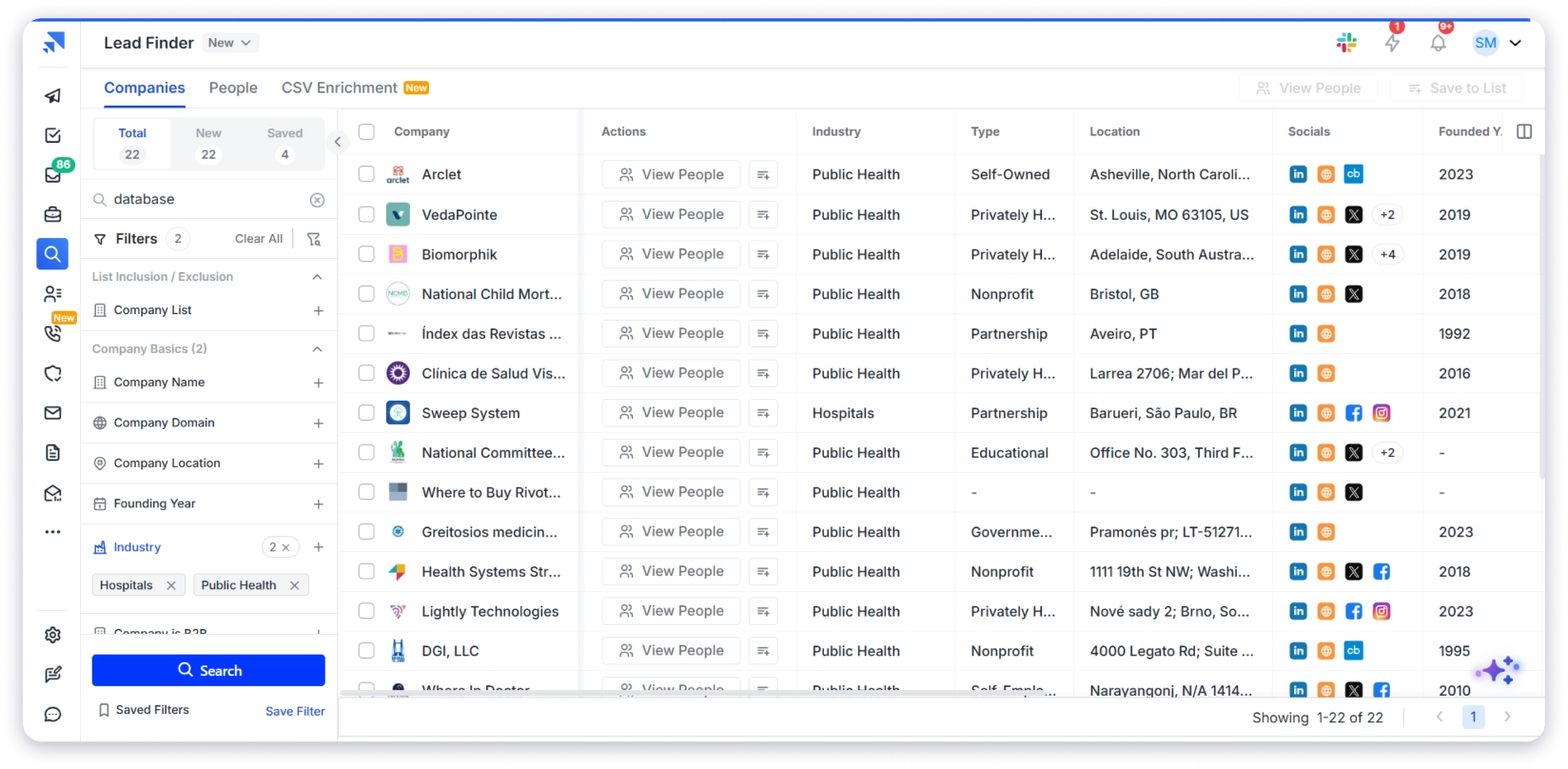
Unlike traditional healthcare list vendors that require demo calls, custom data requests, or long procurement cycles, Saleshandy gives you a self-serve workflow where you can search, preview, and verify healthcare contacts within minutes.
The platform also supports geo-targeting and 75+ filters, helping teams segment healthcare professionals based on specialty, geography, role, company size, and more.
If your goal is healthcare lead generation, recruitment, partnerships, staffing, or outbound prospecting, I think Saleshandy is one of the strongest options currently available.
Pricing
- Starter: $49/mo
- Pro: $79/mo
- Custom: Contact sales
2. Definitive Healthcare
The next tool on this list, Definitive Healthcare, is built for a completely different use case. Instead of helping teams find contact details, it helps them understand the healthcare market in depth.
Definitive Healthcare is one of the strongest platforms for hospital analytics, physician referral intelligence, procedure volumes, prescribing trends, and health system data across the US healthcare industry.
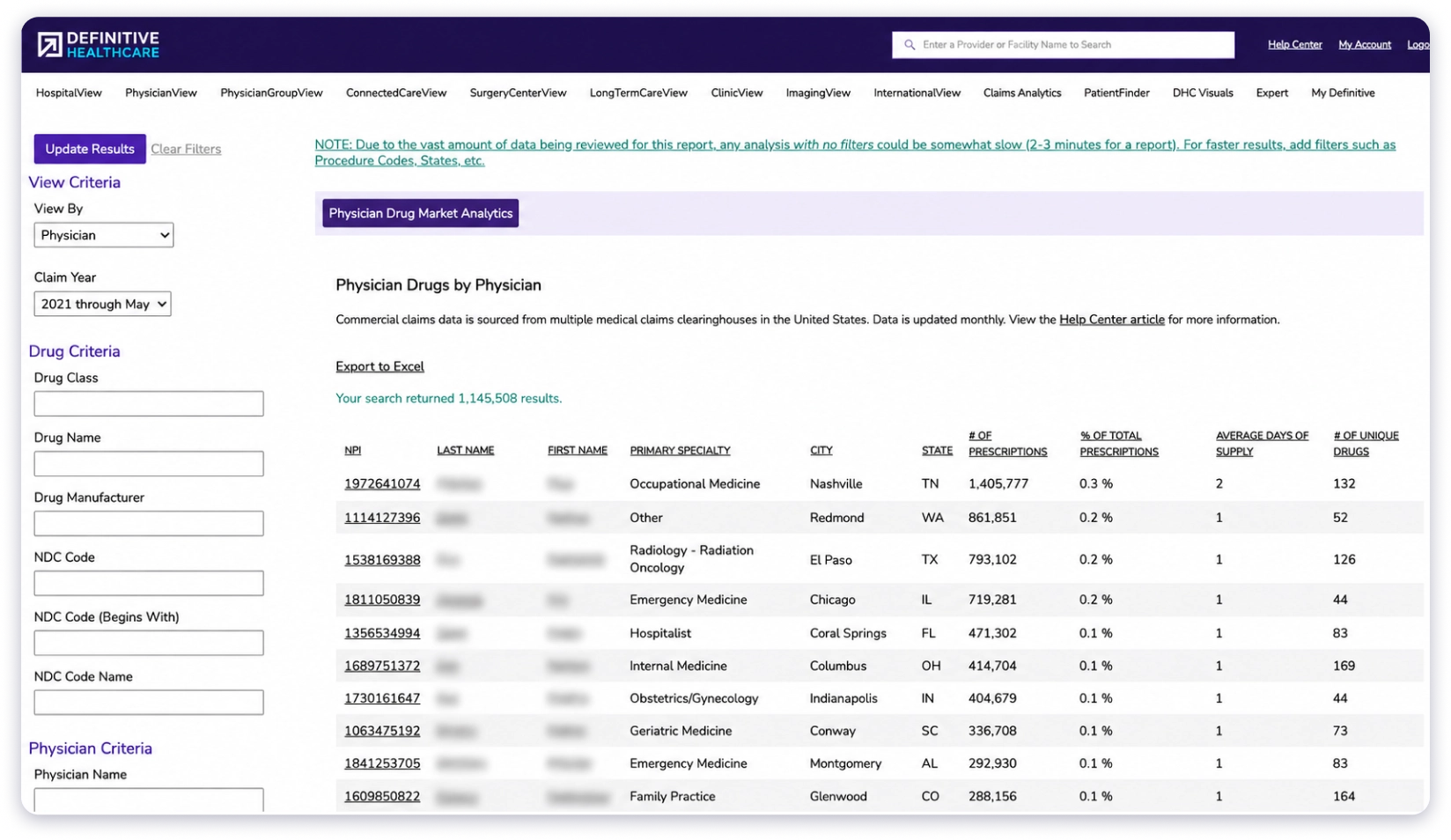
Its biggest strength is the depth of its healthcare analytics and provider-level intelligence. However, it is not designed for outbound prospecting. If you need verified email addresses or phone numbers for healthcare professionals, you will need a separate contact database platform.
Pricing: Enterprise contracts only.
3. IQVIA
IQVIA is widely considered the industry standard for prescription and patient analytics. Pharmaceutical companies use it to track prescribing trends, forecast drug launches, measure market share, and plan clinical trials.
In practice, IQVIA helps healthcare and life sciences teams understand how drugs are performing across markets, specialties, and patient populations. Clinical research teams use it to select trial sites, pharma brand teams use it to measure post-launch drug performance, and medical affairs teams use it to identify key opinion leaders in specific therapeutic areas.
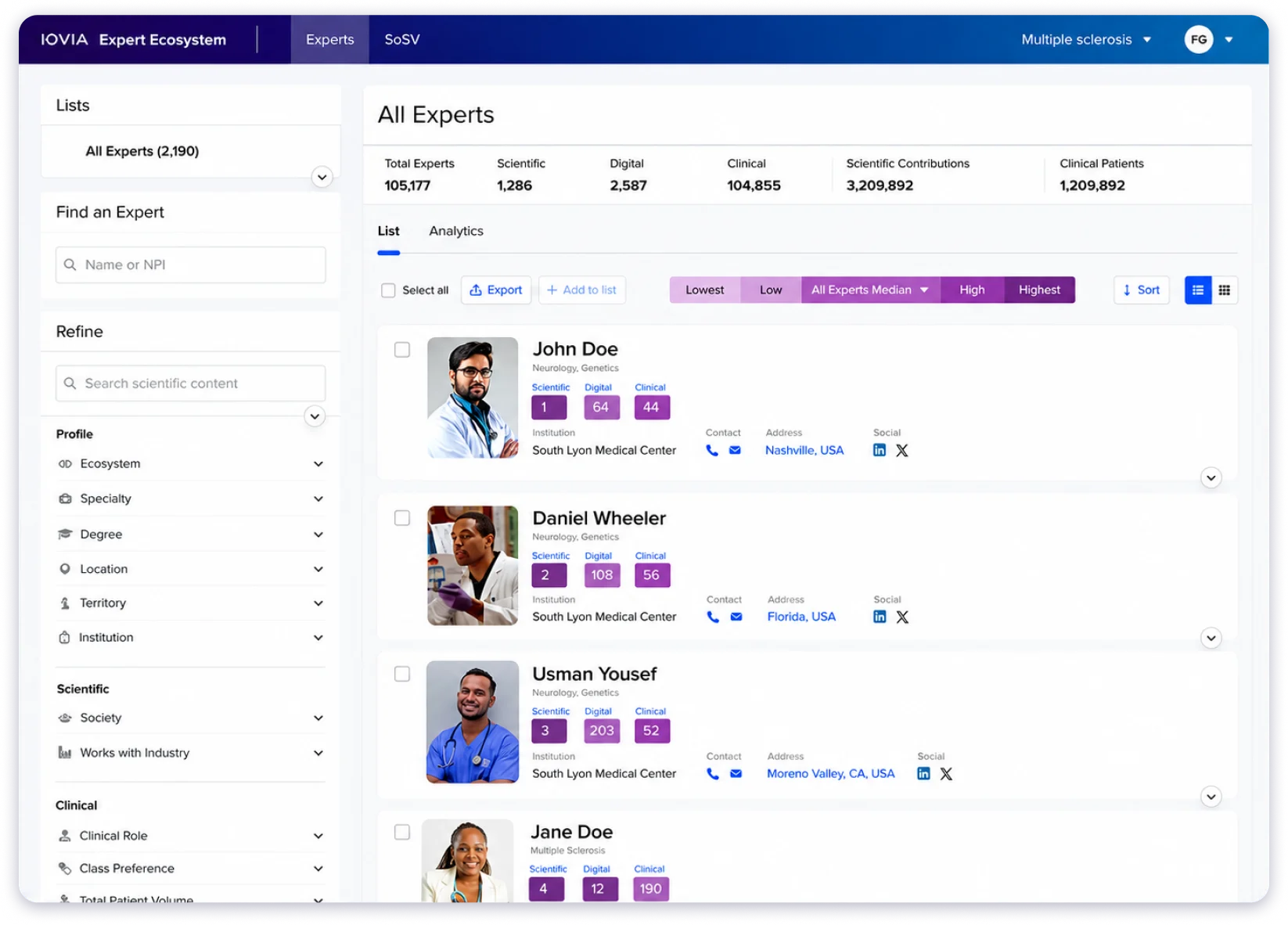
That said, IQVIA is built for healthcare market intelligence, not sales prospecting. While it offers deep insights into prescribing behavior and healthcare trends, it is not designed for finding healthcare professional contact details, such as email addresses, phone numbers, or outbound outreach data.
Pricing: Custom enterprise.
4. Ampliz
Ampliz earns its place on this list because it goes deeper than most healthcare databases when it comes to specialty-level targeting.
The platform includes 5.6M+ physician records across 9K+ US hospitals, with each record containing email, phone number, specialty, facility details, and NPI information.
It also includes a persona builder so you can narrow down exactly the type of healthcare professional you want. That makes it useful when you need precise targeting rather than general lists.
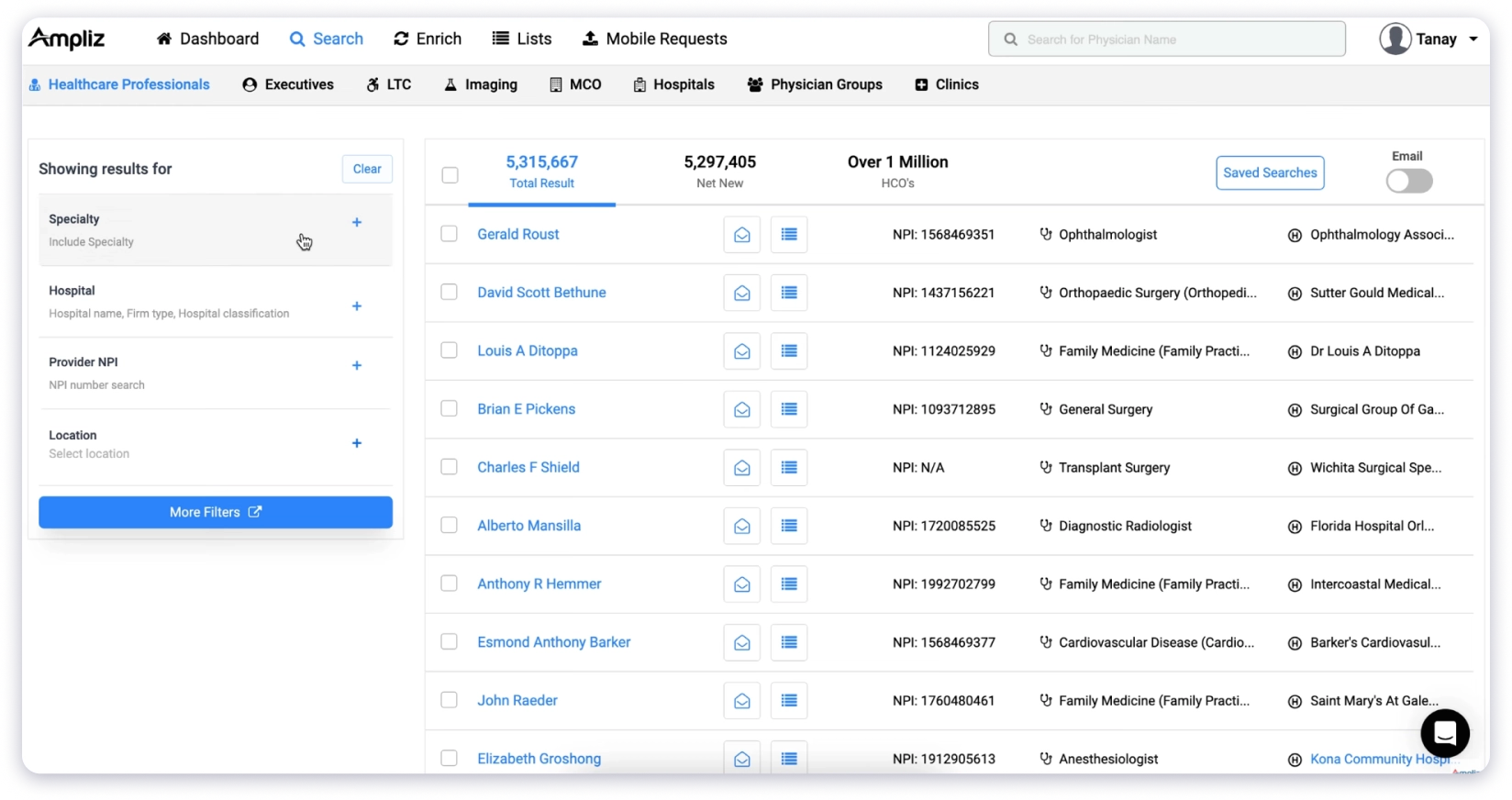
The limitation is clear. Ampliz is mainly focused on the US market, so international coverage is limited. It is also more of a data provider than an outreach tool, meaning you will need to export the contacts and use other tools to engage them. Pricing is credit-based, and the free plan only allows a small number of contacts for testing.
Pricing: Free plan (upto 5 contacts). Paid plans on request.
5. ZoomInfo
ZoomInfo is a common tool many enterprise teams already use, including healthcare teams. The real question is how useful it is for healthcare-specific searches.
It has 260M+ professional records and covers hospitals, health systems, and healthcare executives fairly well. It’s also useful for seeing reporting structures inside organizations, which helps when figuring out who makes decisions in a hospital system.
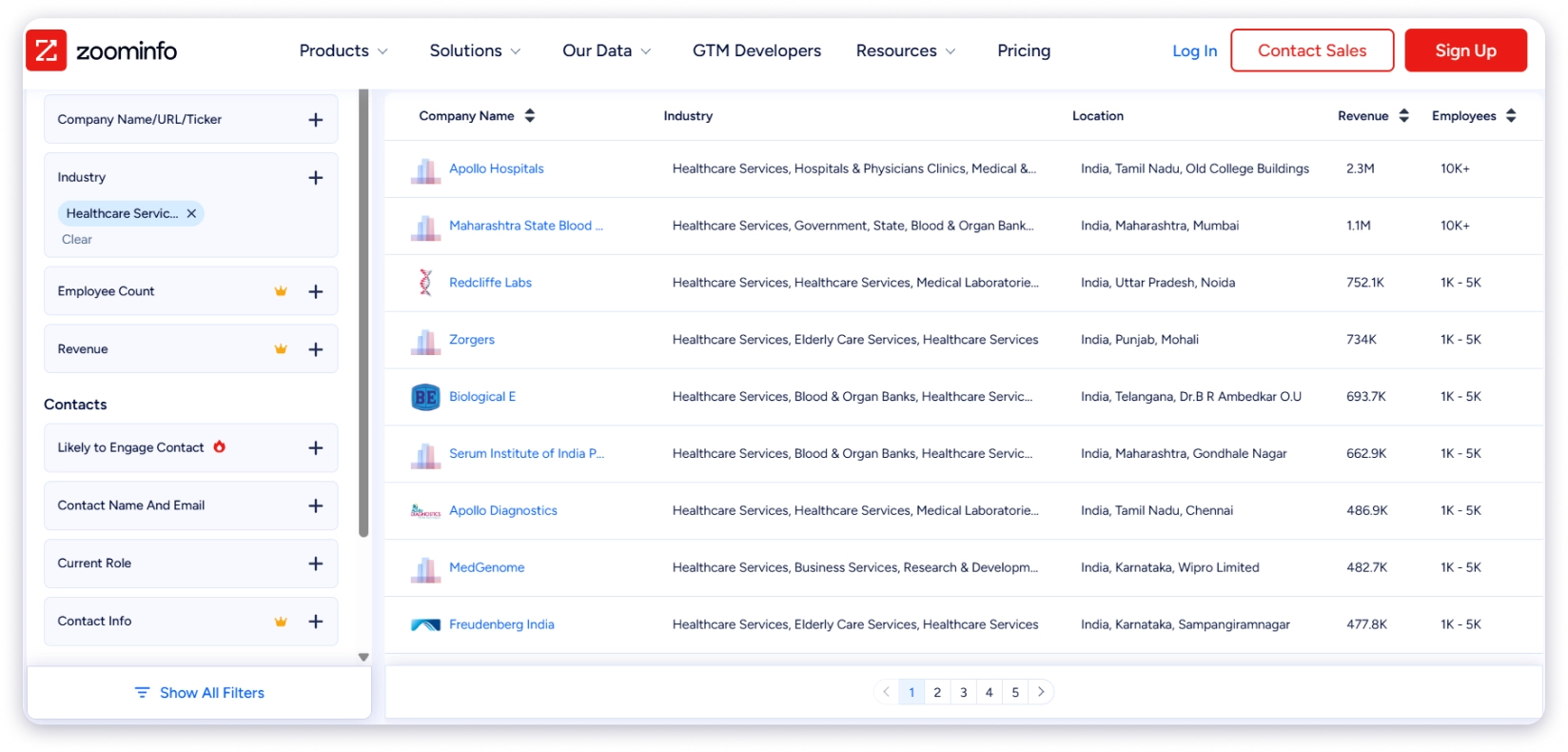
The limitation is targeting. You can’t filter by medical specialty, so you can’t directly search for cardiologists, oncologists, or similar roles. Everything is grouped under general healthcare. Some users also say smaller clinic data may need extra checking.
Pricing: Contact sales.
6. Komodo Health
Komodo Health is not a healthcare contact database. It tracks 330M+ de-identified patient journeys across the US healthcare system, which is impressive, but it solves a completely different problem.
Pharma teams use it for drug launch planning and market access strategy. Payer organizations use it to analyze provider networks. Health system strategists use it to map referral patterns. Useful work, but none of it gets you a single email address.
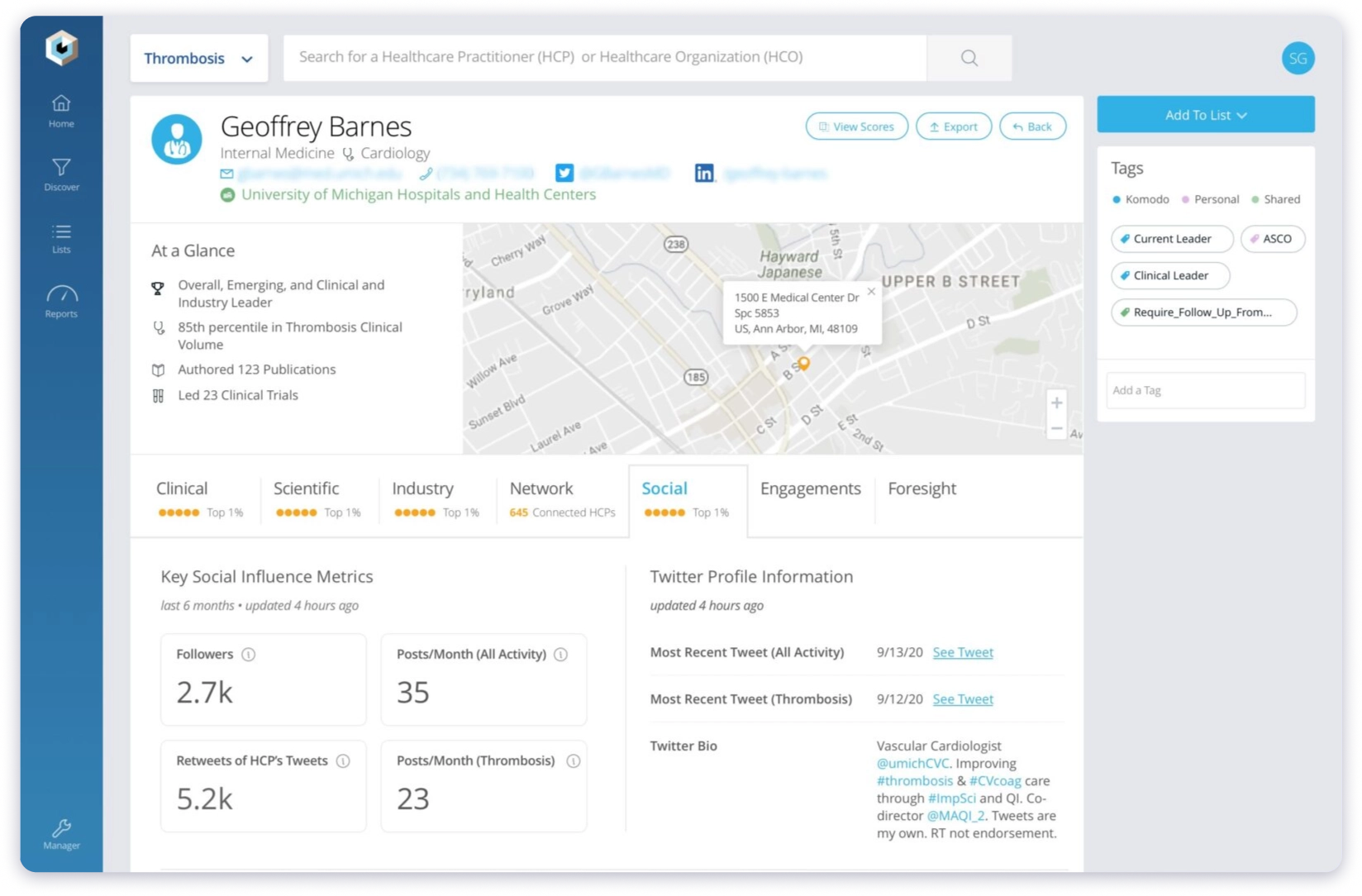
So if you came here looking for verified contact data on physicians, hospital executives, or healthcare decision-makers, Komodo isn’t the tool. Skip it and keep moving.
Pricing: Custom enterprise. Contact sales.
7. MedicoReach
MedicoReach is one of the more traditional ways healthcare data has been bought for years. The process is simple but slow: you contact a vendor, explain what you need, get a quote, and then receive a data file.
It has a large database of 9M+ healthcare professionals across 131 countries, with detailed records that include 78+ data fields per contact such as NPI number, license details, specialty, facility name, and location. Coverage includes the US, Canada, UK, Europe, Australia, and APAC, and data can be segmented by multiple specialties like cardiology, dermatology, oncology, and more.
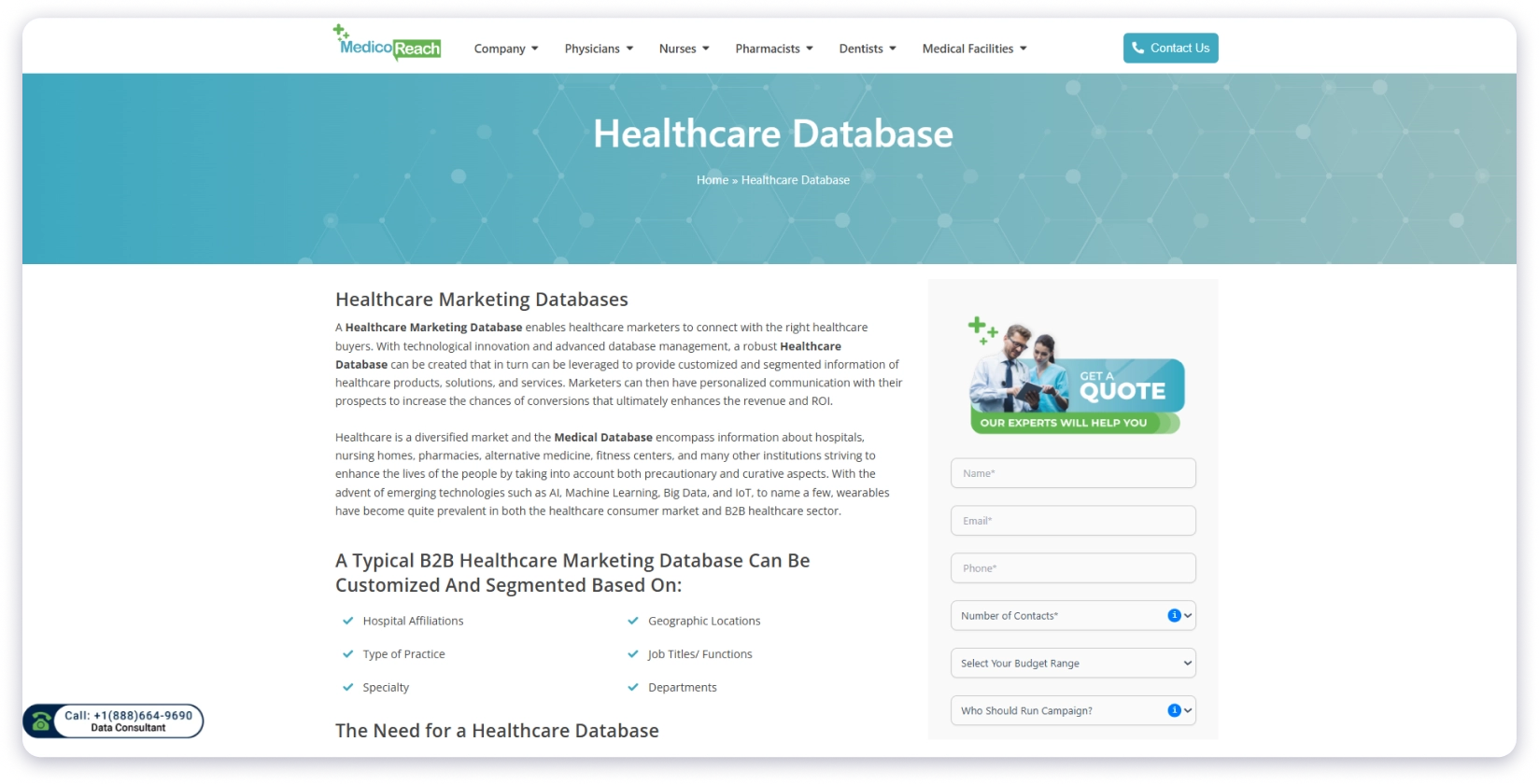
On paper, the dataset is strong and well-structured. The limitation is access. You cannot search or preview the data yourself. Everything is handled through sales requests, and you only see the final dataset after purchase.
This makes it less flexible compared to modern self-serve databases where you can search, filter, and verify contacts instantly before paying.
Pricing: Quote-based. Contact sales.
What Verified Healthcare Contact Data Should Actually Include
A verified healthcare contact database can make healthcare outreach much easier when the data is accurate and up to date.
A good healthcare contact list should include verified email addresses, phone numbers, job titles, healthcare organizations, location details, and other useful targeting information for outreach campaigns.
Here’s what a sample healthcare email list actually looks like👇🏼
Disclaimer: Saleshandy verifies every contact in real time with 92% accuracy on the first reveal, and you’re only charged for contacts that pass verification.
Related guide: How to Build a Physician Email List Using 6 Proven Methods.
Why Saleshandy Stands Out Among Healthcare Database Providers
Many healthcare database providers still rely on outdated contact directories.
By the time outreach campaigns go live, many doctors may have changed hospitals, moved practices, or retired altogether.
Successful healthcare outreach depends on two things: accuracy and timely data.
Saleshandy’s healthcare contact database is built to deliver both. Every record includes up-to-date insights, verified email addresses, and direct phone numbers to help businesses connect with physicians, hospital administrators, and healthcare decision-makers faster and more effectively.
Here’s why buyers trust Saleshandy for healthcare contact data:
1. Efficient Segmentation
The database is segmented across 852+ medical specialties, sub-specialties, practice types, seniority levels, and geographic regions. This allows businesses to create highly targeted outreach campaigns tailored to specific audiences and pain points.
2. Real-Time Data Verification
Every contact goes through AI-powered verification and manual quality checks to ensure the information remains active and accurate. This helps maintain bounce rates below 2%, even for niche specialties.
3. Verified Healthcare Professionals
Every contact belongs to a licensed and actively practicing healthcare professional. This reduces wasted outreach on retired physicians, students, or inactive professionals — a common issue with legacy databases.
4. Compliance-Focused Sourcing
The database is built using public records, professional directories, and opt-in business sources only. No patient data or restricted medical records are included, helping businesses stay aligned with GDPR, CAN-SPAM, CCPA, and HIPAA-aware sourcing practices.
Also read: How to Build a Verified Doctors Email List in the USA.
Frequently Asked Questions
1. What Is a Healthcare Database?
A healthcare database is a collection of verified information about healthcare professionals or organizations. Contact databases store emails, phone numbers, and professional details for doctors, nurses, and hospital executives. Intelligence platforms store claims data, prescribing analytics, and clinical information for research and strategy teams. They serve different buyers with different goals.
2. Is It Legal to Access a Healthcare Professional Contact Database?
Yes. Professional contact data (work emails, job titles, hospital affiliations) is not protected by HIPAA. HIPAA covers patient health information, not business data. Standard communication rules like CAN-SPAM still apply: identify yourself, use accurate subject lines, include a physical address, and make it easy to opt out.
3. How Accurate Are Healthcare Databases?
It depends on the provider and verification process. Healthcare-specific vendors like Ampliz and MedicoReach claim 85-90%+. General directories show documented accuracy issues with healthcare data, with G2 users reporting 25-35% of contacts being outdated. Providers that verify contacts in real time across multiple data sources (like Saleshandy) deliver better results than those pulling from a single source.
4. What Search Filters Matter Most in a Healthcare Database?
Medical specialty is the most important filter for healthcare searches (cardiology, oncology, orthopedics). Beyond that: job title, geographic location (state, city, ZIP), organization size, facility type (hospital, clinic, private practice), and NPI number. The more specific your search, the more relevant your results.
5. How Much Do Healthcare Database Providers Cost?
Searchable contact databases start at $49/mo (Saleshandy). Healthcare-specific vendors like MedicoReach use custom pricing based on list size and specialty. Enterprise directories like ZoomInfo run $15K-$50K+/year. Intelligence platforms like Definitive Healthcare and IQVIA cost $30K-$100K+ annually.
6. Can I Access Healthcare Professional Data Outside the US?
Yes, but coverage varies by provider. Saleshandy covers healthcare professionals across the US, Canada, UK, Europe, Australia, and APAC from one platform. MedicoReach provides data across 131 countries but requires a custom quote for each request. Intelligence platforms like Definitive Healthcare are primarily US-focused.
7. What Is the Difference Between a Healthcare Contact Database and an Intelligence Platform?
A contact database stores verified emails, phone numbers, and professional details so you can find and reach healthcare workers directly. An intelligence platform stores claims data, patient analytics, procedure volumes, and prescribing behavior for market research and strategy. If you need a cardiologist’s email, use a contact database. If you need prescribing trends for a drug launch, use an intelligence platform.