

“Cold calling is dead.”
You’ve probably heard that a hundred times.
It’s an easy conclusion to reach, especially if cold calling has never worked for you.
But the data tells a different story. The average cold calling success rate in 2026 is 2.7%, and 49% of buyers still prefer the phone as their first point of contact.
So, cold calling isn’t dead. Bad cold calling is.
The reps who tell me it doesn’t work are usually making generic, unprepared calls and blaming the channel when those calls fail.
In this guide, I have covered
- How to cold call effectively with proven strategies
- A step-by-step process to turn cold conversations into qualified opportunities
- Frameworks that help structure and improve your calls
- The cold calling framework we use at Saleshandy to prepare and refine outbound conversations
Let’s get into it!
Table of Contents
Key Takeaways
- Build a targeted list: Find verified decision-makers who match your ideal customer profile and show buying intent.
- Research before calling: Spend a few minutes learning one relevant detail about each prospect.
- Prepare before you dial: Know your opening, the problem you solve, and your meeting ask.
- Call at the right time: Reach out on Tuesday to Thursday between 10–11 AM or 4–5 PM.
- Follow a clear call structure: Introduce yourself, discuss a relevant problem, ask questions, and book a meeting.
- Handle objections calmly: Acknowledge concerns first, then explain your value with context.
- Follow up consistently: Combine calls with emails and LinkedIn messages to increase replies.
- Measure and improve: Track your results and review call recordings to get better over time.
4 Strategies for Effective Cold Calling in 2026
Before we get into the step-by-step process, here are the principles that separate reps who book meetings from reps who burn through call lists.
1. Signal-Based Calling Over Volume-Based Dialing
Signal-based calling means only reaching out to prospects who are showing real-time signs of buying readiness.
Instead of calling a random list, focus on companies already showing activity. This could be a recent funding round, a new VP joining, or a team hiring multiple salespeople.
Why does this matter? Only 3 to 5% of companies are ready to buy at any given time. Without signals, you are guessing which ones. With them, you know.
Carlos Iborra, founder of Sales Titans, built his entire cold calling operation around this approach. 49 signal-based calls turned into 20 qualified meetings. Not a better script. Better targeting.
2. Describe Their Problem Better Than They Can
Your cold call hook should never be about your product. It should be about their problem, described so specifically that they think you have been sitting in their team meetings.
Chris Orlob, who helped scale Gong from $200K to $200M+ ARR, breaks this down along with five other cold calling tips that are worth studying before you make your next call.
3. Structure Your Call Around a Pain Point, Not a Pitch
Most reps start cold calls by explaining what their product does. The best reps start by talking about a problem the prospect already understands.
The difference is simple. A generic question like, “Are you struggling with lead generation?” rarely creates interest.
A better approach is to mention a specific situation the prospect might be facing in their daily work.
When the problem feels familiar, the conversation becomes more relevant.
Benjamin Dennehy, known as the UK’s Most Hated Sales Trainer, calls this “leading with the symptom.” The idea is to describe the problem before introducing the solution.
Instead of selling your product immediately, help the prospect recognize the challenge first.
Then ask questions that help them understand the impact of leaving that problem unresolved.
I have found this approach works better because prospects respond to problems they already feel, not products they have never asked for.
4. Multichannel Sequencing
A cold call works better when the prospect has already seen your name before.
From my experience, the most effective cold calling strategy in 2026 is combining phone calls with email and LinkedIn outreach.
The numbers support this approach. Teams that combine email and phone outreach see significantly higher positive reply rates than teams using email alone.
Adding LinkedIn creates even more touchpoints and increases the chances of getting a response.
A simple multichannel cadence looks like this:
- Day 1: Personalized email explaining who you are and why you are reaching out.
- Day 3: Cold call referencing the email. “I sent you a note on Monday about X.”
- Day 3 (voicemail): Follow-up email mentioning the voicemail with more context.
- Day 5: LinkedIn connection request with a short, personalized message.
- Day 7: Second email with a different angle, insight, or case study.
- Day 10: Second call attempt at a different time of day.
The goal is to build familiarity with every interaction. By the time you call on Day 3, your name is already familiar. By Day 10, you are no longer a complete stranger.
How to Cold Call: 9-Step Process Explained for an Effective Cold Call
The reps who consistently book meetings aren’t winging it. They follow the same process every time. The ones who rely on confidence or improve usually burn through call lists without much to show for it.
Here’s the 8-step cold calling process I recommend.
Step 1: Build a Targeted Cold Calling List
A successful cold call starts before you ever dial a number.
The biggest mistake sales reps make is treating every contact the same.
Calling hundreds of random prospects with the same pitch usually leads to low connection rates and poor conversations.
I see this play out across teams on Saleshandy every single week.
The goal is not to call more people. The goal is to call the right people with a relevant reason to start a conversation.
Start by defining your Ideal Customer Profile (ICP).
Identify companies that match your target market, then find the decision-makers who are most likely to have the problem your product solves.
Your cold calling list should include:
- Prospect name
- Job title
- Company name
- Phone number
- Email address
- Industry
- Company size
- Relevant notes or talking points
This information helps you personalize your opening and avoid sounding like another generic sales call.
Prioritize Prospects Showing Buying Signals
Not every prospect deserves the same level of effort. Before picking up the phone, prioritize accounts that show signs they may have a relevant need.
Look for signals like:
- Recent funding: Companies that recently raised capital often invest in new tools and processes.
- Hiring activity: Teams hiring salespeople may be looking to improve their pipeline generation.
- Leadership changes: New executives often introduce new strategies and priorities.
- Business expansion: Growth usually creates new challenges that require solutions.
- Competitor usage: Companies already using similar solutions understand the value of the category.
- Content engagement: Prospects interacting with your website or resources are warmer than completely cold contacts.
Calling these prospects first helps you spend your time where conversations are more likely to happen.
Make Sure Your Contact Data Is Accurate
Even the best cold calling strategy fails if you are calling outdated numbers.
Contact data decays fast. People switch roles, change companies, update their numbers. A list from last quarter could already have 20 to 30% invalid entries. I see this mistake more than any other.
Use a B2B contact database tool like Saleshandy to get verified details quickly.
Let me walk you through a real example. Say you sell a software product and you want to reach IT decision-makers at mid-market companies. Here is exactly how I would build that list:
- Open Saleshandy Lead Finder. Sign up and click the search icon in the left sidebar. You get access to 852M+ verified contacts.
- Set location to United States (or whichever region you are targeting).
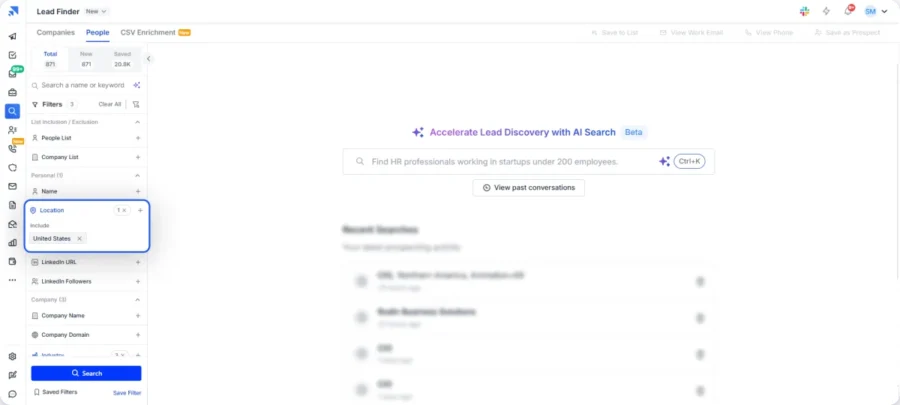
3. Set job title to “IT Director” or “Head of IT” or “CTO” or “VP of Technology.”
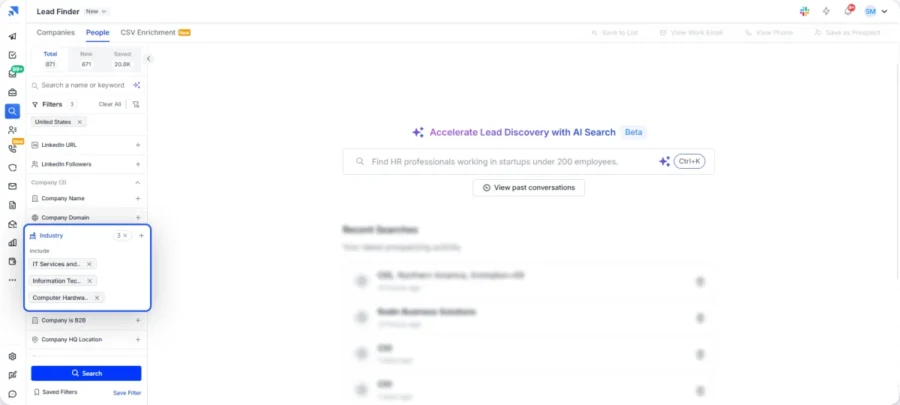
4. Set industry to “Information Technology” or “Software.”
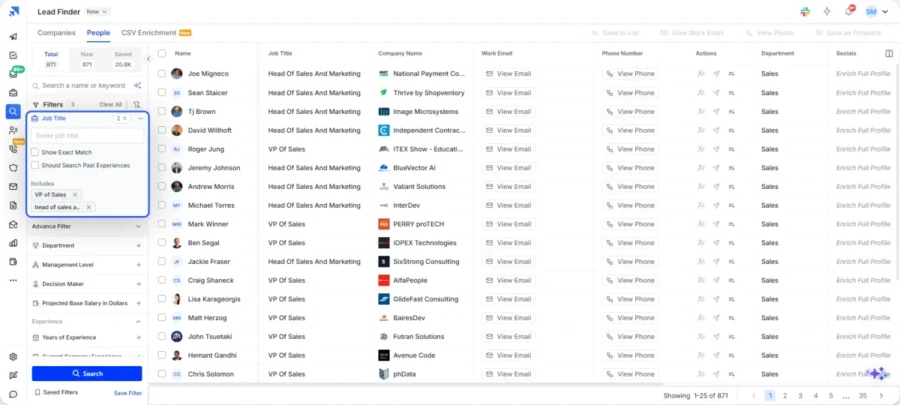
5. Reveal verified contacts. Each number is verified in real time, so you are not dialing dead leads.
You now have a list. Now you need a way to actually call through it without losing momentum.
If you are using Saleshandy, the dialer is already inside the platform.
Call from any prospect profile without opening another tool. Your list, your dialer, and your notes stay in one place.
Step 2: Research Before You Dial
Every cold call needs a clear reason behind it. It should not be just another product pitch that the prospect has heard hundreds of times before.
That reason comes from proper research. Before making the call, find one specific detail about the prospect or their company that you can mention in the first few seconds.
For example, if a company recently hired a new sales leader, expanded into a new market, or raised funding, you can use that information to start a more relevant conversation.
This small effort changes the conversation completely.
Instead of sounding like a stranger trying to sell something, you sound like someone who understands their business and their current situation.
Without research, your call feels like an interruption. With the right context, it becomes a relevant conversation.
The top-performing sales reps I know follow this process consistently.
They spend time understanding the prospect before reaching out.
This simple habit is one of the biggest differences between average callers and successful sales professionals.
Step 3: The 30-Second Opening Framework
The first 30 seconds of a cold call decide whether the prospect keeps listening or moves on.
A strong opening does three things: it builds trust, creates curiosity, and gives the prospect a reason to stay on the call.
Start With Your Full Identity
Introduce yourself with your full name and company name.
It sounds more professional and confident than a vague introduction.
Skipping your company name often creates uncertainty and gives the prospect a reason to ask, “Who is this?”
Break The Pattern
The prospect was not expecting your call, so acknowledge it.
A permission-based opener like, “I’ll be upfront, this is a cold call.
Do you want to hang up or give me 30 seconds?” may sound risky, but it works because it gives the prospect control.
When people feel they have a choice, they are more likely to listen.
Lead With Your Reason for Calling
Explain why you are calling within the first two sentences.
Must focus on why you reached out to this specific person, not what your product does.
A simple phrase like, “The reason I’m calling is…” keeps the conversation clear without sounding aggressive.
❌ Avoid These Common Mistakes
- Avoid opening with “How are you today?” — it immediately sounds scripted.
- Avoid asking “Is now a bad time?” — it makes it easier to end the call.
- Avoid saying “I just wanted to check in” — it gives no reason to continue.
A strong first 30 seconds creates momentum for the rest of the call. A weak opening makes even the best sales pitch difficult to recover.
Step 4: Choose the Best Time to Cold Call
Timing plays a bigger role in cold calling success than most reps realize.
The same script and strategy can get very different results depending on when you make the call.
In my experience, Tuesday, Wednesday, and Thursday usually work best for cold calls.
Monday mornings are often packed with internal meetings, while Friday afternoons are when many people start wrapping up their week.
The best calling windows are typically 10–11 AM and 4–5 PM in the prospect’s local time zone.
One cold calling habit I always recommend is protecting your calling time. Scattered calls throughout the day rarely create momentum.
Instead, block 60–90 minutes, prepare your prospect list, and focus only on making calls.
After your first few calls, you start finding your rhythm.
By the twentieth call, you usually know whether your message is connecting or needs improvement.
Step 5: Execute the Call
This is where all your cold calling preparation comes together.
The call typically lasts under two minutes and follows a tight structure. I’ve broken it into four parts for better understanding.
Cold Call Script Template
The Opener (First 10 Seconds)
Start with your name, your company, and the reason for the call.
In that order.
“Hey [Name], this is [Full Name] from [Company]. The reason I’m calling is…”
Keep it simple.
Avoid openers like “How are you?” or “Is now a bad time?” Research across 300M+ cold calls shows that asking “Is now a bad time?” can reduce booking rates by 40%.
The first few seconds decide whether they keep listening.
The Hook (Next 30 Seconds)
This is where you earn their attention.
Do not lead with your product. Lead with a problem they might already be dealing with.
The goal is to make them think, “Yes, that is something we are facing.”
One technique that works well is mirroring what they say.
If they say, “My sales team manually finds leads,” respond with:
“Your sales team finds all their leads manually?”
That simple reflection makes the problem feel more real.
Then ask:
“Does that sound familiar, or is your team handling it differently?”
Discovery (Next 45 Seconds)
Now let them talk.
Your job is not to pitch. Your job is to understand.
Ask open-ended questions and listen carefully. The best cold callers spend more time listening than explaining.
Successful cold calls often last longer because there is a real conversation happening, not because the rep is delivering a longer pitch.
The Close (Final 15 Seconds)
Do not try to sell the entire product on the first call.
Sell the next conversation.
Make the ask specific:
“It sounds like this might be worth exploring further. Would you be open to a 15-minute conversation on [specific day]?”
The best cold calling advice is simple:
Don’t sell the product.
Sell the time to understand whether there is a fit.
Step 6: Handle Objections
Objections are not a “no.” They are a sign the prospect is interested but does not fully understand yet. Your job is to give them that understanding.
The best framework I have seen for handling objections is Feel, Felt, Found.
The Feel, Felt, Found Framework
One simple framework I recommend for handling objections:
- Feel: Acknowledge their concern and show that you understand.
- Felt: Explain that others in a similar position have had the same concern.
- Found: Share what those people discovered after looking deeper.
Example:
“That makes sense. I’ve heard that concern from other [persona/title] as well. What we usually find is that once they look at [specific outcome], the situation is a little different.”
Here are some common objections and how to handle them.
“I’m Not Interested”
Usually, this is an automatic response. Don’t argue. Ask a better question.
“Totally fair. Is that because you already have something in place, this isn’t a priority right now, or you don’t see a need for it?”
The goal is to understand the reason behind the objection.
“Send Me an Email”
Agree, but create a reason for the follow-up.
“Happy to send something over. Before I do, can I ask one quick question so I can make sure it’s actually relevant?”
“I’m Busy Right Now”
Respect their time.
“Completely understand. Would it make sense to reconnect for 10 minutes on [specific day] instead?”
“We Already Use a Competitor”
This is actually useful information.
They already understand the problem and have a budget allocated.
Ask:
“That makes sense. What do you like most about your current solution? And is there anything you wish it did better?”
“It’s Too Expensive”
Don’t debate price on the first call.
Bring the conversation back to value.
“I understand. That’s exactly why it might be worth a quick conversation. If the numbers don’t make sense, we’ll know quickly.”
“How Did You Get My Number?”
Be transparent.
“I found your contact information through our prospecting database. I reached out specifically because [reason].”
Avoiding the question creates more distrust.
“I’m Not the Right Person”
Turn it into an opportunity.
“No problem. Who would be the best person to speak with about [specific problem]?”
A referral from inside the company is always better than another cold call.
“We Don’t Have a Budget”
Don’t treat this as a final no.
It is often a timing issue.
“That makes sense. When does your team usually plan for the next budget cycle? I’d be happy to reconnect when the timing is better.”
The goal with objections isn’t to win an argument.
It’s to understand what is really stopping the conversation.
Step 7: Close and Follow Up
If the call goes well, the next step should be clear.
Don’t end a good conversation with “I’ll send you some information.” Be specific about what you want and confidently ask for it.
This is where I see many reps lose opportunities. They create interest but never guide the prospect toward a next step.
Here are three closing tactics that consistently work:
Tactic 1: Let Them See the Product
Most prospects understand the value faster when they see the product in action.
Instead of trying to explain everything over the phone, show them.
Ask if they have time for a quick walkthrough.
Tactic 2: Use the “I’m Wasting Your Time” Approach
Sometimes the best way to close is by acknowledging that the cold call itself is not the best place to explain everything.
For example:
“Look, [first name], rather than me rambling on at you, would you be against seeing the platform over a 15-minute call? I could run personalized searches based on your target market and show you the data quality firsthand.”
Tactic 3: Offer Something Useful
Give the prospect something valuable they can take away, even if they don’t buy.
This could be a data sample, a quick audit, or a targeted lead list.
For example:
“Do you have any objection to setting up a 10-minute call where I can quickly build you a free lead list based on your target market?”
If the prospect isn’t ready to make a decision, don’t force it.
Set a follow-up instead.
Many successful deals don’t happen on the first call. They happen after the third or fourth touch.
A multichannel approach using calls, emails, and LinkedIn consistently outperforms relying on a single conversation.
Step 8: Review and Improve
The work doesn’t stop when the call ends.
After every call, take two minutes to review what happened.
What worked? What fell flat? Where did you lose control of the conversation?
This is a habit I recommend every rep build because small improvements compound over time.
Track the core cold calling metrics that actually matter:
- Dials made.
- Connects.
- Conversations.
- Meetings booked.
The post-call workflow matters just as much as the call itself. Here is the process I follow:
- Meeting booked: Send the calendar invite within two minutes while the conversation is still fresh.
- Interested but not now: Add them to a multichannel nurture sequence and stay on their radar.
- Voicemail left: Send a follow-up email within 30 minutes and reference the voicemail.
- Hard no: Tag the reason, log the details, and revisit in 90 days.
One habit separates top performers from everyone else: reviewing their own calls.
At the end of each calling block, spend 10 minutes listening to your recordings. Most reps have no idea how they actually sound until they hear themselves.
I have made this a non-negotiable practice for my teams.
One hour of reviewing your own calls will teach you more than most sales training sessions.
Cold Calling Compliance and Regulations
Cold calling is legal.
But there are rules you need to follow depending on where you are and where your prospect is.
Always ensure before start dialing, not after they get a complaint.
If you or the prospect is in the United States:
You must follow the FTC Telemarketing Sales Rule. Here is what that means in practice:
- Only call residential numbers between 8 AM and 9 PM in the prospect’s local time.
- The call must connect to a live rep within two seconds of the prospect answering. No long pauses or dead air.
- Keep records of all calls, including how many are answered, abandoned, and unanswered.
- Do not call anyone listed on the National Do Not Call Registry. Scrub your lists against it before every campaign.
Call Recording and Consent Requirements
If you are recording calls for coaching or quality review, know your consent requirements before you hit record.
- One-party consent states: Only one person on the call needs to know the call is being recorded.
- Two-party consent states: Both parties must agree. Disclose recording at the start of the call.
- GDPR (EU contacts): You need explicit consent before recording any call with a European prospect.
Best practice: disclose recording at the start of every call regardless of location. It builds trust and keeps you covered.
If you or the prospect is in Europe:
You must follow GDPR regulations. These cover how you collect, store, and use personal data. Non-compliance can lead to significant fines and long-term reputation damage.
For other regions:
Research the specific cold calling regulations in your location and your prospect’s location. Laws vary by country and sometimes by state.
💡 Practical tip: If you are using a verified B2B database like Saleshandy Lead Finder, it is GDPR-compliant and scrubs data against DNC registries automatically. You still need to know the rules. But the right database takes care of most of the heavy lifting.
Start Cold Calling Today
Cold calling requires the right tools.
You need accurate data, a system to track outcomes, and a platform to manage your cadence.
Three categories matter:
1. Data & Prospecting
Before you make a call, you need to know who you are calling.
That means verified phone numbers, direct dials, company information, buying signals, and enough context to know which accounts are worth your time.
It helps your team spend time on prospects who actually have a reason to listen.
2. Dialer & Call Execution
You need a dialer that lets you call efficiently without switching between tabs and tools.
Features like click-to-dial, local presence, and call recording make a real difference in connect rates and post-call review.
3. Multichannel Sequencing
Your cold calling tool should automate follow-up across email, phone, and LinkedIn.
If you are managing calls in one tool, emails in another, and LinkedIn in a third, you are losing time and context on every prospect.
Most teams end up paying for three or four separate tools to cover these categories.
That is where Saleshandy is a complete multichannel outbound platform that helps you run the entire process from one place.
With verified data, a built-in dialer, and multichannel sequencing, your team can:
- Connect with the right people. Access 852M+ verified contacts with direct phone numbers and reach decision-makers directly.
- Call without switching tools. Use the built-in dialer with local presence to increase pickup rates and keep your workflow in one platform.
- Follow up across channels. Combine calls, emails, and LinkedIn in a single sequence so no prospect falls through the cracks.
- Skip manual work. AI call summaries capture key takeaways and next steps automatically after every conversation.
Ready to turn your cold calls into booked meetings?
Frequently Asked Questions
1. How many cold calls should I make per day?
Aim for 40 to 60 targeted dials per day. That typically gives you 5 to 8 live conversations and 1 to 2 booked meetings. If you are making 100+ dials and getting nothing, the issue is not volume. It is your targeting or your message.
2. What is the average cold calling success rate in 2026?
The industry average is 2.7%. But that number includes all the reps making unprepared, generic calls. Top-performing teams that follow a structured process convert at 6 to 11%. The difference is preparation, signal-based targeting, and multichannel follow-up.
3. What is the best cold call opening line?
Start with your full name, your company, and why you are calling. That is it. Research across 300 million+ calls shows that context-first openers are 2.1x more likely to book a meeting. Avoid “Is now a bad time?” as it actually reduces your booking rate by 40%.
4. How do I get past gatekeepers?
Have a one-sentence reason for your call that the gatekeeper can pass along. Something like: “I’m calling [Name] because I noticed their team just [trigger event], and that is exactly what we help companies with.” If you cannot explain your reason in one line, your message is not tight enough.
5. Should I use a cold calling script?
Yes, but treat it as a framework, not a teleprompter. Have your opener, one discovery question, and your closing ask ready before you dial. Let everything else be a real conversation. The best cold callers sound natural, not scripted.
6. Is cold calling legal?
Yes. In the US, you need to follow the FTC Telemarketing Sales Rule and scrub your lists against the National Do Not Call Registry. In Europe, GDPR applies. For other regions, check the local regulations before you start dialing. I have covered this in detail in the cold calling regulations section above.
7. What tools do I need for cold calling?
At minimum, you need a dialer with local presence, a way to find verified phone numbers, multichannel sequencing, and call recording. Saleshandy combines all of these in a single platform so you do not need to juggle multiple tools.