


If you’re looking for a Hunter.io alternative, you’re probably after a tool that does more than find and verify emails.
Hunter built its name on email finding and verification, and it does that well. It also gives you enrichment, technical signals, and basic email sequences.
But outbound has evolved.
Teams now need more targeted data, phone numbers, advanced cold emailing, multichannel outreach, and deliverability tools.
That is where Hunter gets limited.
That is why I compared 11 popular Hunter.io alternatives based on data quality, pricing, outreach features, ease of use, and overall value.
And I also analyzed 1,401+ real user reviews across G2, Capterra, and Reddit.
By the end of this blog, you’ll know which Hunter.io alternative is the best fit for your workflow, budget, and outbound goals.
Let’s get into it.
Best Hunter.io Alternatives – TOC
TL;DR: Best Hunter.io Alternatives at a Glance
These 11 tools each beat Hunter.io in a specific area, from verified data and phone numbers to running the full outreach Hunter cannot.
Here’s the quick side-by-side.
| Hunter.io Alternative | Where It Outshines Hunter.io | Pricing (billed annually) |
|---|---|---|
| Saleshandy TOP PICK |
Best for teams that need higher email accuracy, broader contact coverage, and built-in outreach | $49/mo |
| Snov.io | Adds cold email sequences on top of finding and verifying | $29.25/mo |
| Lusha | Direct phone numbers and mobile dials pulled from an extension | $37.45/mo |
| VoilaNorbert | Simple bulk email finding with a sending add-on | $49/mo |
| Findymail | Verified-only emails with Clay-style automation | $99/mo |
| Prospeo | Lower-cost finding with LinkedIn and mobile lookups | $49/mo |
| Cognism | GDPR-compliant European phone and mobile data | Custom quote |
| UpLead | Real-time verification with an accuracy guarantee | $99/mo |
| Instantly | A high-volume sending engine, not just a finder | $47/mo |
| RocketReach | Personal emails, phones, and API across a bigger database | $33/mo |
| Apollo | A large database with sequences, a dialer, and intent data | $49/seat/mo |
Why People Look for Hunter.io Alternatives
After going through real Hunter.io reviews across G2, Capterra, and Reddit, these are the reasons that come up most often when people switch.
1. Limited Monthly Credits
The most frequent complaint is that credit allowances run out fast and don’t scale with growing prospecting needs.

Common issues:
- The free plan gives just 50 credits a month, gone in one session
- Every search plus verify uses about 1.5 credits per good contact
- Credits run out fast for teams running regular cold email campaigns
- The Growth plan is $104 a month, and it still only finds emails
2. Inconsistent Email Discovery Accuracy
Verification is strong, but users say the email itself misses, especially for smaller or niche companies.
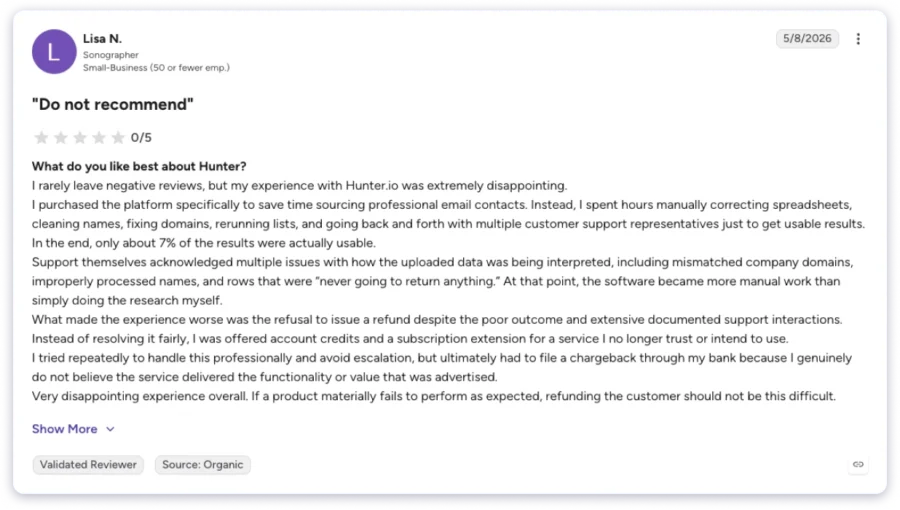
Common issues:
- You get a confidence guess, not a confirmed email
- Weak results for small and niche companies, where email data is limited
- Guessing the format (first.last@company.com) often gets it wrong
- Only about one in three lookups returns an email
3. No Built In Cold Email Automation
Teams outgrow Hunter when they need to actually run campaigns, not just find addresses.

Common issues:
- No real email sequences or automatic follow-ups
- Basic campaigns only, no A/B testing or lead scoring
- No email warm-up to protect your inbox
- Weak CRM, so you need another tool to manage replies
4. Expensive for What You Get
Users question the price against a narrow feature set compared with all-in-one alternatives.
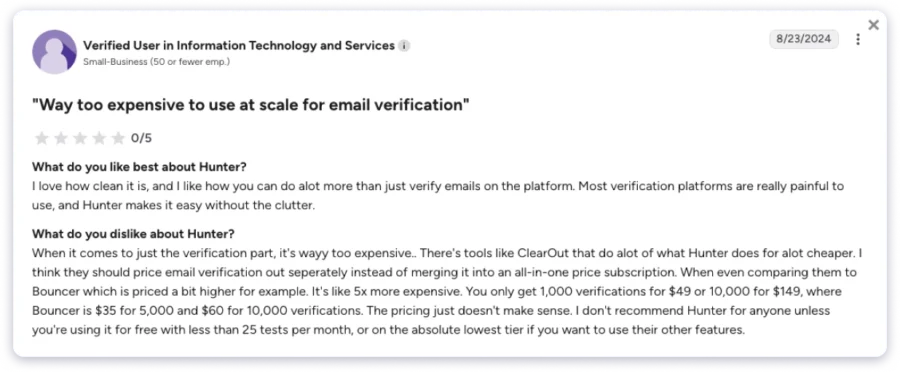
Common issues:
- $1,248 a year for a tool that only finds and verifies emails
- You still pay for a separate sending tool and a warm-up tool
- No outreach is included in any plan
- Each extra email account costs $10 more a month
5. Weak Regional Coverage
Several users report data gaps outside the US and major European markets.

Common issues:
- Best data is in the US and Western Europe
- Limited coverage across Asia-Pacific
- Weaker data in smaller European countries
- Missing contacts in emerging markets
6. Limited Integrations and Workflow Tools
Hunter focuses on finding and verifying, so teams miss the workflow features a full prospecting motion needs.
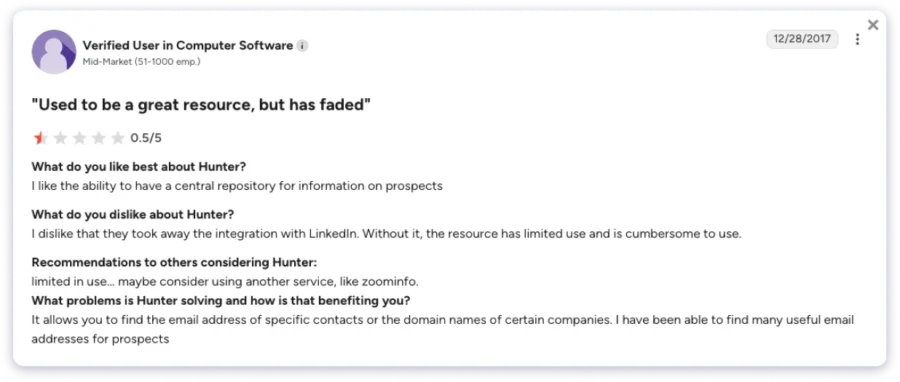
Common issues:
- Basic CRM connections, and no Salesforce on lower plans
- No lead scoring or extra contact data beyond email
- No multichannel outreach or automatic follow-ups
- You end up using several tools to do one job
11 Best Hunter.io Alternatives Compared
Below is a detailed breakdown of 11 tools that stand out as strong Hunter.io alternatives.
You’ll see what each one does well, where it falls short, and which tool is the best fit based on your specific reason for switching.
Let’s get into the details.
1. Saleshandy
Saleshandy is the strongest Hunter.io alternative if you need a bigger contact database and the outreach tools to actually use it.
Hunter is a solid email finder. But when I tried finding emails for cold outreach, I kept hitting its limits.
I ran the same list through Saleshandy to compare, so this comes from real use, not a feature sheet.
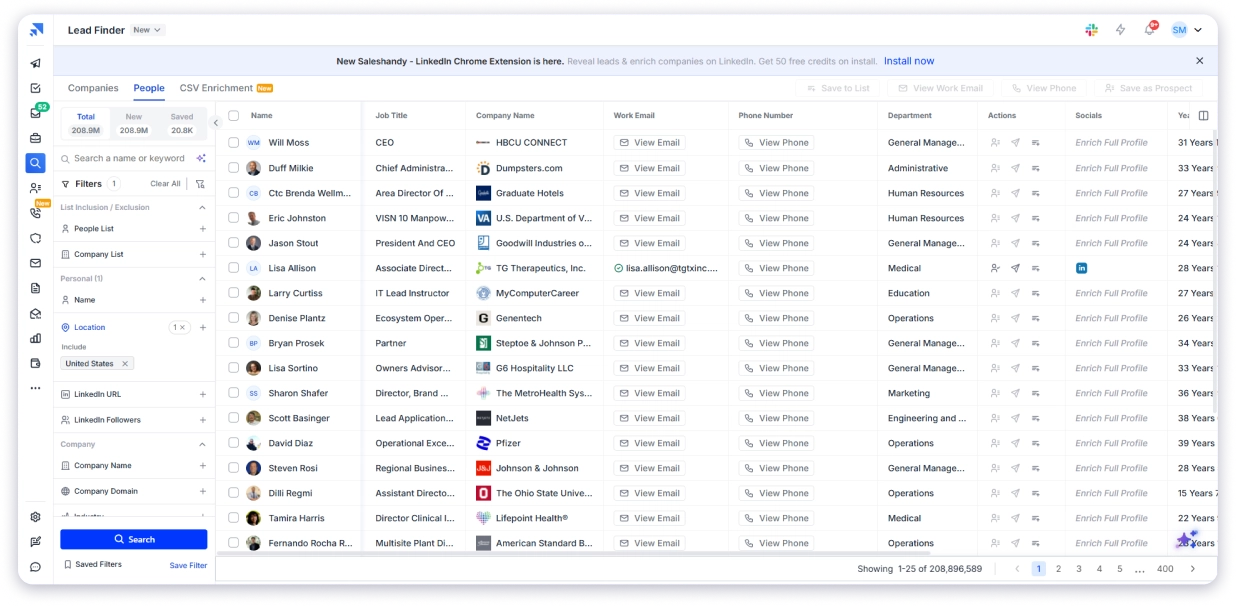
The biggest difference is data quality. Hunter often relies on email patterns and confidence scores, so I still spent credits on unverified contacts.
Saleshandy works differently. Every contact is verified in real time with Waterfall Enrichment before it is revealed. If an email cannot be verified, I do not lose a credit.
The database is bigger, too. It gives you access to 852M+ verified contacts across 42M+ companies, roughly 8x Hunter’s coverage.
I also found stronger coverage for smaller businesses and regions like MENA, Asia-Pacific, and Latin America.
The feature that saved me the most time was AI Search. I typed a prompt like “funded SaaS founders with 50+ employees,” and Saleshandy built the prospect list for me. Hunter has nothing comparable.
When I needed more precision, I used 75+ filters to narrow prospects by buyer intent, hiring activity, funding, and technographics.
The biggest gap came after finding the lead. Hunter helped me find emails, but I still needed separate tools for warm-up, LinkedIn outreach, calling, and campaigns.
Saleshandy kept everything in one place.
I found verified contacts, warmed my inboxes, and launched email, LinkedIn, and calling campaigns from the same dashboard.
That is why Saleshandy is my top Hunter.io alternative. It helped me find more verified contacts and actually turn them into conversations.
Hunter.io vs Saleshandy: How They Compare
The factors below are the ones that come up most in real Hunter.io reviews.
Key Features
- Lead Finder with 852M+ contacts and 42M+ companies
- AI Search that builds lists from a plain-English prompt
- 75+ filters for technographics, buyer intent, funding, and hiring signals
- Waterfall Enrichment across 9 providers for verified emails and phone numbers
- Verified-only credits, so you never pay for unverified data
- CSV enrichment and export straight into your sequences
Pricing
- Lead Starter: $49/mo
- Lead Pro: $79/mo
What Users Have to Say?
“Saleshandy stands out for its ease of use, intuitive interface, and powerful automation features. Setting up cold email sequences is quick and seamless, and the platform offers AI powered tools like the Sequence Copilot and Lead Finder, which save time and improve targeting.”
Read the full review on G2 →2. Snov.io
Snov.io is one of the closest alternatives to Hunter.io if you want email finding and outreach in one platform.
You get a 500M+ contact database, an email verifier, drip campaigns with unlimited follow-ups, warm-up slots, and a lightweight CRM, all on a shared credit system.
While exploring the product, I was impressed with the drip campaign builder.
It shows your sequence in a clean flowchart style, making it easy to visualize how your outreach will play out before you launch it.
Snov.io also includes a full deliverability toolkit that Hunter does not offer at all: email warm-up, sender scoring, and bounce detection.
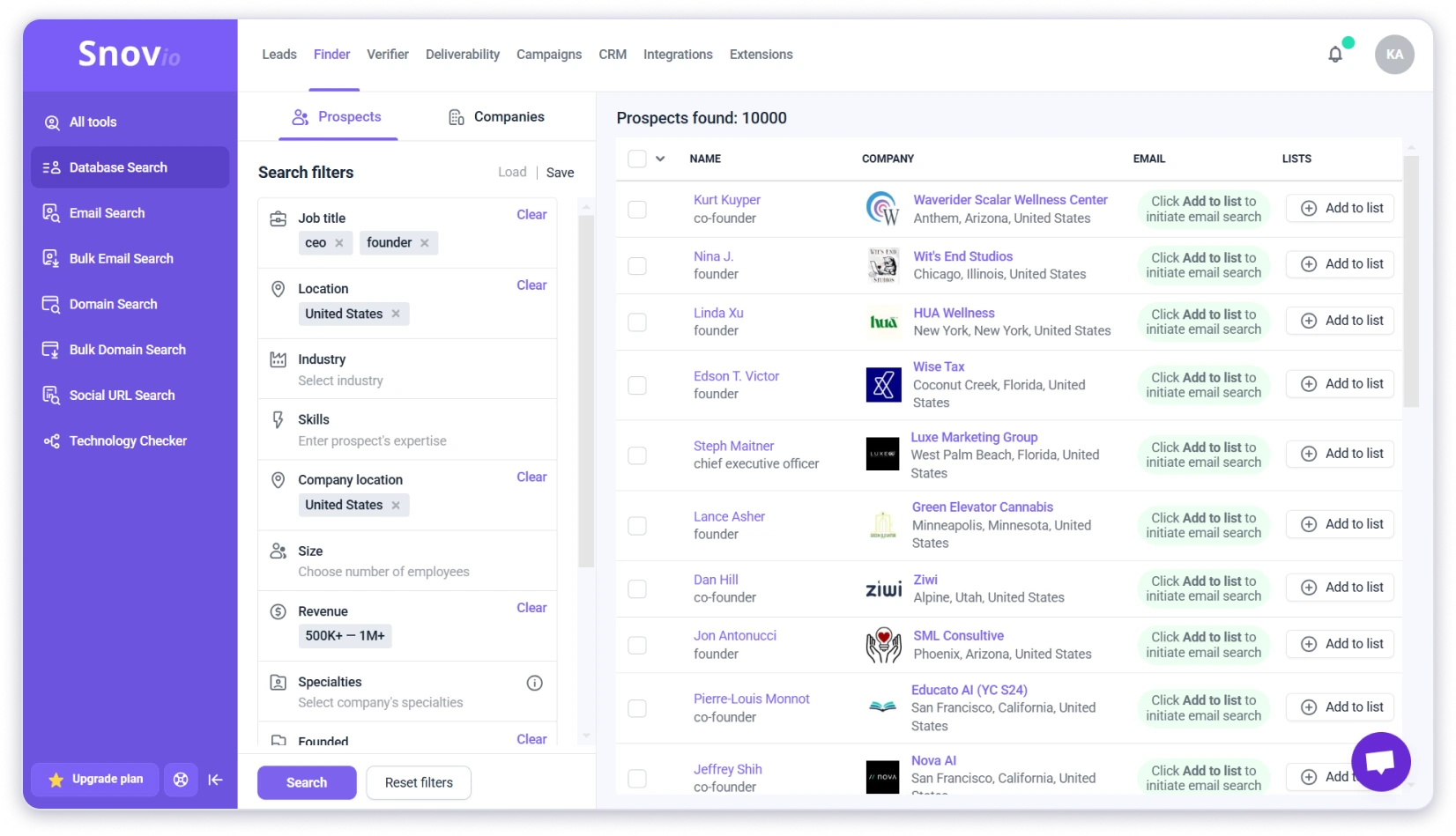
The biggest limitation I noticed was the pricing model.
Credits and recipients have separate limits, making usage harder to track each month.
I also found it frustrating that re-saving an existing contact still consumed credits. That can slowly increase costs during larger prospecting campaigns.
Another drawback is LinkedIn automation. It costs an extra $69 per slot each month because it isn’t included in any plan.
So, Snov.io is a strong Hunter.io alternative for email prospecting and basic outreach.
However, Saleshandy offers better value if you also need calling and LinkedIn automation.
Key Features
- Email finder and verifier on a shared credit pool
- Drip campaigns with unlimited follow-ups and sender accounts
- Email warm-up is included on paid plans
- Basic CRM and 5,000+ integrations
Pricing
- Trial: free
- Starter: $39/mo monthly, or $29.25/mo annual
- Pro: from $99/mo monthly, or $74.25/mo annual, scales up
For a full plan breakdown, see my Snov.io pricing guide.
Snov.io vs Hunter.io: Who Is Better?
If you want to weigh more options, see my full list of Snov.io alternatives.
What Users Have to Say?
“I think Snov.io offers an incredibly versatile range of use cases. The platform basically covers everything you need for a well structured outreach process.”
Read the full review on G2 →3. Lusha
Lusha solves one of Hunter.io’s biggest gaps by giving you access to B2B phone numbers.
Its Chrome extension pulls direct dials, mobile numbers, and email addresses straight from LinkedIn profiles. If your outreach depends on cold calling, that’s something Hunter simply doesn’t offer.
What I liked most was the speed. I could open a prospect’s LinkedIn profile, click once, and instantly see their contact details.
That makes Lusha especially useful for account-based prospecting, where every minute saved helps.

The biggest limitation is that Lusha only helps you find contact data.
It doesn’t include email sequences, warm-up, or outreach, so you’ll still need another tool to contact prospects.
I also found that phone number coverage varied depending on the region. That’s worth testing before committing to a larger plan.
Hence, Lusha is a strong choice if phone numbers are your main reason for leaving Hunter.
Just remember you’re paying for contact data, not a complete outbound platform.
Key Features
- One-click contact reveals via Chrome extension on LinkedIn
- Direct dials and mobile numbers on all plans
- Buyer intent signals on up to 5 topics
- CRM integrations (HubSpot on Pro, Salesforce on Scale)
- CSV bulk enrichment on Pro and higher
Pricing
- Free: $0
- Starter: $37.45/mo
- Pro: $52.45/mo
- Premium: $299.95/mo
- Scale: custom
For a full plan breakdown, see my Lusha pricing guide.
Lusha vs Hunter.io: Who Is Better?
For more picks in this space, here is my full list of Lusha alternatives.
What Users Have to Say?
“Really good tool to find contact information quickly. The Chrome extension makes it easy to get emails and phone numbers directly from LinkedIn.”
Read the full review on G2 →4. VoilaNorbert
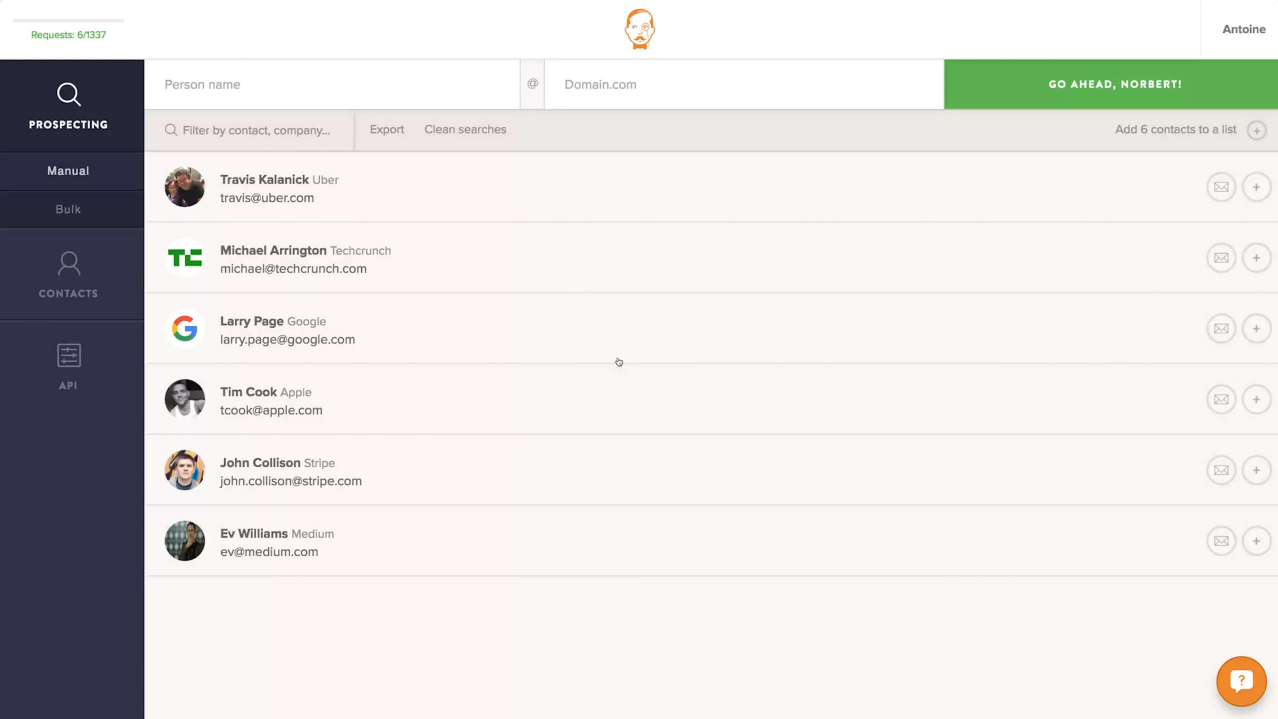
VoilaNorbert is the Hunter.io alternative if you want simple bulk email finding and verification without a steep learning curve.
You can find emails in bulk, verify them, and add email sending through its Mailflow add-on.
What impressed me most was how simple the workflow felt.
I uploaded a list, found email addresses, verified them, and exported everything without any confusion.
Where VoilaNorbert falls short is in depth. The database and coverage are smaller than those of the enterprise-grade tools on this list.
Sending is an add-on rather than a core feature, so it’s a finder first, with outreach bolted on instead of built in.
If predictable bulk email finding is your priority, VoilaNorbert is an easy Hunter.io alternative to adopt.
So, for teams that need more than finding and verification, it can quickly feel limiting.
VoilaNorbert also features in my roundup of personal email finder tools.
Key Features
- Single and bulk email finding by name and domain
- Standalone bulk email verification
- Contact enrichment with job title, company, and social profiles
- Mailflow sequences with warm-up and A/B testing (separate add-on)
Pricing
- Free trial to start
- Valet: $49/mo
- Butler: $99/mo
- Advisor: $249/mo
- Counselor: $499/mo
For a full plan breakdown, see my VoilaNorbert pricing guide.
VoilaNorbert vs Hunter.io: Who Is Better?
What Users Have to Say?
“I use VoilaNorbert to find and verify email addresses for cold email outreach. The list cleaning feature eliminates risky emails that can bounce and affect my campaign deliverability.”
Read the full review on G2 →5. Findymail
Findymail is built around one promise: “You only pay for emails that are actually valid”.
As it solves a common problem with email prospecting. Instead of paying for every lookup, you only pay when it finds a verified email address.
That speaks straight to the Hunter complaint about paying for lookups that come back unusable.
What I liked most was how easily it fit into automated workflows. It connects with Clay, Make, Zapier, and Google Sheets, so building a clean email address list and moving verified contacts between tools is simple. .
I also found its catch-all email verification impressive. It can verify many email addresses that other tools often mark as risky or unknown.
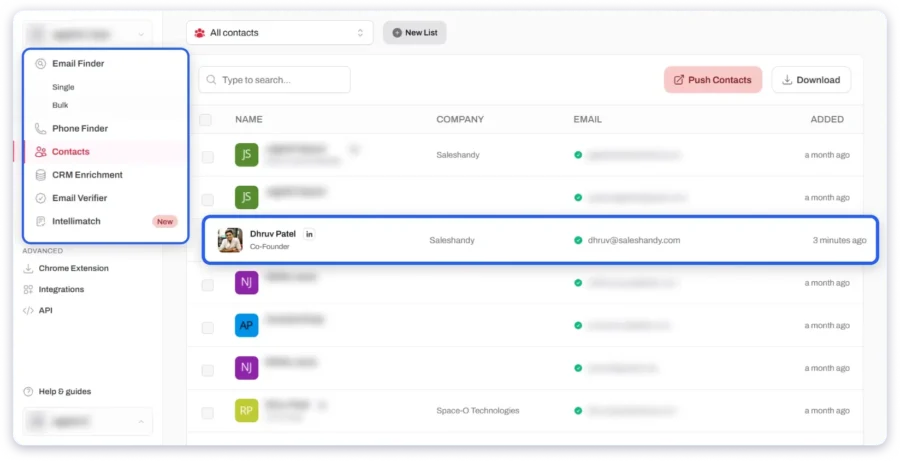
The biggest limitation is coverage.
In many cases, Findymail simply doesn’t find an email, so you’ll often need another data provider to fill the gaps.
When it does return a result, the email is usually highly accurate.
However, phone number enrichment is limited to U.S. contacts, which reduces its usefulness for global prospecting.
Key Features
- Verified-only billing, no charge for misses
- Catch-all domain handling for safer email sends
- Native integrations with Clay, Make, Zapier, and Google Sheets
- Separate credit pools for finding and verifying at scale
Pricing
- Free trial to start
- Starter: $99/mo
- Higher volume on custom plans
Findymail vs Hunter.io: Who Is Better?
What Users Have to Say?
“We have spent hundreds of thousands on data and have visible evidence that Findymail campaigns are superior to the other big providers. People are shocked how well their campaigns do when I switch them over.”
Read the full review on G2 →6. Prospeo
Next on my list is Prospeo, a Hunter.io alternative for teams that want affordable email finding with LinkedIn and phone number lookups.
The platform gives you 300M+ professional profiles, 125M+ verified mobile numbers, a Chrome extension for LinkedIn, and intent data across 15,000+ topics.
What caught my attention most was its 7-day data refresh cycle.
Most email finders update their databases every four to six weeks. In my experience, stale data is the single biggest reason cold emails bounce.

I think it’s one of the best value options for high-volume prospecting.
If every cent per contact matters, Prospeo keeps costs low without sacrificing the essentials.
The biggest limitation is its narrow focus. It’s built for finding contact data, not sending emails or managing outreach.
So, you’ll still need another platform for that.
If you’re leaving Hunter because of pricing or missing phone numbers, Prospeo is an easy choice.
Just keep in mind that it’s a data tool, not a complete outbound platform.
Key Features
- 300M+ professional profiles with 98% claimed email accuracy
- 125M+ verified mobile numbers with direct dials
- 7-day data refresh cycle (vs. industry-average six weeks)
- Chrome extension for LinkedIn prospecting
- Bulk finding and verification
- API access
Pricing
- Free: $0
- Starter: $49/mo
- Growth: $99/mo
- Pro: $249/mo
Prospeo vs Hunter.io: Who Is Better?
What Users Have to Say?
“The weekly data refresh is a game changer. I used to get 10-15% bounces with other tools. With Prospeo, it is consistently under 3% because the data is actually fresh.”
Read the full review on G2 →7. Cognism
If you’re selling into Europe, Cognism is one of the strongest Hunter.io alternatives on this list.
What stood out to me most was Diamond Data. These are mobile numbers that Cognism’s research team manually verifies instead of relying only on automated checks.
Its biggest advantage is GDPR-compliant contact data with high-quality direct dials. Pair that with intent signals, and you can target accounts that are already in-market. That’s an area where Hunter remains focused mainly on email addresses.
Cognism also reports much stronger coverage across Europe, especially in the UK, France, and Germany. For teams targeting those markets, that wider coverage can make a noticeable difference.

I also liked that Cognism verifies many phone numbers through real calls. That extra validation makes its direct-dial data more reliable for cold calling.
The biggest drawback is pricing. Cognism is quote-based and requires a sales demo, making it much less accessible than self-serve alternatives.
If your priority is compliant European contact data with reliable phone numbers, Cognism is an excellent choice.
For smaller teams or tighter budgets, it’s probably more platform than you need.
Key Features
- GDPR-compliant with DNC screening across 15 countries
- Buyer intent signals powered by Bombora
- Automatic CRM enrichment for Salesforce, HubSpot, and Pipedrive
For a wider comparison, see my full list of Cognism alternatives.
Pricing
- Custom quote only, demo required
Cognism vs Hunter.io: Who Is Better?
What Users Have to Say?
“Our DPO approved Cognism without us having to redline the contract. That never happened with ZoomInfo or Apollo. The Diamond Data mobiles connect at a rate we have not seen from any other provider.”
Read the full review on G2 →8. UpLead
UpLead takes the lead over Hunter as an alternative, offering built-in email and phone verification features.
Compared to Hunter.io’s inconsistent data quality, UpLead delivers better accuracy through real-time verification.
And the best part? You’re only charged credits for valid emails, whereas Hunter charges credits even when results fail.
While its database is smaller compared to Hunter, you can still find relevant ICPs using 50+ advanced filters.
If clean lists and deliverability are your priority, that guarantee matters.

What I liked is that verification happens the moment you reveal a contact, not after exporting a list.
This helps keep bounce rates low before they turn into deliverability issues.
The limitation I faced was volume. Entry-level plans come with limited credits, so I ran out faster than expected during larger prospecting tests.
It also meant I had to upgrade sooner than I planned when scaling outreach.
If your main goal is clean data and low bounce rates, UpLead is a strong Hunter alternative.
But if you care more about scale and cost efficiency, it can feel expensive over time.
Key Features
- 95% accuracy guarantee with credit-back on invalid results
- Technographic data showing company tech stacks
- Buyer intent signals for active in-market prospects
- 50+ search filters (company size, industry, revenue, title, location)
- Data enrichment to clean and append existing contact lists
Pricing
- Free trial: $0 (7 days)
- Essentials: $99/mo
- Plus: $199/mo
- Professional: custom annual
UpLead vs Hunter.io: Who Is Better?
For more options in this category, see my full list of UpLead alternatives.
What Users Have to Say?
“I find it challenging that I cannot find some companies I am prospecting, possibly due to their smaller size. The lead list can only reveal 100 at a time, and 170 credits on Essentials runs out fast if you are prospecting actively.”
Read the full review on G2 →9. Instantly
Instantly helps you find leads, use AI sales agents, and automate outreach at scale.
It solves the opposite half of Hunter’s problem. It’s built for sending first, which makes it a strong Hunter.io alternative if your real gap is high-volume cold email execution, not lead discovery.
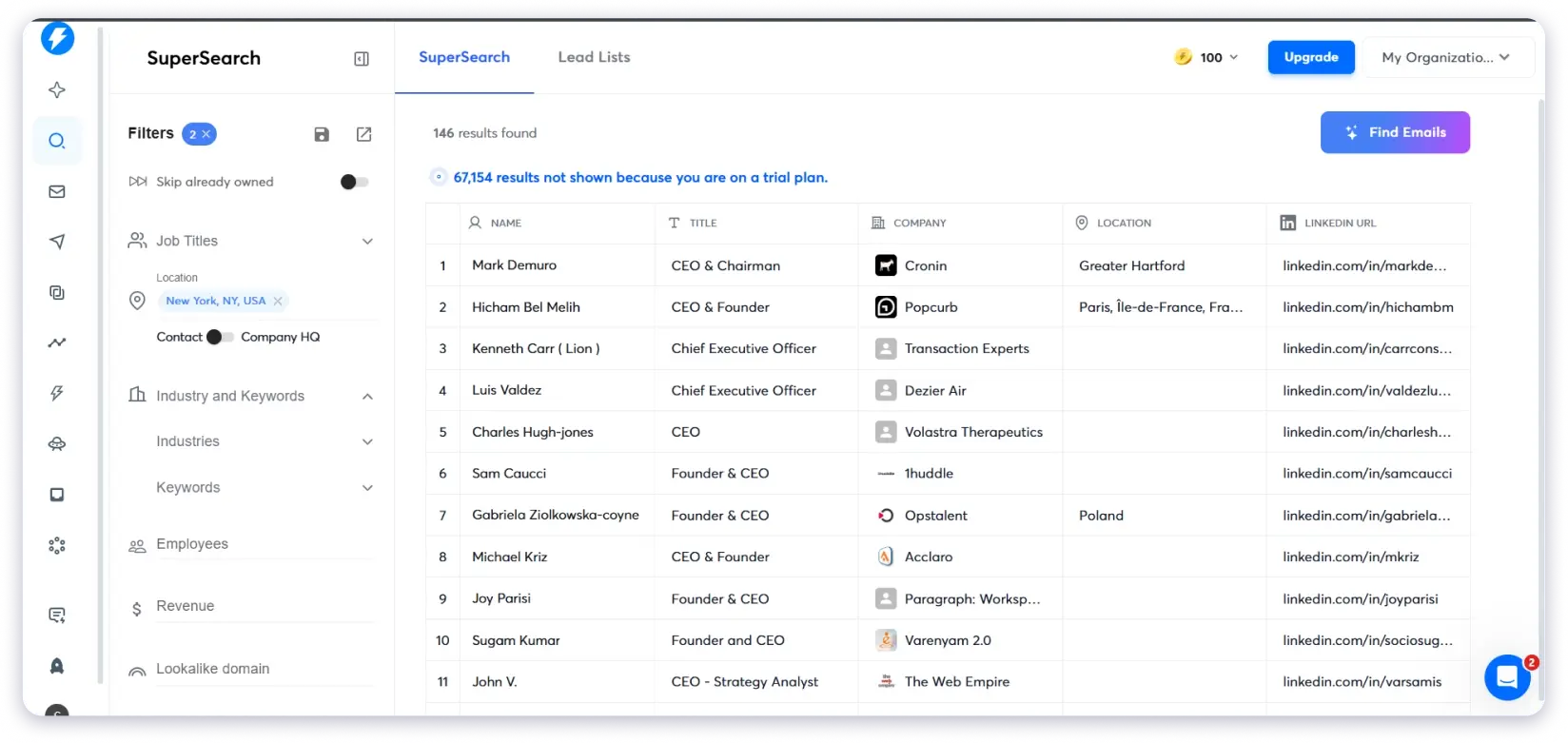
It combines a 450M+ B2B contact database with a sending engine designed for scale.
You can filter leads by job title, industry, company size, and location, then move directly into outreach.
The outreach system is where it stands out. You get unlimited email accounts, inbox rotation, warm-up, smart sending limits, and A/B testing built in.
It’s built to keep high-volume campaigns deliverable through rotation and warm-up.
The limitation is data quality and depth.
If your main need is highly accurate contact discovery, dedicated data tools will outperform Instantly’s database.
So Instantly works best when sending at scale is the real bottleneck.
If lead accuracy is your priority, it won’t be the strongest option here.
Key Features
- Unlimited email accounts with no per-account fees
- Automated warm-up across all connected accounts
- Inbox rotation to protect sender reputation at scale
- 450M+ B2B contact database (separate Leads module)
- Campaign analytics with A/B testing for subject lines and body
Pricing
- Growth: $47/mo (5,000 emails)
- Hypergrowth: $97/mo (100,000 emails)
- Light Speed: $358/mo (500,000 emails)
- Enterprise: custom
Instantly vs Hunter.io: Who Is Better?
You can also check my full list of Instantly alternatives for more sending-focused options.
What Users Have to Say?
“Instantly makes cold email at scale actually manageable. The warm-up and rotation features are the reason my deliverability stays strong across 15+ sending accounts.”
Read the full review on G2 →
10. RocketReach
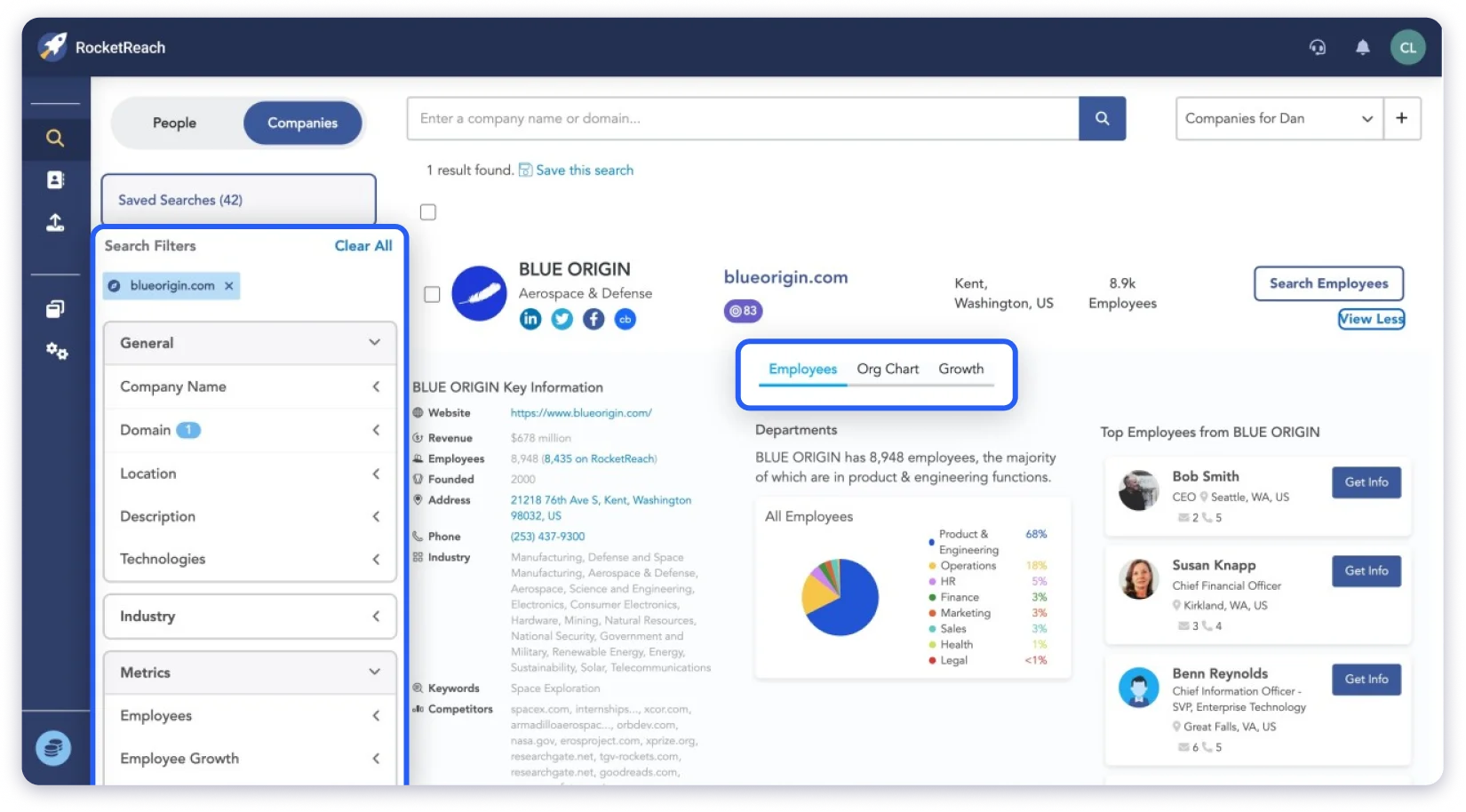
RocketReach stands out over Hunter with wider coverage and access to phone numbers and personal emails.
It has 700M+ profiles, including work emails, personal emails, and phone numbers.
I’ve found it most useful for one-off lookups.
If you already know exactly who you want to reach, especially senior executives who don’t always use company emails, RocketReach often has their details.
The API is another strong point.
It’s well-documented and available on higher tiers, making it useful for teams building custom prospecting workflows or integrating data into internal systems.
Where it stands out is coverage.
When Hunter returns no result for a domain, RocketReach often still finds something because it pulls from a broader dataset.
That extra reach is the main reason to use it over email-only tools.
The limitation is consistency. Data accuracy can vary depending on region and role, so verification is still important before outreach. Phone data is also locked behind higher plans.
If you need verified-only accuracy, tools like UpLead or Findymail are a better fit.
Key Features
- Large contact database with emails and phones
- Personal and professional email lookups
- Chrome extension and bulk lookups
- Strong API for enrichment
Pricing
- Essentials: $33/mo
- Pro: $75/mo
- Ultimate: $175/mo
RocketReach vs Hunter.io: Who Is Better?
You can also browse my full list of RocketReach alternatives.
What Users Have to Say?
“The database is huge and I can usually find anyone I am looking for. The API is solid for building custom workflows. The downside is some contacts are outdated, especially if someone changed jobs recently.”
Read the full review on G2 →11. Apollo
Apollo is one of the main reasons people leave Hunter for an all-in-one platform.
The database includes 210M+ verified contacts with company data, funding stage, employee count changes, and technology stack information.
On top of that, you get email sequences, a built-in dialer, meeting scheduling, and buyer intent signals.
The free plan is one of the most generous in the category. I would recommend anyone evaluating Hunter alternatives to at least test Apollo’s free tier.

That said, I found the outreach side a bit cluttered. Apollo tries to do a lot, and the sequencing workflow is not as clean as a dedicated cold email tool.
And because it is per-seat, costs climb with team size in a way Saleshandy’s no-per-seat model does not.
Where I would be careful is data accuracy. Based on practitioner reports, it runs around 85-90%. I always recommend running Apollo’s data through a verification layer before high-volume sending.
If you want a cleaner sending experience or no per-seat pricing, weigh it against Saleshandy.
You can also read the head-to-head Saleshandy vs Apollo comparison.
Key Features
- 210M+ contacts with firmographics, funding data, and tech stack
- Multi-step email sequences with A/B testing
- Built-in dialer with call recording and logging
- Buyer intent signals based on web behavior
Pricing
- Free: $0
- Basic: $49/seat per month
- Professional: $79/seat per month
- Higher tiers: custom
For the full plan-by-plan cost, see my Apollo pricing breakdown.
Apollo vs Hunter.io: Who Is Better?
For the full picture, see my roundup of Apollo alternatives and my hands-on Apollo review.
What Users Have to Say?
“Apollo has a massive database and the free plan alone gives you enough to test the platform properly. The sequences and dialer save time, but data accuracy is hit or miss on some contacts.”
Read the full review on G2 →Which Hunter.io Alternative Should You Actually Pick?
After reviewing all 11 tools, here is what I would recommend based on your situation.
Before choosing any alternative to Hunter, ask yourself three questions.
1. Do I just need a better email finder, or do I need outreach too?
This is the first fork in the road. If you only need more emails at a lower cost, tools like Prospeo, VoilaNorbert, or UpLead solve that.
If you need to find contacts AND send campaigns from the same platform, you are looking at Saleshandy, Snov.io, or Apollo.
2. Do I need phone numbers?
Hunter has zero phone data at any tier. If your outbound motion includes cold calling, you need a tool that provides direct dials.
Lusha and Cognism are the strongest for phone numbers. Saleshandy and Apollo include them as part of broader platforms.
3. Am I going to scale past 2,000 contacts a month?
If yes, pick a tool where pricing does not punish growth. Per-user fees, per-client workspaces, and tight credit caps will drain your budget the moment you add volume.
Saleshandy has no per-seat pricing and rolls over 50% of unused credits. Apollo’s free tier is generous but per-seat costs add up fast on paid plans.
Once you are clear on these three, the right tool on this list becomes obvious.
There is no single “best” tool for everyone. But if I had to pick one that covers the most ground for the widest range of outbound teams, it would be Saleshandy.
I would suggest starting with the free trial to see if it fits your workflow before committing.
So, Which Is the Best Hunter.io Alternative?
That wraps up my honest look at the best Hunter.io alternatives.
So which one is right for you? It comes down to what your outbound actually needs.
Do you just want cleaner verified emails? Do you need phone numbers and calling? Or do you want to find, verify, and send from one place instead of paying for three tools?
Hunter is a good finder, and if email-only lookups are all you need, it still does the job. Most people leave for one reason. They want more than to find and verify.
If you are still on the fence, the easiest way to decide is to try it.
Sign up for Saleshandy and use the 7-day free trial with 50 free credits.
FAQs
1. What Is the Best Free Hunter.io Alternative?
Apollo and Prospeo both offer free plans with monthly credits, and Snov.io has a renewable free trial. For finding plus sending, Saleshandy’s free trial and free credits let you test the full workflow without a card.
2. Is There a Hunter.io Alternative With Phone Numbers?
Yes. Hunter is email only. Saleshandy, RocketReach, Lusha, Cognism, and Apollo all provide phone numbers, with Cognism strongest for European mobiles and Saleshandy bundling phones into Lead Finder.
3. What Is a Cheaper Alternative to Hunter.io?
Prospeo and Snov.io start below Hunter on a per-contact basis, and Saleshandy Outreach starts at $25/mo with no per-seat fees. The cheapest option depends on whether you also need sending.
4. Hunter.io vs Apollo: Which Is Better?
Hunter is a focused, non-per-seat email finder. Apollo is a full platform with a large database, sequences, and a dialer. Pick Hunter for simple email work, Apollo for database plus outreach in one.
5. Can I Find LinkedIn Emails Without Hunter.io?
Yes. Prospeo, Lusha, and Saleshandy can find emails tied to LinkedIn profiles, which Hunter’s domain-first approach is not built for.
6. Which Hunter.io Alternative Is Best for Agencies or Scaling Outbound?
Saleshandy fits agencies well, with unlimited email accounts, no per-seat pricing, and find-plus-send in one platform. Snov.io is a lower-cost option for email-only agency work.