

If choosing between Apollo and Saleshandy feels confusing, you’re not alone.
Saleshandy gives you an 852M+ verified contact database, built-in outbound CRM, multichannel outreach, advanced deliverability infrastructure, and flat pricing that scales without per-seat costs.
Whereas Apollo.io combines a 275M+ contact database with prospecting, sequencing, calling, and sales engagement features inside one platform.
Both platforms can handle outbound from lead generation to outreach execution.
But the difference starts showing when you compare
- data quality
- deliverability control
- scalability
- how much you actually pay once your team starts scaling outreach.
I spent time testing both platforms by building lead lists, running sequences, checking inbox placement, and comparing how the pricing changes once credits and usage limits start stacking up.
Here is what stood out, feature by feature.
Saleshandy vs Apollo.io – TOC
Quick Comparison of Saleshandy & Apollo
Here’s a fast overview so you can immediately see where each platform stands. I have compared the major deciding factors side by side.
 Recommended
Apollo Vs. Saleshandy Feature Comparison
I’m not here to throw a biased “X is better than Y” statement at you.
Because both tools can work, depending on what you need.
So let’s walk through each feature one by one and see how they stack up in actual use cases.
- B2B Database Comparison: Saleshandy or Apollo?
- Sequence Automation Comparison
- Comparison of Personalization Options
- Comparison of Email Warm-Up & Deliverability Stack
- Reply Management Comparison
- Features for Agencies Comparison
- Outbound CRM Comparison
- Integrations Comparison
- Whose Customer Support Is Better?
B2B Database Comparison: Saleshandy or Apollo?
When it comes to outbound, your results are only as good as the data you start with.
That’s why the B2B database is where the Apollo vs. Saleshandy comparison really begins.
Now, Apollo.io is quite well-known for its database. You can filter by industry, company size, title, and more.
It has a pool of 275M+ contacts from over 35M companies.

Also, Apollo provides data enrichment, where you can enhance your existing records.
And you can even set up job change alerts (which is great for recruiters).

But it all sounds impressive on paper.
The problem? Popularity doesn’t always equal quality.
If you check Reddit threads or G2 reviews, you’ll notice a pattern.
The users love Apollo’s coverage but often mention data accuracy issues.
And in some cases, they also mentioned a sudden spike in bounce rates when running large-scale campaigns.
On the other hand Saleshandy Lead Finder has an 852M+ verified contact database — more than 3x the size of Apollo’s.
But the real difference is not just size. It is how the data is sourced and verified.
Saleshandy uses waterfall enrichment, which means it pulls contact data from multiple providers and cross-verifies it before showing results. Apollo relies on a single-source enrichment model.
In practice, that means Saleshandy catches valid emails and phone numbers that Apollo’s database misses entirely.

On top of the larger database, Saleshandy gives you 75+ advanced search filters to narrow down prospects:
- Company name, location, and geography
- Company size, revenue, and funding stage
- Role, seniority, and department
- Years of experience and career data
- Tech stack (know what tools your prospects already use)
- Buying signals and news — recent funding rounds, hiring activity, leadership changes
Buying signals help you target companies that are actively spending or scaling. Most databases give you static contact data. Saleshandy gives you timing.
Saleshandy also has an AI Lead Search feature.
Describe your ideal prospect in plain English (“Find marketing directors at Series B SaaS companies with 50-200 employees”), and it generates a targeted, verified list instantly. No manual filtering needed
Verdict:
Apollo has a solid database for US-focused mid-market prospecting.
But when it comes to global coverage, data accuracy, and the depth of search filters, Saleshandy is ahead.
852M+ contacts, waterfall enrichment, 75+ filters, and buying signals — that combination means you spend less time cleaning data and more time sending emails that actually reach real people.
For any team running outbound at scale, the database is the foundation. Saleshandy gives you a stronger one.
Check out our blog for detailed review on Saleshandy.
Sequence Automation Comparison
Once you’ve got the right leads, the next question is: how do you reach them consistently?
That’s where email sequence automation comes in.
For that, Apollo.io gives you a decent sequence builder with multi-step, multichannel workflows.

You can combine emails, LinkedIn tasks, and even calls in a single sequence.
This is great for enterprise teams running complex outreach motions.
But here’s the catch: it feels heavy.
The interface is packed with options, filters, and steps that can quickly overwhelm smaller teams or solo reps.
You’ll need to invest time in setup and learning before you can really automate at scale.
On the other hand, Saleshandy takes a different approach to sequences. Instead of making you build complex workflows from scratch, it gives you tools that do the heavy lifting upfront.
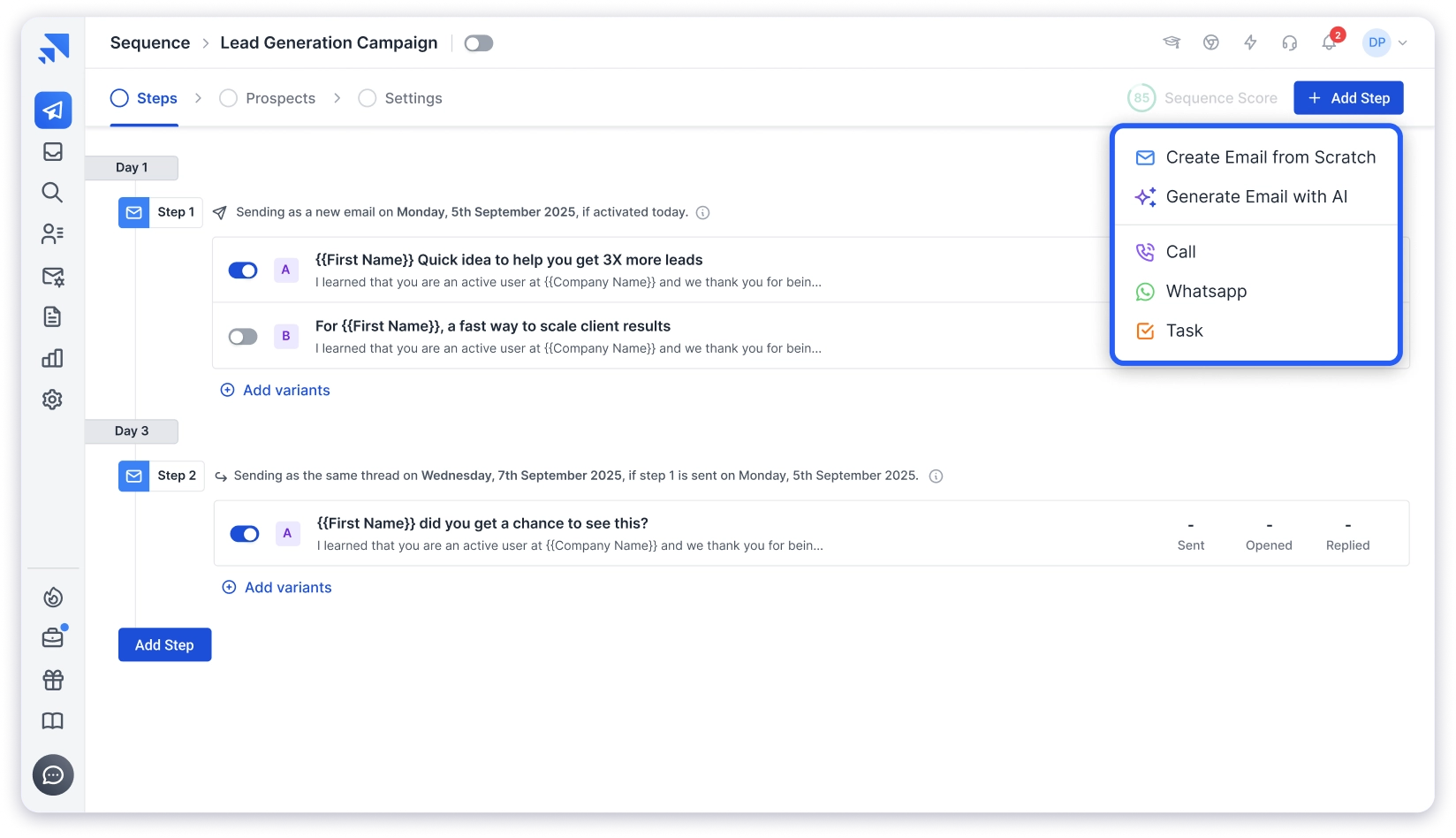
AI Sequence Copilot generates your entire multi-step campaign from your website URL. It analyzes your audience, creates the messaging, and builds the sequence for you.
From there, you can add multichannel task steps — including LinkedIn, calls, and WhatsApp — so your outreach is not limited to email alone.
Here is what makes Saleshandy’s sequences stand out:
- Subsequences — if a prospect opens, clicks, or replies, Saleshandy triggers a different follow-up path automatically. Warm leads get a different experience than cold ones.
- A-Z variant testing — creates up to 26 unique versions of each email step. No two prospects get the exact same message.
- Sequence Score — analyzes your email setup, sequence structure, and copy quality in real time. Tells you exactly what to fix before you hit send.
- Sender rotation — auto-rotates between unlimited email accounts to protect domain reputation.
Verdict:
Both tools support multichannel sequences. Apollo lets you add LinkedIn steps, calls, and tasks inside a single workflow. Saleshandy does the same with multichannel task steps for LinkedIn, calls, and WhatsApp.
Where Saleshandy pulls ahead is in what surrounds the sequence:
- AI Sequence Copilot — zero to live campaign in minutes
- A-Z variant testing — 26 unique versions per step
- Subsequences — behavior-based follow-up branching
- Sequence Score — real-time optimization before you send
For teams that want to launch optimized campaigns fast, Saleshandy gets you there with less friction and more built-in intelligence.
Comparison of Personalization Options
Everyone talks about personalization, but very few tools make it easy to actually do it at scale.
Why? Because you want context-rich, natural-sounding emails even when automated.
Apollo.io does a decent job here. It lets you add dynamic variables, merge tags, and even conditional logic for different prospect segments.

So yes, you can tailor your sequences based on role, industry, or company type.
But in practice, the editor feels a bit… mechanical.
Once your campaigns get larger, double-checking how each email looks for different recipients becomes a pain.
Saleshandy focuses on clarity and control.
Its personalization engine is off the charts.
Why? Because Saleshandy has just launched AI Prospect Enrichment.
Where you can use AI to find latest information about any prospect.
This way, you can personalize your email with better context.
This way, your emails will sound differently from the first touch.

Also, you can create multiple AI Variants to A/B test your email copies.
Plus, when paired with Saleshandy’s deliverability stack, these personalized emails land in inboxes like real human messages.
Verdict:
Apollo has a wide range of data variables you can pull into sequences. That is useful for complex, multi-segment campaigns.
Saleshandy takes personalization further with:
- AI Prospect Enrichment — finds the latest information about any prospect using AI, so you personalize with real context, not just merge tags
- Spintax + merge tags — multiple layers of variation in every email
- A-Z variant testing — 26 unique versions per step, generated automatically
If your goal is to make every cold email feel like a one-on-one conversation at scale, Saleshandy gives you more tools to do that.
If you’re considering Apollo, check out this detailed review of Apollo.
Comparison of Email Warm-Up & Deliverability Stack
If you are comparing Saleshandy and Apollo. You know how important deliverability is.
Apollo.io now offers email warm-up as a built-in feature. It supports progressive, flat, and random warm-up modes, and it is included in paid plans at no extra cost.
That is a solid addition.

But warm-up alone is only part of the equation. You also need to know whether your emails are actually reaching inboxes before you launch a campaign.
Saleshandy does not just offer warm-up. It has a full deliverability stack.
Here is what you get:
- Unlimited email warm-ups — across all connected accounts, with real-time tracking of warm-up status and outreach readiness per inbox
- Inbox Placement Testing — test exactly how many of your emails land in inboxes vs. spam folders across multiple providers, before you send a single campaign
- Email Infrastructure — buy domains and mailboxes directly inside Saleshandy with pre-configured SPF, DKIM, and DMARC. No separate vendor, no manual DNS setup.
- Sender Rotation — auto-rotate between unlimited sending accounts to protect domain reputation
- AI Bounce Detection — actively monitors and protects your sender reputation while campaigns run
- ESP Matching — matches your sending patterns to email service provider expectations

Aollo does not offer inbox placement testing, built-in email infrastructure purchasing, or ESP matching.
Verdict:
Apollo covers the basics with email warm-up.
Saleshandy covers the full deliverability lifecycle:
- Warm-up
- Inbox placement testing
- Email infrastructure
- Sender rotation
- ESP matching
- AI bounce detection
If deliverability is a priority (and for cold email, it should be), Saleshandy is not just ahead here. It is in a different category.
Useful resource: Top Apollo.io Alternatives.
Reply Management Comparison
When you’re running multiple campaigns or managing multiple inboxes.
Reply management becomes a big differentiator between outreach tools.
Apollo.io does give you basic reply tracking, but that’s pretty much where it ends.
Replies are treated like simple inbox responses.
No smart categorization or no automatic labeling.
Basically no easy way to know which replies are positive, negative, or out-of-office.
If your outreach volume increases, keeping track of all these manually would eventually become difficult.
Now, when it comes to Saleshandy, you can manage replies more intelligently.
It automatically detects and labels replies so you instantly know which responses need attention.

This means you don’t wake up to a wall of messages with no idea where to start — your inbox is already pre-sorted for you.
And if you’re running outreach as part of a team, Saleshandy’s shared inbox visibility makes collaboration easy.
Everyone can monitor replies and never lose track of a hot lead again.
It’s a clean, efficient system that helps you respond faster. Which directly impacts conversions.
Verdict:
Apollo helps you check and respond to replies.
Saleshandy helps you manage them properly.
If you want reply handling that feels organized and built for high-volume cold email. Saleshandy clearly wins this round.
Features for Agencies Comparison
Agencies run outreach very differently from individual sales reps or small teams.
And the last thing you need is a tool that makes you jump through hoops just to manage them.
This is where the gap between Saleshandy and Apollo starts to widen.
Apollo.io is built primarily for internal sales teams.
Yes, you can manage multiple sequences and accounts, but it’s not designed for client-based outreach.
You don’t get isolated workspaces or any method to separate client campaigns.
Everything exists under one big umbrella, which quickly becomes chaotic if you have several campaigns running for different clients.
Many agencies using Apollo end up creating separate logins, separate CRMs, or separate folders just to keep campaigns from mixing…
Which is not ideal when you’re managing paying customers.
Saleshandy, on the other hand, is built with agencies in mind.
You get:
- Whitelabeling — brand the platform as your own
- Multi-client account management — add unlimited clients, each with isolated campaigns
- Unlimited email accounts at no additional cost
- Agency-level reporting across all clients
- Client access with full or limited permissions
- Team collaboration and user roles
- Built-in outbound CRM for tracking prospect progress per client
- Dialer add-on for teams that need calling alongside email outreach
It’s basically everything an agency needs to run cold email at scale.

If you work with multiple clients, this structure alone saves hours every week.
And this also helps you avoid costly mistakes like sending Client A’s email from Client B’s domain.
(Yes, it happens all the time with tools not built for agencies)
Verdict:
Apollo can work for agencies, but it’s not built with them in mind.
Saleshandy is designed specifically to handle multi-client outreach.
Outbound CRM Comparison
Once prospects start replying, you need a system to track conversations, prioritize follow-ups, and move deals forward.
Saleshandy recently launched a purpose-built outbound CRM. It replaces the old static Prospects tab with a Kanban-based visual pipeline where every prospect’s full context is visible in one place.
Here is what it includes:
- Kanban pipeline — see prospects grouped by stage (Not Contacted, Replied, Interested, Closed, or custom stages you create). Drag and drop as conversations progress.
- Prospect Activity Timeline — every email sent, reply received, open, click, note, and task in one chronological view. Full context before every follow-up.
- 1:1 Emails, Tasks, and Notes — send direct emails outside sequences, add notes, tag team members, and create follow-up tasks for calls, LinkedIn, or WhatsApp.
- Custom Fields and Views — track deal value, demo dates, priority leads, or anything else your workflow needs. Pin important fields so they are always visible.

The whole system is designed around one question: who needs action today and why?
Apollo.io also has a CRM with deal pipelines, contact records, and task automation. It connects to their database and sequences, so you can manage the full sales cycle inside one platform.
Apollo’s CRM is more mature for traditional sales pipeline management — stages, forecasting, deal tracking. If your team runs both inbound and outbound through one system, Apollo’s CRM handles that complexity.
But for cold email workflows, Apollo’s CRM can feel heavy. You end up maintaining pipeline stages and deal records for conversations that might only be two emails deep.
Verdict:
If you need a full-cycle sales CRM with pipeline reporting, Apollo is the more established option.
If you need a CRM that shows your reps who to follow up with, what the last interaction was, and what to do next — without the overhead of traditional deal management — Saleshandy CRM is built for that.
It is lighter, faster, and designed for the way cold email outreach actually works.
Integrations Comparison
This is another area where the philosophies of Apollo and Saleshandy differ.
Apollo.io comes with a decent list of integrations.
It has an option to connect with CRMs, dialers, and enrichment tools.
Here’s a list of integrations Apollo provides:
- Hubspot
- Pipedrive
- Salesforce
- SalesLoft
- SendGrid
- Mailgun
- Zapier
But here’s the nuance most people miss.
Apollo tries to be an “all-in-one” platform.
But a lot of teams end up using fewer integrations than expected.
Not because they don’t want to, but because the setup is a bit much.
Saleshandy keeps things straightforward.
It integrates with:
- HubSpot
- Salesforce
- Pipedrive
- Zoho
- Zapier
- Webhooks and API
- MCP (Model Context Protocol) — for teams building AI-powered sales workflows
Plus, Saleshandy has a dedicated mobile app, so you can manage sequences and check replies on the go.
Basically everything you need to run cold email without bloating the system.
This simplicity is intentional.
And since Saleshandy focuses on cold email + deliverability rather than becoming an all-in-one monster, its integrations are cleaner, faster, and easier to maintain long-term.
Verdict:
Apollo has more integrations overall, especially with enterprise tools like SalesLoft, SendGrid, and Mailgun.
Saleshandy has fewer but more focused integrations, plus a mobile app and MCP support that Apollo does not offer.
If your tech stack is enterprise-heavy, Apollo covers more ground. If you want clean, fast integrations that just work for cold email, Saleshandy is the smoother choice.
Whose Customer Support Is Better?
This is one area people underestimate… until something breaks.
Because things go south, you want answers fast.
And this is exactly where Saleshandy and Apollo differ more than most people think.
Let’s start with Apollo.io.
Apollo has a massive user base. And with big platforms, support usually becomes… well, big-platform support.
They have documentation, tutorials, and a help center that covers the basics. All good.
But when something actually goes wrong?
Here’s the pattern you’ll notice if you read through Reddit threads or G2 reviews:
- Responses can be slow during peak hours
- Issues get escalated, but not always resolved quickly
- For technical bottlenecks, you often get a link instead of a fix
- Wait times increase as your issue becomes “more complex”
And it’s not because Apollo doesn’t care.
It’s because large, multifaceted platforms naturally introduce more complexity.
Now, compare that to Saleshandy.
Saleshandy follows a different approach. It’s smaller, more focused, and more hands-on with users.
This makes their support experience feel… human.
Here’s what I mean:
- Live chat actually replies fast
- They walk you through the steps
- Deliverability questions get proper answers (not something like “check your DNS” responses)
- They help you fix issues instead of diagnosing them and leaving you hanging
And if you’re an agency (or sending from multiple client accounts), this becomes even more important.
Because when one inbox faces issues, the whole campaign slows down.
A quick fix can literally save revenue.
I also talked to a few users who migrated from Apollo to Saleshandy.
And their feedback was pretty consistent:
“With Apollo, I’d wait half a day for answers. With Saleshandy, I get help within minutes.”
Verdict
Apollo’s support is functional and documentation-rich. But not fast.
Saleshandy’s support is faster, more practical, and more hands-on.
If quick, human, problem-solving support matters to you (and it should), Saleshandy clearly wins this round.
Saleshandy Vs. Apollo: Pricing Comparison
Saleshandy’s Outreach Starter plan is $25/month (billed annually).
For that, you get:
- Unlimited email accounts
- Free email warm-up
- AI-powered sequences with A-Z variants
- Access to the built-in outbound CRM
- No per-seat charges
For prospecting, Saleshandy’s Lead Finder starts at $49/month (Lead Starter) with 30,000 credits per year. Unused credits roll over.
Apollo’s Basic plan starts at $49 per user per month. It uses a unified credit system:
- 1 email reveal = 1 credit
- 1 phone number = 8 credits
- Basic plan = 1,000 credits/month
Here is the part that catches most teams off guard: Apollo credits expire at the end of each billing cycle. No rollover. If you do not use your 1,000 credits this month, they are gone.
If you run out mid-month, prospecting stops until you buy more.
Real cost comparison for a team of 5:
- Apollo Professional ($79/user/month) = $395/month before any credit top-ups
- Saleshandy Outreach Pro ($69/month total) = $69/month with 30,000 active prospects and 150,000 emails/month included
On top of that, Saleshandy includes a built-in outbound CRM at no extra cost, inbox placement testing, and a dialer add-on starting at $23/month.
Saleshandy vs. Apollo: And The Winner Is
SHere is how I see it after comparing both platforms side by side.
Choose Apollo if you need:
- A full-cycle sales CRM with pipeline forecasting
- Native LinkedIn automation that executes automatically within sequences
- A large all-in-one GTM platform with enterprise integrations
Apollo works well for enterprise teams that want everything consolidated and are comfortable managing a credit-based system.
Choose Saleshandy if you want:
- 852M+ verified contacts with waterfall enrichment and 75+ filters
- Multichannel sequences with AI Copilot, A-Z variants, and Subsequences
- A full deliverability stack — warm-up, inbox placement testing, email infrastructure
- An outbound CRM built for cold email workflows
- A built-in dialer with AI call summaries
- Flat pricing that does not charge per seat or expire your credits
For solo reps, growing sales teams, and agencies running outreach at scale, Saleshandy gives you more features per dollar, stronger data accuracy, and a platform that is purpose-built for cold outreach.
FAQs
1. Which tool is more beginner-friendly?
Saleshandy. The UI is cleaner, the setup is faster, and pricing is easier to understand. Apollo can feel overwhelming for beginners because of its feature depth and credit system.
2. Which tool is more affordable?
Saleshandy. It has flat, transparent pricing with no credit add-ons. Apollo can become expensive once you scale prospecting or need more credits.
3. Which tool is better for agencies?
Saleshandy, because multi-account management, deliverability stack, client separation, and predictable pricing make it easier to scale safely.
4. Should I switch from Apollo to Saleshandy?
Switch if you want:
- predictable pricing
- verified contacts
- cleaner outreach workflows
- better deliverability